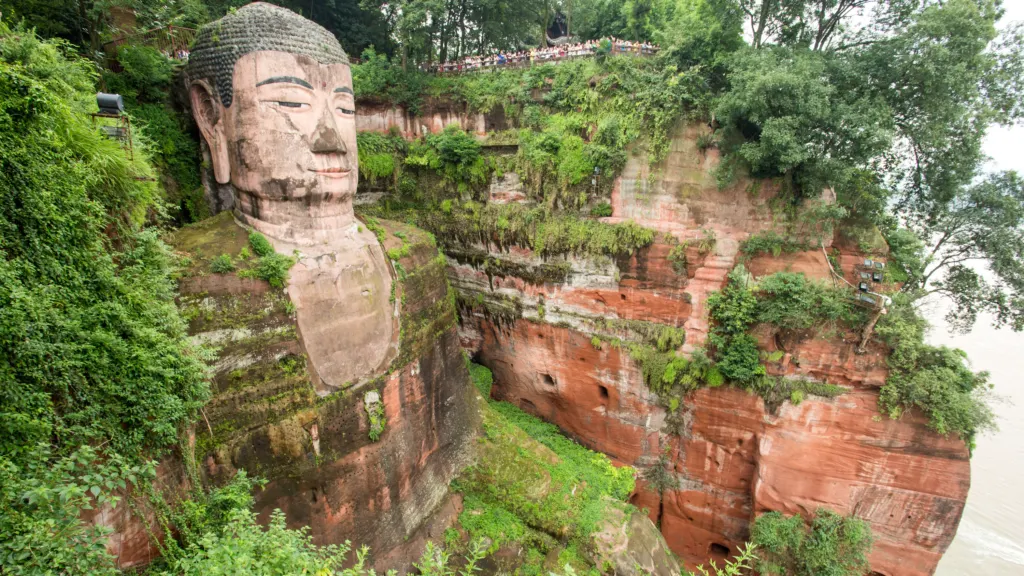
A Buddhist monk named Hai Tong set out in the eighth century to tame a river by turning a cliff into a Buddha. The result, the Leshan Giant Buddha in China’s Sichuan Province, stands 71 meters (233 feet) tall, and it took the better part of a century and a string of backers to finish.
Cut directly from a red sandstone cliff where the Min and Dadu rivers meet near the city of Leshan, the seated Maitreya Buddha gazes across the water toward Mount Emei. It is the largest stone Buddha in the world and, by a wide margin, the tallest statue left to us from the pre-modern era.
A monk, a river and a money problem
Hai Tong started work in 722 AD, under the Tang dynasty. Boats kept running into trouble in the churning currents below the cliff, and he believed a giant Maitreya would quiet them. Funding was shaky from the start, and when he died only the head and shoulders were complete.
His disciples kept going with help from a local official and reached the knees before that patron was called back to the imperial court in Chang’an. The project then sat for roughly 70 years until Wei Gao, a regional military governor, paid to finish it. Hai Tong’s followers completed the statue in 803.
How long did it take? The math
The answer depends on which dates you trust. From the documented start in 722 to completion in 803 is 81 years. The broader range often cited, 712 to 804, stretches it to 92 years. Either way the job outlived its founder and at least two of its sponsors.
The river plan has a twist. So much rock was cut away and tipped into the water that it appears to have altered the currents, making the passage safer for ships. The monk got his calmer river, just not by the route he expected.
Plumbing hidden in the stone
The carvers also built a drainage network into the figure. Concealed gutters and channels run through the hair, collar and chest, with openings behind the ears, so rainwater drains out instead of soaking the rock. It still works, and it is credited with shielding the statue from erosion for about 1,200 years.
A few measurements show the scale:
- Head: 14.7 meters (48 feet) tall, topped with 1,021 coiled curls.
- Ears: 7 meters (23 feet) long, and made of wood covered in clay rather than stone.
- Eyebrows and nose: 5.6 meters (18 feet) each.
- Fingers: 8.3 meters (27 feet).
- Instep: about 8.5 meters (28 feet) wide, with room for around 100 people. The smallest toenail can seat one.
A 13-story wooden pavilion once kept sun and rain off the Buddha. It was destroyed in the fighting at the end of the Yuan dynasty, and the statue has stood exposed ever since. Lichen, ferns, moss and shrubs now grow on its body, and air pollution and heavy tourism add to the wear. Two repair phases funded through the World Bank began in 2002, one reworking the chest and head, the other fixing eroded rock at the feet.
Locals sum the place up with a saying: “The mountain is a Buddha and the Buddha is a mountain”. From the river, the surrounding ridge is said to look like a sleeping Buddha, with the carved figure at its heart.
The statue joined the UNESCO World Heritage List in 1996 as part of the Mount Emei Scenic Area. For another look at early Buddhist history, read how Ashoka’s own edicts show a slower conversion than legend claims, or browse more on our History page.
Between 2005 and 2007 the site drew 2.3 million to 2.8 million visitors a year, more than any other heritage site in Sichuan.
Further reading
Image: 王计 (Wang Ji), CC BY 2.5 via Wikimedia Commons
This article was produced with AI assistance and reviewed by our Editorial Desk. How we work.