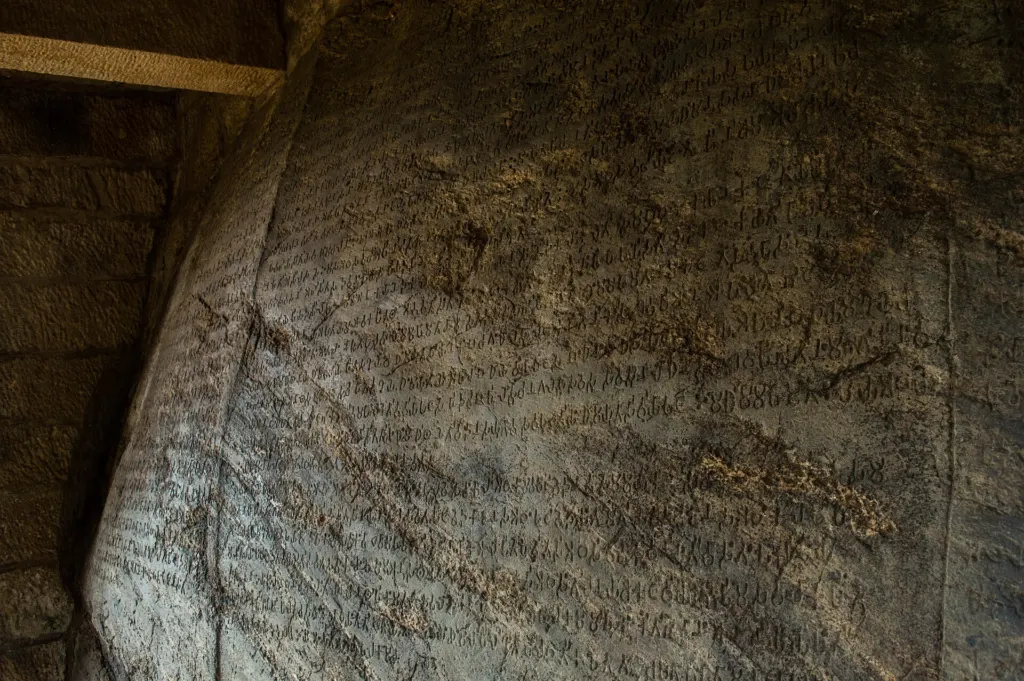
Ashoka’s own words on the Kalinga war are carved into rock at ten sites from Afghanistan to Andhra Pradesh, and they do not describe a conversion. They describe a tally. “One hundred and fifty thousand in number were the men who were deported thence, one hundred thousand in number were those who were slain there, and many times as many those who died,” reads the thirteenth Major Rock Edict in the 1925 Hultzsch translation.
What follows that count is the line every schoolbook paraphrases: “This is the repentance of Beloved of the Gods on account of his conquest of (the country of) the Kalingyas.”
The popular version turns those sentences into a single night. A bloodthirsty emperor walks the battlefield, sees the dead and wakes up a Buddhist. The inscriptions tell a slower, stranger story.
What the stone says, and when it says it
The edict dates the war itself: “When King Beloved of the Gods Priyadarsin had been anointed eight years, (the country of) the Kalingans was conquered by (him).” Modern dating puts that around 261 BCE.
The remorse text was not written on the battlefield. The third and fourth Major Rock Edicts are explicitly dated to the twelfth year after his anointing, and the fifth to the thirteenth, so the Kalinga confession belongs to the same campaign of inscriptions, four to five years after the fighting ended.
And the edict never uses the word Buddhist. It speaks of “a zealous study of morality, to the love of morality, and to the instruction (of people) in morality.” The Buddha, the monastic order and Buddhism itself are absent from all fourteen Major Rock Edicts; ascetics are listed alongside Brahmans in a neutral roll-call of the sects he honors.
The earlier edicts that break the overnight story
For the religious label, you have to read the older, rougher inscriptions known as the Minor Rock Edicts. In the version compiled from several sites, the king says: “I have been a Buddhist layman (Upāsaka) for more than two and a half years, but for a year I did not make much progress. Now for more than a year I have drawn closer to the Order (Sangha) and have become more ardent.”
The Maski copy, the one that finally tied the title “Beloved of the Gods” to the personal name Asoka, puts it as “Two and a half years [and somewhat more] (have passed) since I am a Buddha-Sakya.”
Those lines are dated to about the eleventh year of his reign. Count back two and a half years and the lay vows land close to the eighth year, the year of Kalinga. Some translators read the chronology differently and place his first lay vows at least two years before the war, which would make him a lukewarm Buddhist when he ordered the invasion. Either way, there was no overnight switch. Then comes the part the legend leaves out: a full year, in his own telling, of not making much progress. The man who supposedly changed in a single night admits on stone that he drifted for twelve months before anything took.
Badiyaa’s timeline from the inscriptions
- Year 8 after anointing: Kalinga conquered; 100,000 slain, 150,000 deported, by his own count.
- Roughly years 8 to 9: becomes a lay Buddhist, then “did not make much progress” for a year.
- Year 10: the first known inscription, a Greek and Aramaic text at Kandahar.
- Year 11: Minor Rock Edicts, where he first calls himself a Buddhist layman.
- Years 12 to 13: Major Rock Edicts, including the Kalinga remorse, with no mention of the Buddha.
So the claim is half right. The horror was real and the regret is in his own hand. But the conversion was a gradual, stop-start affair that he was still describing as a work in progress three years after the war, and the remorse was published only once it fitted a wider program of what he called conquest by morality.
One scholarly outlier goes further and argues the Major Rock Edicts were written by a different king altogether, a view mainstream Ashoka specialists reject. The stones do not need that twist to undercut the legend.
The edict ends with instructions to his heirs: his sons and great-grandsons “should not think that a fresh conquest ought to be made” and should “regard the conquest by morality as the only (true) conquest.” Whatever the pace of his change of heart, that is the sentence he wanted carved for the future.
Further reading
Image: Bhajish Bharathan, CC BY-SA 4.0 via Wikimedia Commons
This article was produced with AI assistance and reviewed by our Editorial Desk. How we work.