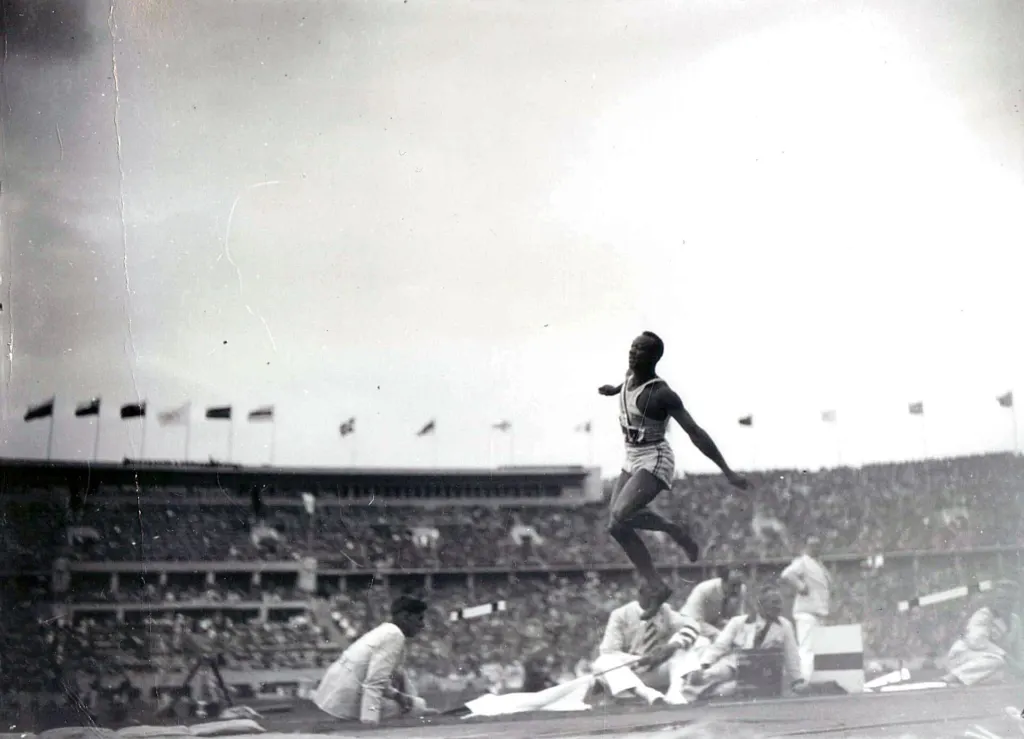
The story goes that Adolf Hitler stormed out of the Berlin Olympic Stadium rather than shake Jesse Owens’s hand. The record is less tidy. By the time Owens won his first gold medal on August 3, 1936, Hitler had already stopped congratulating any winner in public, and Owens spent that autumn telling American audiences that the slight he felt had come from his own government.
What happened in the stadium
On the first day of track and field, August 1, Hitler shook hands with the German winners only and then left. Henri de Baillet-Latour, president of the International Olympic Committee, insisted that Hitler greet every medalist or none. Hitler chose none and stayed away from the medal presentations that followed.
The snub story began the next day, and not with Owens. On August 2, while Owens was running his qualifying heats, another Black American, Cornelius Johnson, won the high jump with an Olympic record of 2.03 meters. A communist newspaper in New York claimed Hitler had received the other track winners and walked out after Johnson’s jump. The charge later moved onto Owens, whose golds came in this order:
- 100 meters, August 3: 10.3 seconds, a tenth of a second ahead of teammate Ralph Metcalfe
- Long jump, August 4: 8.06 meters, ahead of Germany’s Luz Long
- 200 meters, August 5: 20.7 seconds, ahead of Mack Robinson, older brother of Jackie Robinson
- 4×100-meter relay, August 9: a world record of 39.8 seconds
Every one of those finals took place after the IOC ruling, so a public handshake from Hitler was off the table for all winners, German or not. That does not mean goodwill. Albert Speer, the Nazi armaments minister, later wrote that Hitler was “highly annoyed” by the run of victories and dismissed Black athletes in openly racist terms.
Owens’s own words, then and later
Owens brushed the story aside at the time. “Hitler had a certain time to come to the stadium and a certain time to leave,” he said, explaining that Hitler had gone before the 100-meter ceremony. Passing near the leader’s box on his way to a broadcast, Owens added, “He waved at me and I waved back.” Robert L. Vann, a Black newspaper editor in the stands, wrote on August 4 that he had watched Hitler salute Owens after the sprint.
The treatment at home was colder. After a ticker-tape parade in New York, Owens was refused entry through the main doors of the Waldorf Astoria and rode a freight elevator to the reception held in his honor. President Franklin D. Roosevelt never invited him to the White House. Letters in Roosevelt’s official files urged the president to receive the Olympians “without regard to race or color”; the White House reply, archivists note, was evasive and pointed to a full schedule of trips to flood-hit areas.
On October 15, 1936, Owens spoke to Black voters at a Republican rally in Kansas City, Missouri, and said: “Hitler didn’t snub me—it was our president who snubbed me. The president didn’t even send me a telegram.”
One complaint, three wordings
That line circulates in more than one form, which is worth knowing before you share it. The version above is the one most often cited for the Kansas City speech. A 2020 newspaper column renders the middle as “It was (Roosevelt) who snubbed me,” with the name supplied in brackets. A third remark, quoted by archivists at the National Archives, makes the same point more gently: “I wasn’t invited to shake hands with Hitler, but I wasn’t invited to the White House to shake hands with the president, either.” No date or venue is attached to that one, so it is best treated as Owens’s settled view rather than a dated quotation.
Context matters too. Owens was a Republican who campaigned for Alf Landon against Roosevelt in the 1936 election, so the Kansas City words were also a campaign line. That does not make them false: no congratulatory telegram arrived from the president.
The verdict
Mostly myth. Hitler never shook Owens’s hand, but after the first day he shook no winner’s hand in public, under pressure from the IOC. The person Owens himself named was the American president. His Berlin haul, set out in his biography, went unmatched for 48 years, until Carl Lewis won the same four events in 1984.
White House recognition came on August 5, 1976, when President Gerald Ford presented Owens with the Presidential Medal of Freedom, 40 years to the day after his 200-meter win. The letters that asked Roosevelt to honor him are still in the Franklin D. Roosevelt President’s Official Files, folder OF 720: Olympic Games, catalog number NAID 2780709.
Further reading
Image: U.S. National Archives and Records Service, Public domain via Wikimedia Commons
This article was produced with AI assistance and reviewed by our Editorial Desk. How we work.