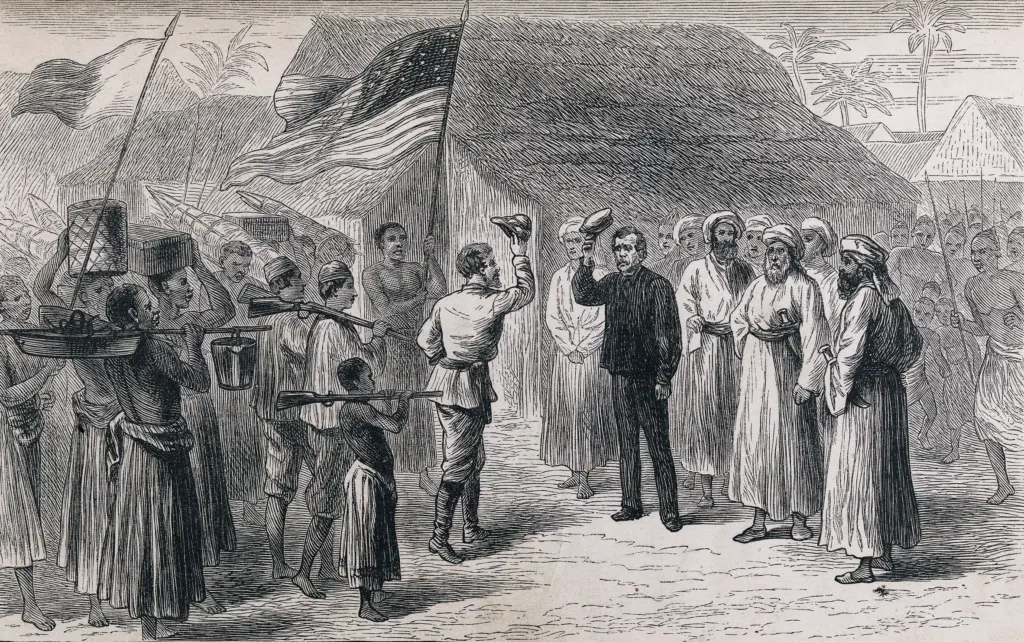
On November 10, 1871, 155 years ago today, Henry Morton Stanley walked up to a pale, gray-bearded Scot in the lakeside town of Ujiji, in what is now Tanzania, raised his hat and, by his own account, said four of the most quoted words in exploration: “Dr. Livingstone, I presume?”
The problem is that the only firm evidence for those words is Stanley himself, writing after the fact. His diary pages for that exact moment are missing, and his biographer thinks he made the line up.
What Stanley says happened
Stanley’s version comes from his 1872 book How I Found Livingstone. In the passage, reproduced in Fordham University’s Internet History Sourcebooks, he describes a dense crowd, a man in a long white shirt greeting him in English, and the news that the missing missionary was in the village.
He admits he was torn between joy and pride. He wanted to run to the older man and hug him, he writes, but held back because he did not know how an Englishman would take it. So he chose what he called the most dignified option:
“Dr. Livingstone, I presume?”
“Yes,” said he, with a kind smile, lifting his cap slightly.
In Stanley’s telling the two men shook hands, and he added: “I thank God, Doctor, I have been permitted to see you.” Livingstone answered: “I feel thankful that I am here to welcome you.”
Why historians doubt the line
Here is the catch. According to the record of Stanley’s life, the phrase does not appear in the journal he kept at the time. The two pages right after his first sighting of Livingstone were torn out at some point.
Neither man used the line in any letter written then. When Livingstone described the arrival, he tended to tell it through his servant Susi, who shouted: “An Englishman coming! I see him!” Stanley’s own book, notably, has a version of the same scene in which Susi greets him first with “Good morning, sir!”
The four words reached print only in July 1872, months later, in newspaper accounts of Stanley’s letters. Biographer Tim Jeal argued that Stanley invented the line afterward to lift his standing, out of what Jeal called “insecurity about his background.” The irony is that readers at the time found the greeting comically stiff for two men meeting in the middle of Central Africa.
Who was really speaking
That insecurity had deep roots. Stanley was not born Stanley. He was John Rowlands, born in Denbigh, Wales, in 1841, and he spent years of his childhood in the St Asaph workhouse. He emigrated to the United States at 18, took a new name, fought on both sides of the American Civil War, and became a newspaper correspondent.
The search was funded by a New York newspaper owner, James Gordon Bennett Jr. In the sourcebook excerpt, Stanley recalls the order that sent him: “Take what you want, but find Livingstone!” He reached Zanzibar in March 1871. His first dispatch put the expedition at 111 people, though he later claimed 192 porters, a gap typical of a writer who, as his biographer documented, tended to inflate numbers.
Livingstone had been out of contact for years, and many people believed he had died. When Stanley asked his servant Chumah whether the Doctor was well, the answer was blunt: “Not very well, sir.” Stanley stayed and explored with him, and the pair established that Lake Tanganyika did not drain into the Nile.
The verdict
So, did he say it? A fair reading of the evidence:
- Documented: the meeting at Ujiji on November 10, 1871, and Stanley’s published account of the greeting.
- Missing: any contemporary diary entry or letter from either man containing the words.
- Likely: Stanley polished, or created, the line after the fact.
The quote should be attributed to Stanley’s 1872 book, not treated as a verbatim record of the moment. A later twist on his reputation is darker: Stanley went on to work for King Leopold II of Belgium, helping set up the Congo Free State, which has shadowed his name ever since. He died in London on May 10, 1904, and his grave at Pirbright, Surrey, carries the Kongo name Bula Matari, “Breaker of Rocks.”
Further reading
- Fordham Internet History Sourcebooks: Stanley, How I Found Livingstone, 1871
- Wikipedia: Henry Morton Stanley
Image: Unknown illustrator, Public domain via Wikimedia Commons
This article was produced with AI assistance and reviewed by our Editorial Desk. How we work.