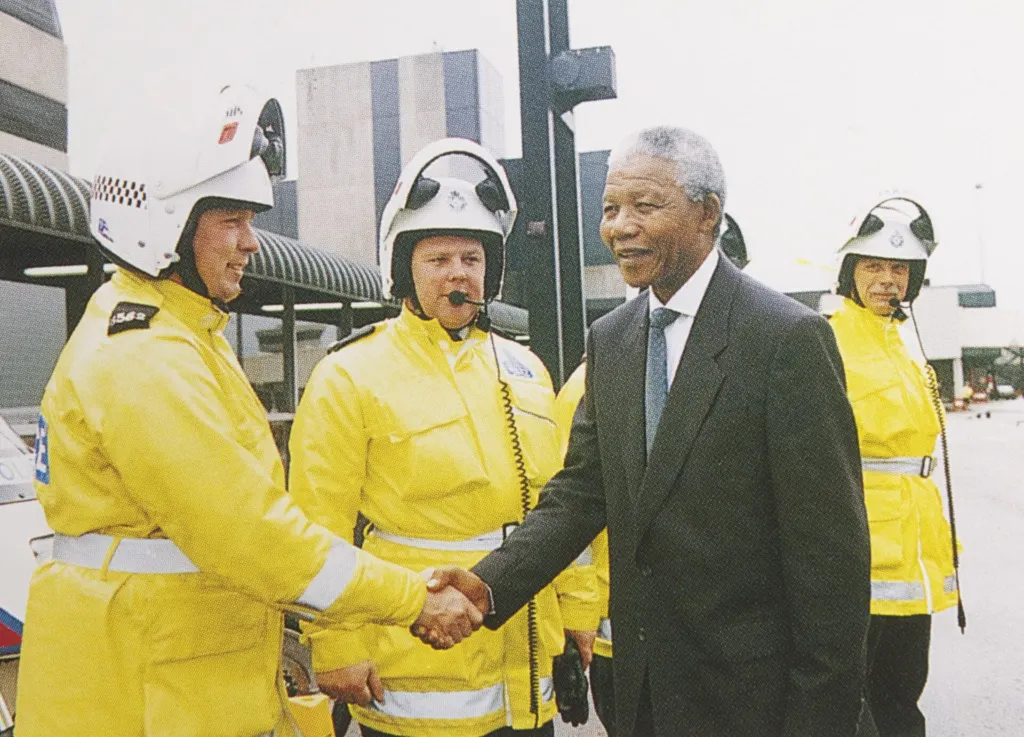
The paragraph most often credited to Nelson Mandela’s 1994 inauguration is not in the speech he gave at the Union Buildings in Pretoria on May 10, 1994. The lines “Our deepest fear is not that we are inadequate. Our deepest fear is that we are powerful beyond measure” were printed two years earlier, in chapter seven of Marianne Williamson’s first book, A Return to Love, published by HarperCollins in New York in 1992.
Mandela (1918 to 2013) spent 27 years in prison before his release in 1990. In 1994 he became South Africa’s first Black head of state, elected in the country’s first fully representative vote, and he served a single term that ended in 1999. The foundation that bears his name calls him an often-quoted man, and it still receives requests to reprint the passage as his words.
What the inauguration text contains
The South African government keeps the address in its online speeches archive, filed under its formal title as the ANC president’s statement on taking office as head of the Democratic Republic of South Africa. After the greetings it runs to 874 words. A search of that text for “deepest”, “inadequate” or “beyond measure” returns nothing. The word “fear” appears exactly once, and “light” once, in a tribute to the security forces who protected the election from groups that “still refuse to see the light.”
The single use of “fear” is worth reading in full, because it is the real inaugural line about fear. Mandela promised a covenant to build a society “in which all South Africans, both black and white, will be able to walk tall, without any fear in their hearts, assured of their inalienable right to human dignity – a rainbow nation at peace with itself and the world.”
The speech also holds the sentence many South Africans still recite: “Never, never and never again shall it be that this beautiful land will again experience the oppression of one by another and suffer the indignity of being the skunk of the world.”
The Nelson Mandela Foundation, which keeps his archive in Johannesburg, checked all three public addresses tied to the handover: his address to the people of Cape Town on May 9, 1994, the Pretoria statement and the oath of office on May 10. The passage appears in none of them. In a correction posted on November 9, 2007, archivist Razia Saleh said: “As far as I know, he has never used the quote in any of his speeches,” adding that the foundation had “catalogued about 1 000 thus far.”
Where the words come from
Williamson, an American spiritual author, began lecturing small groups in 1983 about A Course in Miracles, a 1976 spiritual text by Helen Schucman. A Return to Love, her book of reflections on that course, was a hit in 1992, spending 39 weeks on a US best-seller list. The paragraph sits in the “Work” chapter, page 165 of the first edition. It closes with the sentence: “As we’re liberated from our own fear, our presence automatically liberates others.”
Williamson has corrected the record herself. In December 2017, after a televised awards show repeated the error, she wrote on her verified social media account: “I’d be honored had Mr. Mandela quoted the words, but he didn’t. An urban myth.”
How the misattribution traveled
Quotation researchers have traced the drift year by year. This timeline brings the documented steps together:
- 1992: A Return to Love is published; the passage is in chapter seven.
- May 10, 1994: Mandela is inaugurated in Pretoria. His statement contains no version of the passage.
- February 1996: A newspaper columnist in Nashville, Tennessee, quotes the paragraph as words Mandela spoke “in his inaugural address”, the earliest misattribution researchers have found.
- Spring 1998: Commencement speakers credit Mandela, among them Hillary Rodham Clinton at Howard University and astronaut Mae C. Jemison at Duquesne University. A newspaper item that June points out that the lines belong to Williamson.
- 2005: The basketball film Coach Carter gives a trimmed version to the student character Timo Cruz, played by Rick Gonzalez, dropping the “child of God” lines.
- November 9, 2007: The Nelson Mandela Foundation publishes its correction.
- December 2017: Williamson objects after the error airs on television.
The order matters. The film arrived nine years after the first known misattribution, so it did not start the confusion, and on screen the words belong to a fictional teenager in Richmond, California, not to any politician. The 1996 column already placed them in an inaugural address that was barely 21 months old.
The fix is simple and public. The full statement of May 10, 1994, is posted by the South African government, the foundation still fields requests to reprint it as a classic, and its closing lines are short enough to quote correctly: “Let freedom reign.” The 33rd anniversary of the inauguration falls on May 10, 2027.