Search the three anti-lynching texts that made Ida B. Wells famous and one of her most-quoted sentences is missing from all of them. “The way to right wrongs is to turn the light of truth upon them” is printed on posters, classroom walls and journalism-school banners, yet the line does not appear in Southern Horrors (1892), in her Boston lecture “Lynch Law in All Its Phases” (February 13, 1893) or in The Red Record (1895).
Badiyaa read all three texts word for word, in open-access editions of the two pamphlets and in a university archive’s text of the 1893 speech, and the phrase “light of truth” is not in any of them. That does not make the line fake. It means the usual citation, her 1892 pamphlet, is wrong, and the sentence still needs a primary source.
Who she was
Ida Bell Wells was born enslaved on July 16, 1862, in Holly Springs, Mississippi, and gained her freedom as a baby when Union troops took the town. Yellow fever killed both her parents in 1878, when she was 16; she took a teaching job so the younger children could stay together, later moved to Memphis and bought into the Free Speech newspaper.
In May 1892 she published an editorial that Memphis business leaders found so offensive they met at the Cotton Exchange Building and threatened to lynch its author. Wells was in New York on vacation. Creditors seized the press, and she never went home. She died in Chicago on March 25, 1931, and in 2020 received a posthumous Pulitzer Prize special citation.
What she did write in 1892
The preface to Southern Horrors is dated “New York City, Oct. 26, 1892” and dedicated to the Black women of New York and Brooklyn whose fundraiser at Lyric Hall on October 5, 1892, paid for its printing. Its closest cousin to the famous line sits in the final section, “Self-Help”: “The people must know before they can act, and there is no educator to compare with the press.”
The preface also carries a sentence that biographies quote in full: “Somebody must show that the Afro-American race is more sinned against than sinning, and it seems to have fallen upon me to do so.” Both are checked against the 1892 text; neither says anything about turning a light.
Timeline of the texts we checked
- June 25, 1892: her long article “Exiled” runs in the New York Age.
- October 26, 1892: Southern Horrors goes to print in New York. No “light of truth.”
- February 13, 1893: “Lynch Law in All Its Phases,” Boston. No “light of truth.”
- 1895: The Red Record, Chicago. No “light of truth.”
How the line is used today
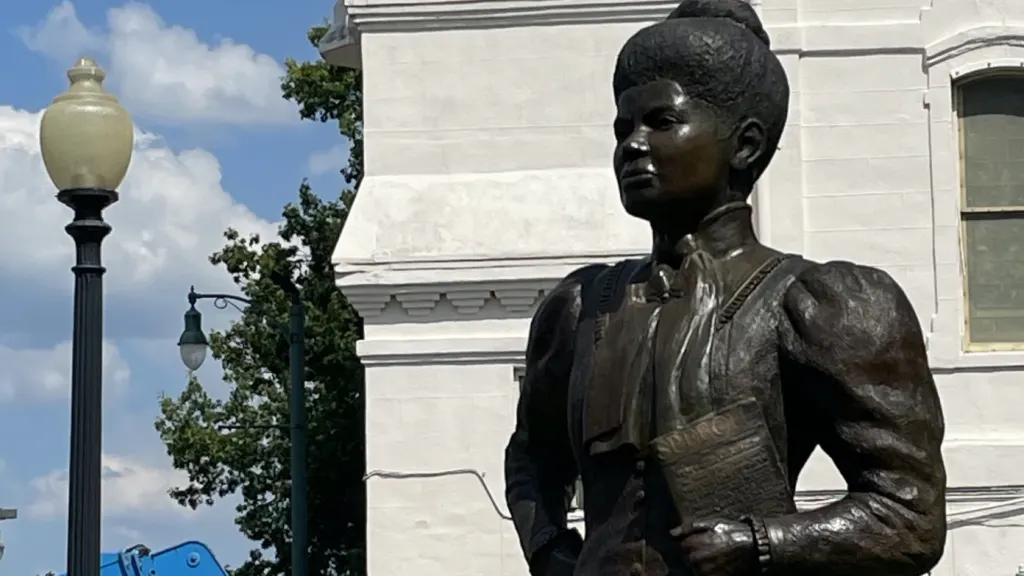
Chicago’s 2021 monument to Wells in Bronzeville, by sculptor Richard Hunt, is officially called The Light of Truth Ida B. Wells National Monument, and the open encyclopedia entry on Wells gives the quotation behind the name with a different verb: “cast the light of truth” rather than “turn.” Two verbs circulating for one sentence is a classic sign that a quotation has been passed hand to hand rather than copied from a page.
Memphis dedicated its own life-sized Wells statue in 2021 beside Beale Street Baptist Church, where the Free Speech was produced. The sentence appears on neither of the two 1892 and 1895 pamphlet title pages.
The still-open candidates for an original source are the June 1892 New York Age article, her 1900 essay “Lynch Law in America,” and her autobiography Crusade for Justice, published in 1970. Until one of them is read in full, the honest citation for the line is “attributed to Ida B. Wells,” with the year of the Lyric Hall meeting, October 5, 1892, as the closest fixed date for the work it describes.
Further reading
Image: Southern Hollows/S. Liles, CC BY-SA 4.0 via Wikimedia Commons
This article was produced with AI assistance and reviewed by our Editorial Desk. How we work.