The most quoted line in boxing was not Muhammad Ali’s invention. “Float like a butterfly, sting like a bee” came from his cornerman, Drew “Bundini” Brown, and by the morning of February 25, 1964, the two men were shouting it together at the weigh-in in Miami Beach, hours before a 22-year-old Cassius Clay took Sonny Liston’s heavyweight title.
The famous wording is real. The credit, and the second half of the rhyme most people quote, have drifted.
What was said in Miami Beach
The version tied to Brown has a different tail from the one on posters. The encyclopedia entry on Brown gives it as “Float like a butterfly, sting like a bee, rumble, young man, rumble,” and says Clay used it to needle Liston at the press session before the fight. A sports column written days after Brown’s death in 1987 described the same routine in the same words: “Float like a butterfly, sting like a bee. Rumble, young man, rumble.” After a pause, the column added, the pair would “roar, ‘Aaargh,’” and dissolve laughing.
Accounts of the weigh-in place it at the Miami Beach Convention Hall, with Clay in a denim jacket stitched with the words “Bear Huntin” and the two men starting the chant as people filed in. They kept it going into the press conference, rattling Clay’s own trainer, Angelo Dundee, along with the champion.
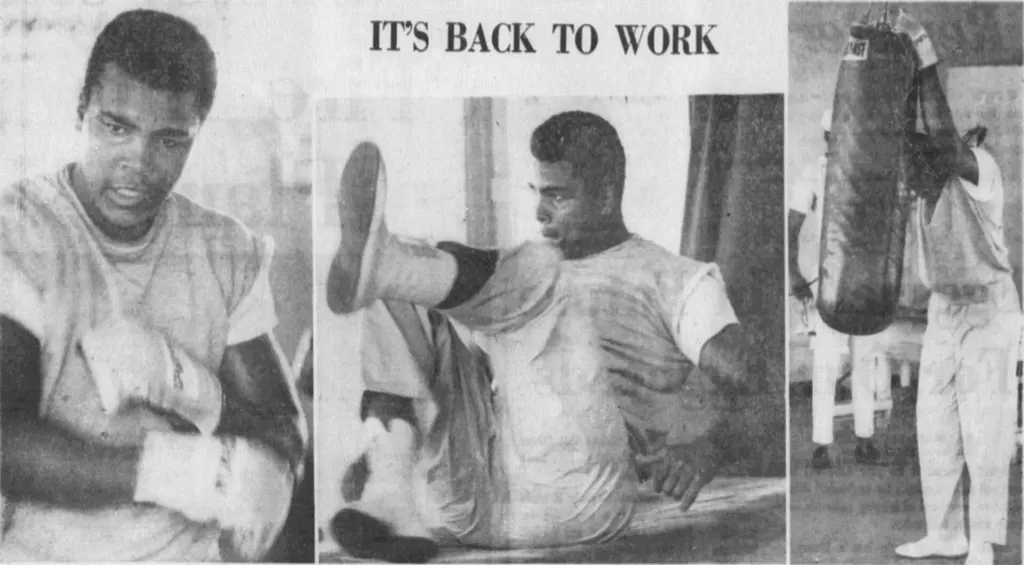
The best evidence that the line predates that morning is a ringside report dated March 9, 1964, less than two weeks after the bout. Its second paragraph says Clay “for weeks had cried” the couplet before he “floated and stung.” So the phrase was already a training-camp refrain in Miami Beach in the run-up to the fight, not an improvisation for the cameras on fight day.
Where “the eyes can’t see” comes in
The line that usually follows today, about hands that cannot hit what eyes cannot see, is Ali’s extension, and its date is shakier than the couplet’s. A college library’s anniversary post attaches “The hands can’t hit what the eyes can’t see” to the Liston fight. The best-known open, sourced collection of Ali’s sayings files a slightly different version, “his hands can’t hit what his eyes can’t see,” under his 1974 bout with George Foreman in Zaire, and its only citation is a newspaper roundup from 2016.
That fits how the pair worked. Brown is credited with the chant itself, while the endings changed from fight to fight and opponent to opponent; in the documentary about the Foreman fight, the two can be seen trading riffs on it ten years after Miami. The pronouns shift between tellings (“the hands,” “his hands”), which is typical of a line that lived in performance long before anyone wrote it down.
A short timeline of the line
- 1963: Brown joins Clay’s camp as a cornerman after seven years with Sugar Ray Robinson.
- Weeks before February 25, 1964: Clay is calling out “Float like a butterfly, sting like a bee” while training in Miami Beach.
- February 25, 1964: the weigh-in chant; that night Liston does not come out for the seventh round and Clay is champion.
- March 9, 1964: a published fight report treats the couplet as Clay’s established slogan.
- 1974: a version ending in “his hands can’t hit what his eyes can’t see” is linked to the Foreman fight.
- September 24, 1987: Brown dies in Los Angeles County, aged 59.
The man behind the rhyme
Brown was born on March 21, 1928, in Midway, Florida, and left school after the eighth grade. He lied about his age to join the US Navy at 13, spent years at sea in the merchant marine, and worked for Robinson before Robinson steered him toward the young Clay. He was a cheerleader, speechwriter and sometime exile from Ali’s camp across nearly two decades, and he later took small film roles, including in Shaft and The Color Purple.
So the verdict is simple. The couplet is genuine and dates from Miami Beach in early 1964; Brown wrote it; “rumble, young man, rumble” was its original second line; and the “eyes can’t see” ending is Ali’s, with the firmest documented version tied to 1974. Ali seems to have known whose line it was. About a week before Brown died, Ali visited him in a Los Angeles hospital and, by one account, leaned close to whisper “Float like a butterfly, sting like a bee . . . rumble, young man, rumble.”
Further reading
Image: Joe Rimkus, Public domain via Wikimedia Commons
This article was produced with AI assistance and reviewed by our Editorial Desk. How we work.