The oldest printing of the line now credited to Maya Angelou sits on page 244 of a 1971 book from Salt Lake City, and the name beneath it is not hers. It reads: “They may forget what you said — but they will never forget how you made them feel.” The man credited is Carl W. Buehner, a Utah church official and, three years earlier, a candidate for governor.
The book is Richard Evans’ Quote Book, put together by Richard L. Evans, who for more than four decades narrated the Mormon Tabernacle Choir’s weekly broadcast Music and the Spoken Word. Quotation researcher Garson O’Toole reported the citation in April 2014, after librarians at Brigham Young University’s Harold B. Lee Library in Provo checked scans of the page. Nobody has yet produced an earlier text.
Who Carl W. Buehner was
Buehner was born in Stuttgart, Germany, on December 27, 1898, and grew up in Salt Lake City after his family emigrated. From 1952 to 1961 he served as second counselor in the Presiding Bishopric of the Church of Jesus Christ of Latter-day Saints. In 1968 he ran for governor of Utah as the Republican nominee and lost to the Democratic incumbent, Cal Rampton. He died in Salt Lake City on November 11, 1974.
One caution belongs here. The quote book names Buehner but gives no speech, date or occasion for the remark. That makes 1971 a floor rather than a birth date: Buehner may have coined the sentence, or he may have been repeating something already in the air at church gatherings.
How the line drifted toward Angelou
The saying spread for three decades with Buehner’s name attached, or with no name at all. A 1996 speechmaking guide written for Rotary International members still credited him: “They may forget what you said — but they will never forget how you made them feel.” Other speakers reshaped it. At a Missionary Baptist Church event in Owensboro, Kentucky, in January 1995, a speaker named Hankins split it in two: “People will forget what you did,” then “People will never forget how you made them feel.”
Angelou’s name arrives in 2003, carried by a chain message. It presented a list of “I’ve learned” sayings as something she wrote for her 70th birthday. Several entries, including the one about rainy days, lost luggage and tangled Christmas tree lights, actually come from H. Jackson Brown Jr.’s 1991 compilation Live and Learn and Pass It On, where they were credited to anonymous contributors identified only by age. The feelings line was tacked onto the end. Angelou turned 70 on April 4, 1998, so the supposed birthday list would have postdated Brown’s book by seven years.
From there the attribution hardened in print. A 2004 book for teachers ran the now-standard version under her name: “I’ve learned that people will forget what you said, people will forget what you did, but people will never forget how you made them feel.” The open quotation compendium Wikiquote files it under “Misattributed” on her page and points to Buehner.
The record, in order
- 1971: Buehner credited in Richard Evans’ Quote Book, page 244, column 2.
- 1995: the two-sentence “what you did” variant in a church talk in Kentucky.
- 1996: Buehner still credited in a guide for Rotary speakers.
- March 2003: first Angelou credit found, in a Georgia newspaper column reprinting the birthday list.
- 2004: the three-part wording printed under her name in a teachers’ book.
Counting from the Utah printing to the first known Angelou credit gives 32 years (2003 minus 1971). Buehner had been dead for 29 of them (2003 minus 1974), so he was never in a position to object.
What Angelou herself is documented saying
Fairness to Angelou, born Marguerite Annie Johnson in St. Louis in 1928, means stating the gap plainly. No source checked for this story shows her claiming the sentence as her own, and none shows her disowning it. From the 1990s she gave roughly 80 talks a year; if she spoke the line from a podium, no dated transcript or recording turned up here.
The wording did reach a book with her name on the cover. Rainbow in the Cloud: The Wit and Wisdom of Maya Angelou, an 83-page collection whose UK edition is catalogued with a publication date of October 28, 2014, prints it in the “I’ve learned” form. That edition appeared five months after her death in Winston-Salem, North Carolina, on May 28, 2014, and the searchable text gives no date or occasion for the remark.
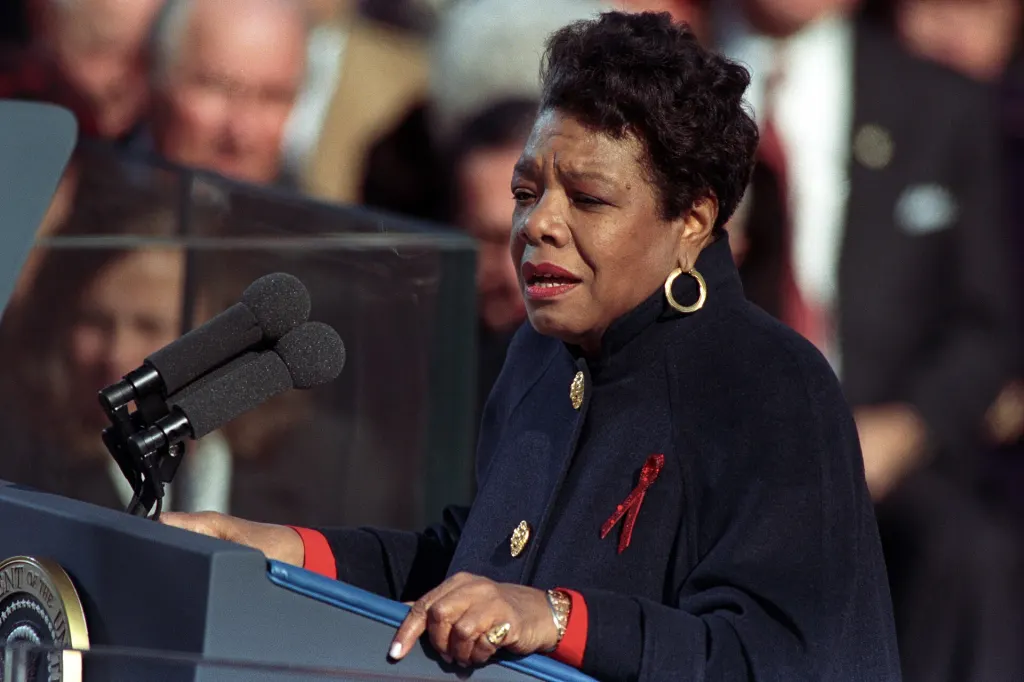
What she unquestionably wrote is a shelf of seven autobiographies and the poem “On the Pulse of Morning,” which she read at Bill Clinton’s first inauguration on January 20, 1993. The Buehner wording, meanwhile, can still be checked where it first appeared: page 244, column 2, of the 1971 quote book in the Harold B. Lee Library’s collection in Provo.
Further reading
Image: White House Photograph Office (Sharon Farmer), Public domain via Wikimedia Commons
This article was produced with AI assistance and reviewed by our Editorial Desk. How we work.