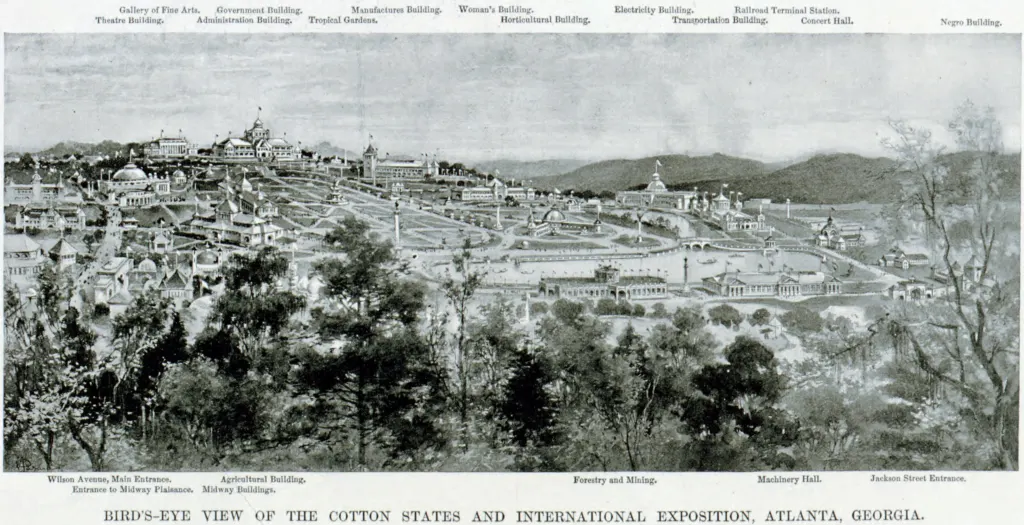
“Cast down your bucket where you are” is one of Booker T. Washington’s most quoted lines, and it began as a story about a ship dying of thirst at sea. Washington told the parable in Atlanta, Georgia, on September 18, 1895, in a speech of under ten minutes at the Cotton States and International Exposition, and he repeated the line until the audience could not miss it.
The parable, word for word
According to the transcript kept by the National Park Service at the Booker T. Washington National Monument in Virginia, the story runs like this. A ship that had been lost for many days spots a friendly vessel and signals: “Water, water; we die of thirst!” The reply comes back to cast down a bucket where they are.
The thirsty crew signal again, “Water, water; send us water!” and get the same answer. A third and fourth plea bring the same reply. When the captain finally obeys, the bucket comes up “full of fresh, sparkling water from the mouth of the Amazon River.” The joke of the story is that the crew had been sitting in drinkable water all along.
Washington then turned the image on his listeners. To Black Southerners hoping to improve their lives “in a foreign land,” he said: “Cast down your bucket where you are.” In the opening section the park service publishes, the phrase appears five times, counting its use in the parable (once with a typo, “you bucket”), and Washington went on to aimed the same line at white Southern employers, urging them to hire the Black workers already around them.
What he meant by it
The line carried the core of what became known as the Atlanta Compromise. Washington urged Black Southerners to stay in the South, focus on farm work, trades and business, and put off campaigns for equal political rights. In return he hoped white Southerners would offer jobs, property and schools. He summed up the bargain with another famous image: “In all things that are purely social we can be as separate as the fingers, yet one as the hand in all things essential to mutual progress.”
The white audience gave him a standing ovation, and the text was wired to newspapers across the country. President Grover Cleveland wrote to congratulate him within days.
Who pushed back
Not everyone cheered. Washington never called his proposal a compromise; W. E. B. Du Bois coined the term “Atlanta Compromise” eight years later, in his 1903 book The Souls of Black Folk, where he wrote that Washington’s program “practically accepts the alleged inferiority of the Negro races.” In 1905 Du Bois and William Monroe Trotter formed the Niagara Movement, a forerunner of the NAACP, in direct opposition.
History also ran against the bucket’s advice. From around 1910, millions of Black Americans left the South for cities such as New York, Detroit and Chicago in the Great Migration. Historians still debate whether Washington’s caution was conviction or a tactic forced on him; later research found he quietly funded legal challenges to voter exclusion and jury exclusion.
Why the line outlived the speech
Part of its staying power is structure. The phrase is short, concrete and repeated, and it works without context, so it travels easily far from its 1895 meaning. Washington, born into slavery in 1856 and head of the Tuskegee Institute from 1881, had a gift for images that stuck. Badiyaa has traced another of his lines, the one about measuring success by the obstacles overcome, to his 1901 memoir, and our piece on George Washington Carver and the peanut butter myth covers another Tuskegee legend.
Washington died in 1915. The full text of the Atlanta address is still published by the Booker T. Washington National Monument in Hardy, Virginia.
Further reading
Image: Unknown author, Public domain via Wikimedia Commons
This article was produced with AI assistance and reviewed by our Editorial Desk. How we work.