“In Flanders fields, the poppies blow / Between the crosses, row on row.” John McCrae, a Canadian army doctor, drafted those lines on May 3, 1915, a day after he buried a close friend near Ypres in Belgium. Within six years, the flower in his opening line had become the badge that millions now pin on in November.
From a poem to a poppy on every lapel
The flower needed two women, working years after the poem appeared, to become a symbol.
Moina Michael, a professor from Georgia, read the poem in November 1918 and wrote a reply called “We Shall Keep the Faith.” She vowed to wear a red poppy for the rest of her life, then began selling silk poppies to raise money for disabled veterans she taught after the war. She pushed for the American Legion to adopt it as an official emblem.
A Frenchwoman recorded as Madame E. Guérin heard the idea at the Legion’s 1920 convention. She took it home and sold poppies to fund care for French war orphans. In 1921 she sent poppy sellers to London ahead of Armistice Day, and Field Marshal Douglas Haig, a co-founder of the British Legion, backed the sale. The habit spread across the British Empire within a few years.
Six and a half years from grave to lapel
Put the dates side by side and the chain is short: a burial on May 2, 1915, a poem on May 3, a professor’s vow in November 1918, and poppy sellers on London streets by November 1921. In about six and a half years, one doctor’s grief became a ritual shared across continents.
Back to Ypres: where the poem came from
McCrae was 41 when he signed up with the Canadian Expeditionary Force. Trained in medicine, he still chose to serve as a gunner as well as a medical officer. In the spring of 1915 he was at the Second Battle of Ypres in Flanders, a stretch of front that held for more than two weeks against one of the first gas attacks in history.
On May 2, Lieutenant Alexis Helmer, his friend, was killed. McCrae led the burial service himself and noticed how fast red poppies were springing up between the graves. The next day, sitting in the back of an ambulance at a dressing station outside Ypres, he wrote the poem. That spot is now known as the John McCrae Memorial Site.
The voice in the poem belongs to the dead. “We are the Dead. Short days ago / We lived, felt dawn, saw sunset glow,” it says, before handing a torch to the living and closing with a warning: “If ye break faith with us who die / We shall not sleep, though poppies grow / In Flanders fields.”
Crumpled, rescued, then rejected
A popular story says McCrae was unhappy with the draft and threw it away, and that a fellow soldier picked it up. The sergeant major who watched him write, Cyril Allinson, said the poem was “almost an exact description of the scene in front of us both.” A battlefield nurse, Clare Gass, copied it into her diary on October 30, 1915.
One London weekly turned it down. A London humor magazine then printed it, without a byline, on December 8, 1915. Even the first line is disputed. Allinson recalled that the draft ended with “grow,” while the printed text used “blow,” and McCrae wrote out both versions for friends.
The poem spread fast. It was used to sell war bonds and to recruit soldiers, and at least 55 American composers had set it to music by 1920. Translated widely, it drew a joke from McCrae himself: “it needs only Chinese now, surely.” He never saw the war end. He died of pneumonia and meningitis in France in January 1918.
Badiyaa has traced other Remembrance traditions, including how the two-minute silence began in Cape Town in 1918 and the record of the Harlem Hellfighters in World War I.
The United States honored Moina Michael with a 3-cent stamp in 1948, four years after her death.
Further reading
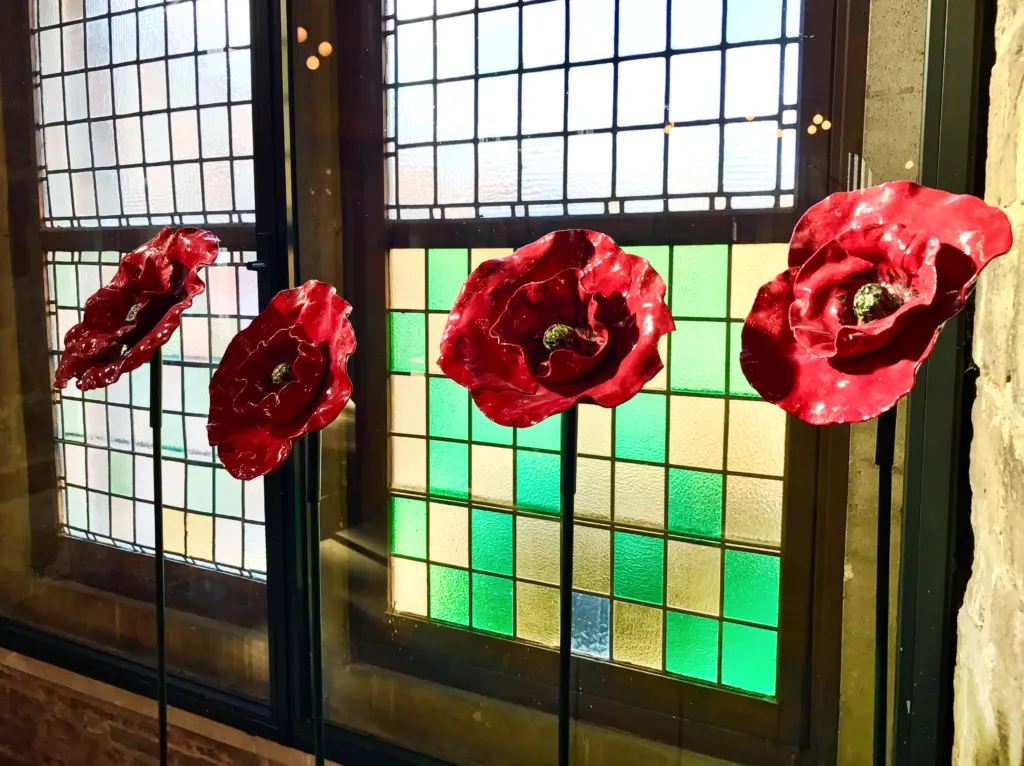
Image: Winniepix, CC BY 2.0 via Wikimedia Commons
This article was produced with AI assistance and reviewed by our Editorial Desk. How we work.