Theodore Maiman’s employer paid him $300 for the patent on the world’s first working laser. US Patent 3,353,115, titled “Ruby Laser Systems,” was granted on November 14, 1967, and assigned to Hughes Aircraft Company, which went on to find it was the most profitable patent the firm ever held.
By the time the paperwork came through, the device itself was old news inside physics. Maiman had first fired it on May 16, 1960, at the Hughes laboratories in Malibu, California, where a small pink ruby crystal sent out the first coherent light, every wave the same length and marching in step.
The ruby nobody else trusted
In 1960 a handful of big laboratories were racing to build a laser, including teams at IBM, Bell Labs, MIT, Westinghouse, RCA and Columbia University. Many of them took their cue from a 1958 proposal by Arthur Schawlow and Charles Townes that pictured a gas system built around potassium vapor. Ruby had been written off by others as a dead end.
Maiman disagreed. He had already shrunk a ruby maser for the US Army Signal Corps from a 2.5-ton cryogenic machine to about 4 pounds (1.8 kilograms), and he believed rival groups had misread how pink ruby behaves. “I was the only one that analyzed ruby in enough detail to have the confidence to stick with it,” he later said. His design wrapped a coiled xenon flash lamp around a synthetic pink ruby grown by Union Carbide’s Linde division.
Hughes backed the project with its own money from mid-1959. The whole effort cost about $50,000 including Maiman’s salary, a figure Stanford’s School of Engineering calls “likely one of the greatest research bargains of all time.”
From press conference to patent office
Hughes showed the laser to reporters at a Manhattan press conference on July 7, 1960. Maiman’s write-up was turned down twice by the journal Physical Review Letters before a short paper appeared in Nature on August 6, 1960. Townes, the maser pioneer, later rated that article as “probably more important per word than any of the papers published by Nature over the past century.”
The timeline shows how slowly the legal side moved. From the first firing on May 16, 1960, to the grant on November 14, 1967, is seven years and six months. In that gap Maiman left Hughes in 1961, ran a ruby-growing lab at a startup called Quantatron, and in 1962 founded Korad Corporation to build high-power ruby lasers. Other researchers had meanwhile bounced a ruby laser beam off the Moon.
What the $300 bought
Maiman earned his master’s in electrical engineering and his PhD in physics at Stanford, where his doctoral work under Willis Lamb measured fine detail in excited helium atoms. That blend of physics and hands-on engineering shows up in every account of the build.
The honors came later: the Wolf Prize in Physics for 1983/84, a place in the National Inventors Hall of Fame and the 1987 Japan Prize for “realization of the world’s first laser.” He died in Vancouver in 2007.
Badiyaa has traced other inventions and discoveries that changed daily life, from Lewis Latimer’s 1882 filament patent to the glowing screen behind Wilhelm Röntgen’s discovery of X-rays. Maiman’s date to remember is the earlier one: in 2017 UNESCO declared May 16, the day his ruby first lased, the International Day of Light.
Further reading
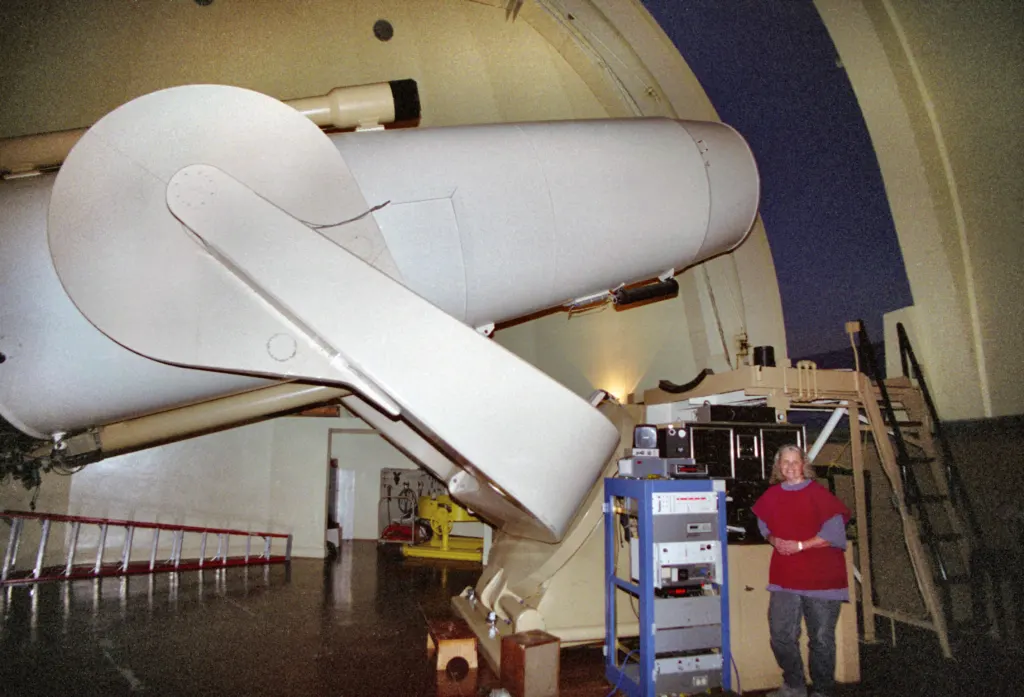
Image: International Gemini Observatory/NOIRLab/NSF/AURA/J. Chu, CC BY 4.0 via Wikimedia Commons
This article was produced with AI assistance and reviewed by our Editorial Desk. How we work.