Voyager 1, now about one light-day from Earth, is not drifting toward empty black. It is heading in the direction of Ophiuchus, the serpent-bearer, a sprawling constellation that also happens to sit on the ecliptic, the yearly track our Sun follows across the sky. Our Sun will move into it on November 29, eleven days from now.
NASA pointed skywatchers to the spot in its What’s Up guide for November 2026: to picture where Voyager 1 is traveling, look toward Ophiuchus. The agency’s chart shows the spacecraft’s position low in the west around 5 p.m. on November 17, the evening of its Shine Bright for Voyager’s Light-Day event. We covered the milestone itself in the math behind Voyager 1’s growing signal delay and in NASA’s call to flash V-G-R at the sky.
Where exactly Voyager 1 is pointed
As of July 2020, Voyager 1 sat between three stars, Alpha Herculis, Alpha Ophiuchi and Kappa Ophiuchi, at a right ascension of 17h 13m and a declination of +12 degrees 25 minutes. Alpha Ophiuchi is better known as Rasalhague, a name meaning “head of the serpent charmer”, and at magnitude 2.07 it is the brightest star in the pattern.
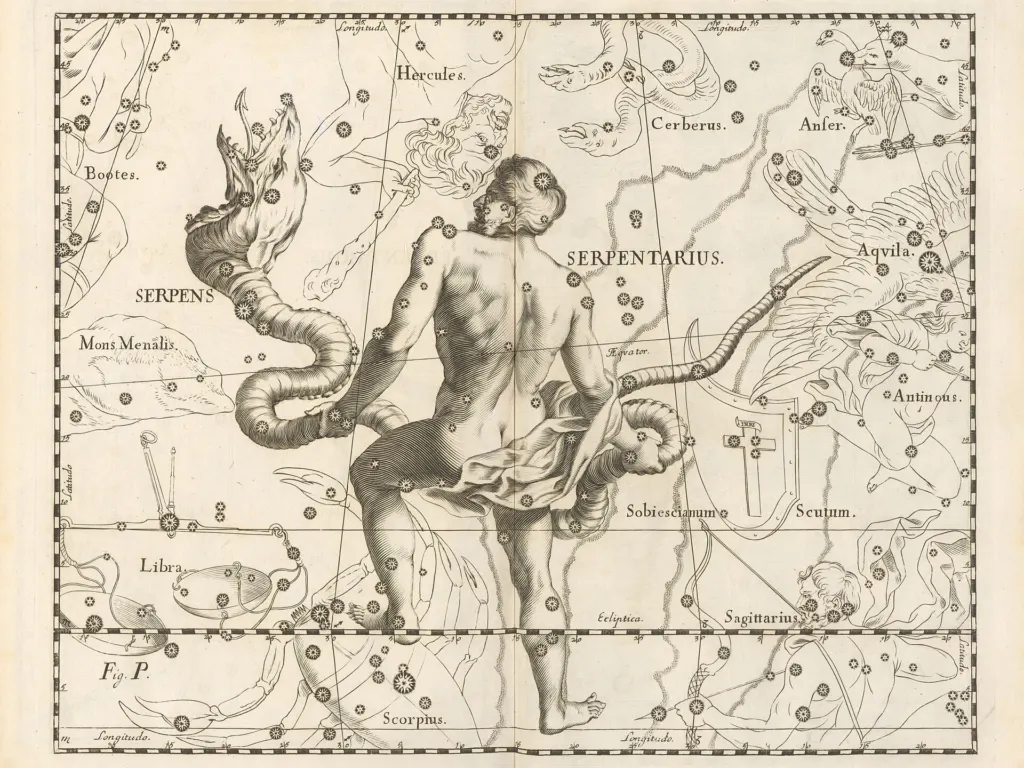
The constellation is huge, covering 948 square degrees, the 11th largest of the 88 modern constellations. It was one of the 48 listed by the second-century astronomer Ptolemy, and it is drawn as a man gripping a snake. The snake is a separate constellation, Serpens, and the figure’s body splits it into two halves, Serpens Caput, the head, and Serpens Cauda, the tail.
What else lives in the serpent-bearer
- Barnard’s Star: one of our nearest stellar neighbors; only the Alpha Centauri system and Proxima Centauri are closer.
- Kepler’s Supernova: first seen on October 9, 1604, near the star Theta Ophiuchi, and still the most recent supernova in our galaxy visible without a telescope.
- Globular clusters: seven Messier objects, including M10, about 20,000 light-years away.
Johannes Kepler spotted the 1604 star a week after its discovery and studied it in a book titled De stella nova in pede Serpentarii, “On the New Star in Ophiuchus’s Foot”. Galileo used it to argue against the old claim that the heavens never change.
The thirteenth sign that is not a sign
Ophiuchus is one of 13 constellations crossed by the ecliptic, which is why it keeps resurfacing online as a supposed 13th zodiac sign. That mixes up two systems. Astrological signs are 12 equal slices of 30 degrees each, tied to the seasons. Constellations are unequal patches of stars. Because Earth’s axis slowly wobbles, the dates have drifted since Babylonian times, and our Sun now crosses Ophiuchus from November 29 to December 18, inside the dates given for the sign of Sagittarius, November 23 to December 21.
Limits for skywatchers
Do not expect to see the constellation well now. From November to January, Ophiuchus lies in the daytime sky for most of the world, setting soon after sunset, so NASA’s chart catches only its last moments low in the west. Its best season is northern summer; around 9 p.m. in July it stands high enough to trace the serpent-bearer’s shoulders.
Voyager 1 itself is far too faint for any telescope to spot. For a sense of how long its signal takes to cross that gap, our story on Ole Rømer measuring the speed of light in 1676 explains where the first estimate came from.
Further reading
Image: Johannes Hevelius, Public domain via Wikimedia Commons
This article was produced with AI assistance and reviewed by our Editorial Desk. How we work.