In November 1676 a 32-year-old Danish astronomer told the Royal Academy of Sciences in Paris that light does not arrive instantly. Ole Rømer had predicted that Jupiter’s moon Io would slip out of the planet’s shadow about ten minutes later than the official tables said, and the sky agreed with him. Three and a half centuries later, his reasoning still sits at the root of every light-year and signal delay we quote.
Rømer was working at the Royal Observatory in Paris under its director, Giovanni Domenico Cassini. According to the history of Rømer’s measurement, he presented his method to the academy on November 21, 1676, after an emergence of Io observed on November 9 backed up the prediction he had made for November 16.
How a moon became a clock
Io circles Jupiter every 42 and a half hours and dips into the giant planet’s shadow on almost every lap. Astronomers of the 1600s used those eclipses as a celestial clock to work out longitude on land. That made their timing a practical question, not an academic one.
Rømer noticed that the gap between eclipses was not constant. When Earth was moving away from Jupiter the interval stretched, and when Earth was closing in it shrank. He was confident Io’s orbit itself was steady, so the change had to come from the shifting distance the light had to cover on its way to Paris.
The effect on any single orbit is tiny. In spring 1672 his apparent period for Io grew by only about 32 seconds over a run of observations, yet that small lag added up until an emergence on April 29 came roughly a quarter of an hour after the old method predicted.
Rømer’s number, checked against today’s
Rømer put the delay at about 11 minutes for light to cross the distance from our star to Earth, or 22 minutes across the full width of Earth’s orbit. The modern figure is 8 minutes 19 seconds. Working it through: 11 minutes is 660 seconds, the true value is 499 seconds, so his travel time was about 32% too long. Plugged into modern orbit sizes, his estimate gives roughly 226,663 kilometers per second, against the true 299,792 kilometers per second.
That gap mattered far less than the principle. Before 1676 many thinkers assumed light was instantaneous. Rømer turned the question into a measurement with an answer that could be refined.
Who believed him
Cassini never fully accepted the idea, partly because the other moons of Jupiter did not show the effect as clearly. Christiaan Huygens backed Rømer and turned the delay into the first rough speed, about 110 million toises a second. In England, Isaac Newton accepted the finite speed and gave seven or eight minutes for sunlight in his 1704 book Opticks.
Final confirmation came in 1729, when James Bradley explained stellar aberration, the slight tilt in starlight caused by Earth’s motion. Rømer had died in 1710, and most of his papers burned in the Copenhagen fire of 1728. One surviving sheet listing about sixty Io eclipses resurfaced in 1913.
From Io to Voyager
Earthbound measurements took over in 1849, when Hippolyte Fizeau timed light with a spinning toothed wheel and got about 313,000 kilometers per second. Today the speed is a fixed constant that defines the meter itself.
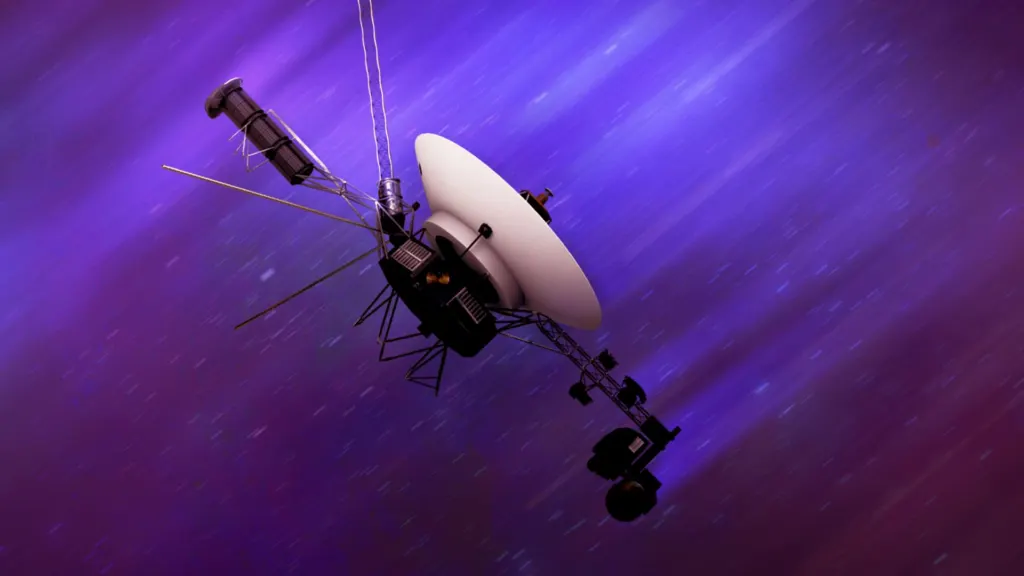
The same delay Rømer spotted now governs how mission controllers talk to spacecraft. Our story on Voyager 1 reaching one light-day from Earth works through that delay for the most distant probe, and the account of how Urbain Le Verrier found Neptune with math shows another case where careful timing of the planets revealed something no one could see directly.
Io is still a usable clock. Anyone with a small telescope can time an eclipse a few months apart and watch the same delay that convinced Paris, a lag of up to about 16 minutes between Jupiter at its closest and its farthest.
Further reading
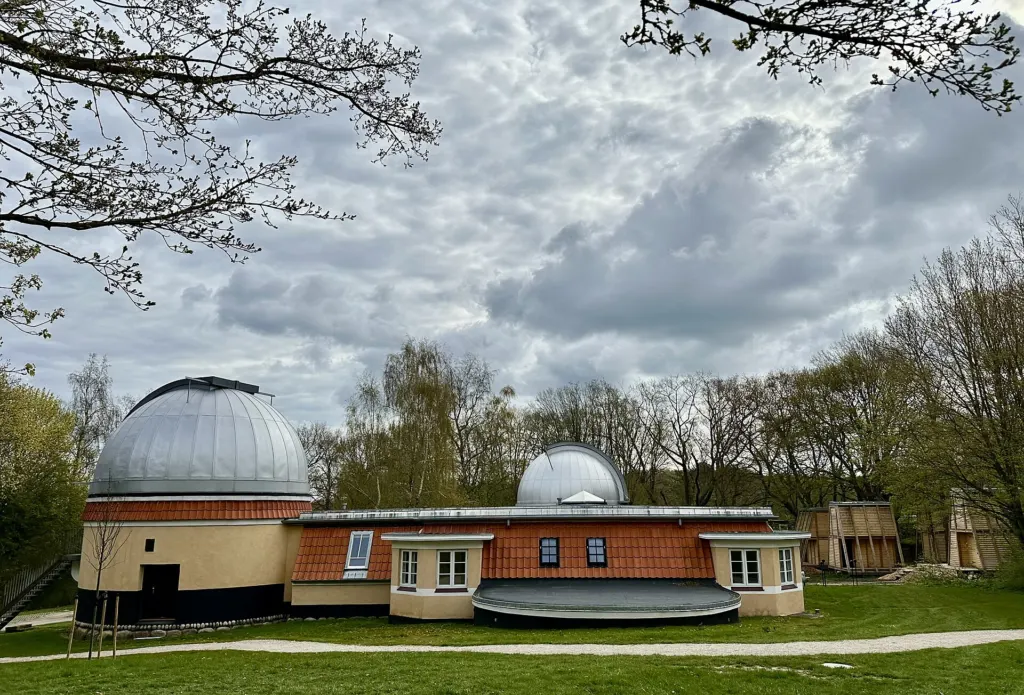
Image: De naturvidenskabelige museer i Aarhus, CC BY 4.0 via Wikimedia Commons
This article was produced with AI assistance and reviewed by our Editorial Desk. How we work.