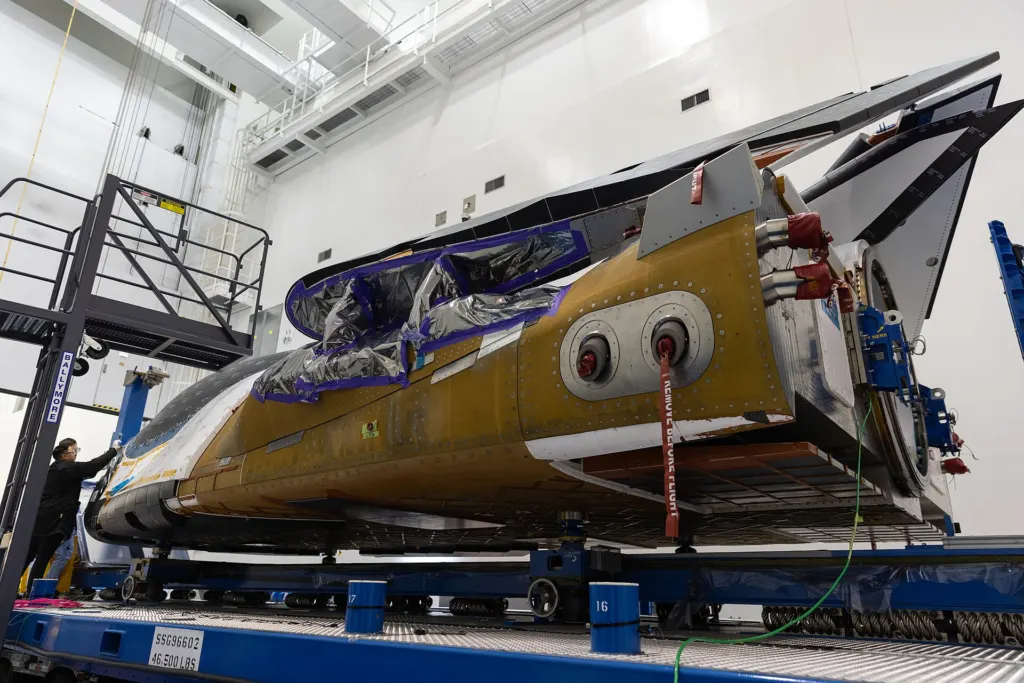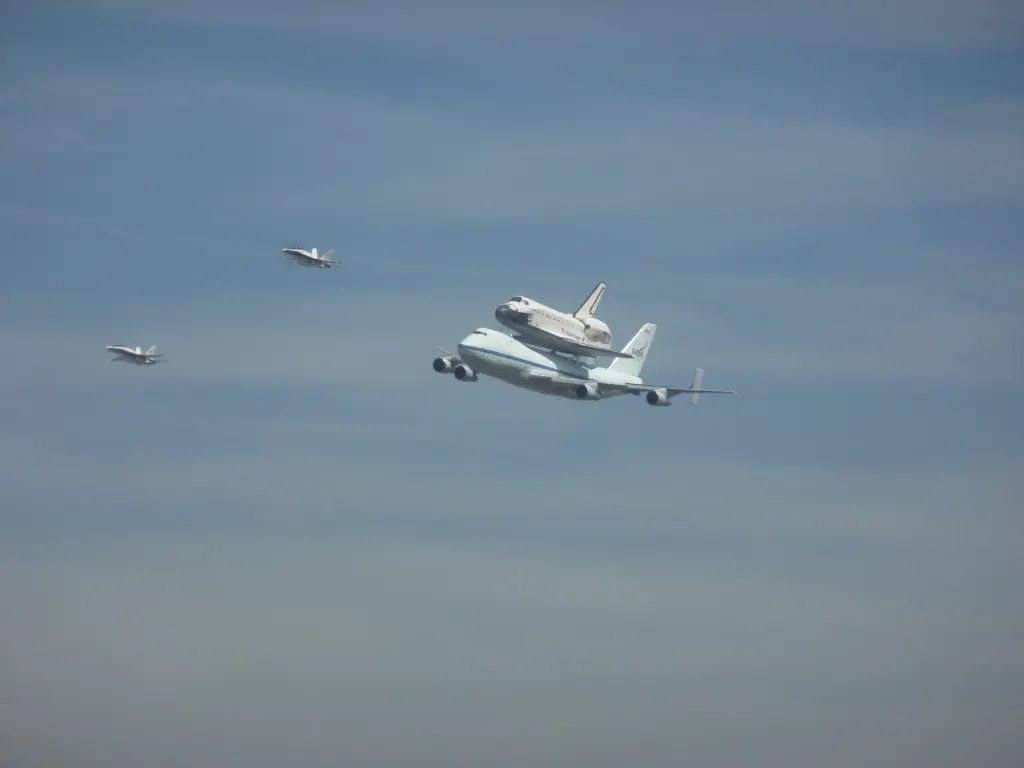
Space Shuttle Endeavour now stands upright in Los Angeles’ new Samuel Oschin Air and Space Center, and the setting is a homecoming: according to the State of California, every NASA space shuttle, Endeavour included, was manufactured and assembled in Southern California. The shuttle fleet came together in Palmdale, about an hour’s drive north of the museum in Exposition Park.
The new wing at the California Science Center opened on November 13 and adds roughly 200,000 square feet to the museum. We covered the opening itself, with the 185-foot launch stack, the gantry elevator and the descent slide, in our story on Endeavour standing in launch position as the Samuel Oschin Air and Space Center opened. This piece follows a different thread: how much of the machine in that gallery, and of US spaceflight generally, traces back to the region around it.
The last orbiter built
Endeavour was the last space shuttle built. It first launched in 1992 and flew 25 missions, including flights that helped assemble the International Space Station and servicing work on the Hubble Space Telescope. After its final mission in 2011, NASA picked the California Science Center as its permanent home, a choice the state’s June preview release ties directly to the region’s aerospace history.
That history runs deeper than the shuttle. The same release lists a chain of Southern California firsts and workhorses:
- Saturn V: the Moon rocket that carried the Apollo crews was built almost entirely in California, and the original Apollo spacecraft was made across the state.
- Skylab: the first US space station was built in Huntington Beach.
- Shuttle fleet: assembled in Palmdale.
- RS-25: the shuttle’s main engine has come out of San Fernando Valley design offices and factories for about half a century and now powers NASA’s Space Launch System for Artemis II.
The engine is the thread that ties the museum to current spaceflight. The RS-25 design that pushed Endeavour off the pad decades ago is the same family of engine NASA chose for the Space Launch System, the rocket behind its Artemis Moon program.
What the numbers say
California still leads the country in NASA work, according to the state’s figures from late 2024. NASA procurement spending in California came to $5.8 billion, which the state says is 25% of NASA’s procurement nationwide and produces $18.6 billion in economic output. Working backward from those two figures, total NASA procurement nationwide comes to roughly $23 billion, since $5.8 billion divided by 0.25 is $23.2 billion.
The state also says each NASA job in California supports another 35.7 jobs, for a total employment impact of 66,208 jobs. NASA runs three major sites in the state: Ames Research Center in Silicon Valley, Armstrong Flight Research Center at Edwards Air Force Base, and the Jet Propulsion Laboratory in Pasadena, which builds Mars rovers and manages the Deep Space Network of radio antennas.
A free museum with a full stack
The building was paid for through a public-private partnership, and Endeavour is displayed with its external tank and twin solid rocket boosters, an arrangement described as the world’s only authentic shuttle shown in launch position. Admission to the Science Center remains free.
Endeavour is not the only shuttle-era story we have told this month. The Soviet answer to it had a far shorter career, as our piece on how Buran flew its only mission in 1988 with nobody on board explains.
For visitors in Los Angeles, the Science Center is open daily from 10 a.m. to 5 p.m., with timed reservations for the new gallery.
Further reading
Image: Bluesnote, CC BY-SA 3.0 via Wikimedia Commons
This article was produced with AI assistance and reviewed by our Editorial Desk. How we work.