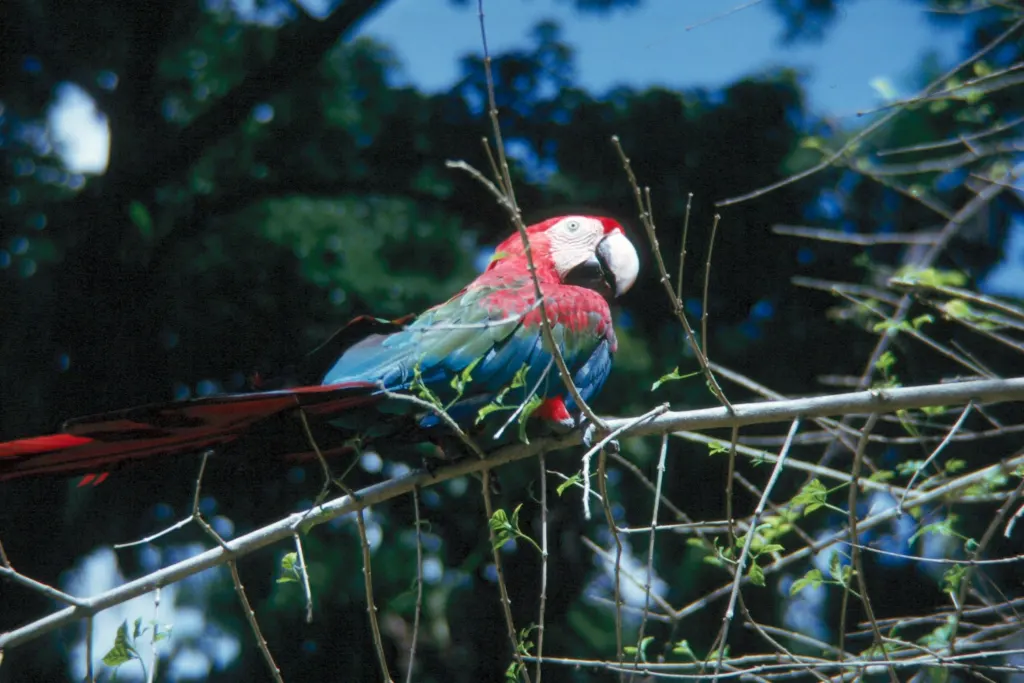
The red in a parrot’s wing does more than catch the eye. When researchers let a feather-eating bacterium loose on parrot plumage, red feathers colored by psittacofulvin pigments held up about as well as black, melanin-rich ones, while plain white feathers broke down faster.
The experiment, run by a five-person team led by Edward H. Burtt that included Kevin McGraw, appeared in the journal Biology Letters in April 2011 under the title “Colourful parrot feathers resist bacterial degradation.” McGraw is based at Arizona State University’s School of Life Sciences.
A pigment only parrots make
Psittacofulvins are the pigments behind the bright reds, oranges and yellows of parrots, and no other bird group is known to produce them. Most colorful birds get their reds from carotenoids in their food. Parrots instead build psittacofulvins themselves, using a polyketide synthase enzyme switched on in growing feathers. Chemically they are chains of alternating double bonds capped with an aldehyde group, and five are known, including one still unidentified in scarlet macaw feathers.
That raised a question the team set out to test. Earlier work had suggested that melanin, the dark pigment in many feathers, does a second job: it toughens the keratin that feathers are made of, so bacteria struggle to digest it. Could a parrot’s homemade red do the same?
How the feather test worked
The researchers exposed a range of parrot feathers to Bacillus licheniformis, a common soil bacterium that can break down keratin, and compared how fast each color degraded. Their findings sorted neatly into two groups:
- Red psittacofulvin feathers degraded at roughly the same rate as black melanin feathers.
- White feathers, which carry no pigment at all, degraded more quickly than either.
- Blue feathers, whose color comes from the microscopic arrangement of keratin, air and melanin granules rather than from a blue pigment, held up like red and black ones.
- Green feathers, which combine that structural blue with yellow psittacofulvin, also matched red and black.
Put simply, every colored feather in the test outlasted the white ones, whichever way the color was made. The authors suggested that the color patterns of parrots may have evolved partly to resist bacterial damage, alongside their better-known roles in display and camouflage.
What the study does not show
This was a lab study with one bacterial species, so it does not prove that wild parrots lose fewer feathers to bacteria because of their colors. It also says nothing about pet parrot care; plucked or damaged feathers in a pet bird are a question for an avian veterinarian, not for pigment chemistry.
Later work has added nuance. A 2019 study of White-shouldered Fairywrens in Papua New Guinea, published in Scientific Reports, cited the parrot results among experiments showing that melanins “and also parrot psittacofulvins” improve feather resistance to bacteria, but found that the shiny, iridescent structure of male plumage, rather than melanin alone, lined up with differences in feather microbes. The authors noted they had not measured degradation directly.
Parrots have featured often on Badiyaa lately, from African grey parrot Apollo naming objects and materials to Grecia the toucan and her 3D-printed beak, a reminder that bird plumage and bills are working tools as well as decoration.
The 2011 paper is three pages long, pages 214 to 216 of volume 7 of Biology Letters, and it has been cited 53 times according to the Scopus count on Arizona State University’s research portal.
Further reading
Image: Warren Garst, CC BY-SA 4.0 via Wikimedia Commons
This article was produced with AI assistance and reviewed by our Editorial Desk. How we work.