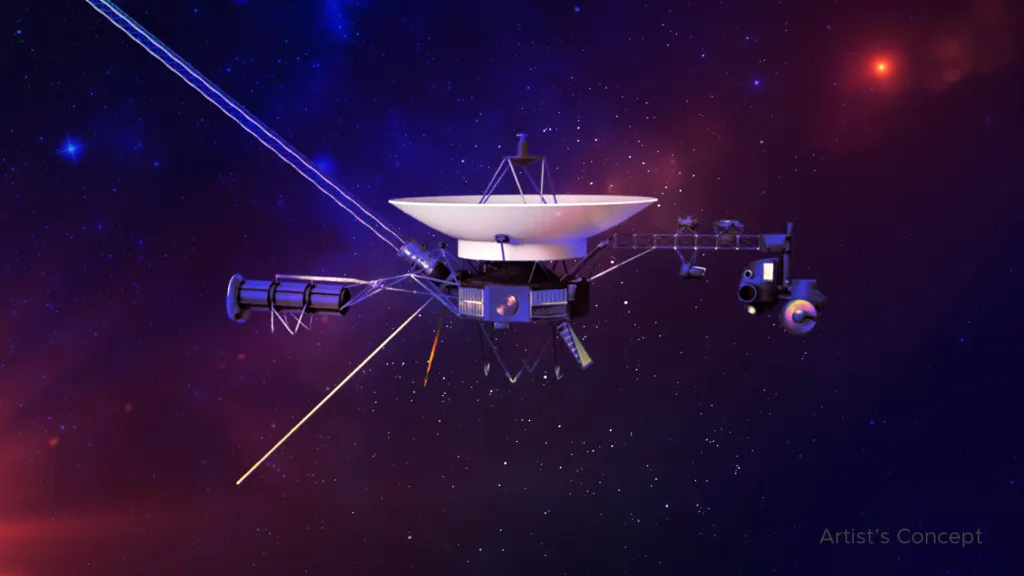
Voyager 1 is now farther from Earth than light travels in a full day. NASA says the probe crossed the one light-day mark on Wednesday, November 18, 2026, at 5:16:07 a.m. EST, after 49 years, two months and 11 days in flight. No other object built by people has ever been that far away.
One light-day sounds like a unit of time, but it is a distance: NASA puts it at 16,094,799,096 miles, or about 25.9 billion kilometers. A radio command sent from mission control now needs a whole day to arrive, and the probe’s answer needs another day to come home.
How Voyager 1 got here
The spacecraft left Florida on September 5, 1977, two weeks after its twin, Voyager 2, but on a faster route. It flew past Jupiter and then Saturn, and in 1980 it swung away from the plane of the planets. In August 2012 it became the first spacecraft to enter interstellar space, the region beyond the bubble of particles and magnetic fields that our star blows outward.
Badiyaa covered the run-up in detail, including the math behind Voyager 1’s growing signal delay and NASA’s invitation to flash V-G-R in Morse code at the sky on the eve of the crossing. With the line now behind it, the useful question is what comes after.
What comes next for the twin probes
Voyager 2 is the obvious follow-up. It took a slower path so it could visit Uranus and Neptune, and NASA says it is on pace to reach one light-day from Earth in November 2035, nine years after its sibling.
Voyager 1 itself is cruising at close to 38,000 mph (61,000 kph). That speed is enormous by human standards and painfully slow compared with light. Its long-range target is a dim star called AC +79 3888, also cataloged as Gliese 445, which sits in the Little Dipper more than 17 light-years from us. The probe will not arrive there: NASA expects it to slide past at a distance of about 1.7 light-years, roughly 40,000 years from now.
Here is a quick way to feel the gap. Voyager 1 needed just over 49 years to cover one light-day. A light-year holds about 365 light-days, so at the same pace the probe would need around 18,000 years to cover a single light-year. The nearest star system, Proxima Centauri, sits about 4.24 light-years away, which works out to more than 75,000 years of Voyager-speed travel.
Distances that light makes easy to picture
NASA’s own comparison chart helps put the new mark in context:
- The Moon is about 1.3 light-seconds from Earth.
- Sunlight needs about 8 minutes and 20 seconds to reach us.
- Mars ranges from 3 to 22 light-minutes, depending on where the two planets are in their orbits.
- Neptune averages 4 light-hours and 10 light-minutes from Earth.
- Voyager 1, as of this week, is 24 light-hours out and still moving.
That last line is the one that keeps growing. Every day the probe adds distance, so every day its record grows. Readers who want to follow where it is pointing can look back at our piece on Voyager 1’s path toward the Ophiuchus constellation.
The limits of the milestone
The light-day line is symbolic. Nothing physical marks it, and the probe’s instruments did not record anything special as it passed. The mission’s real constraint is power: both Voyagers run on slowly fading nuclear generators, and engineers have spent years switching off heaters and instruments to keep the science going.
Both probes carry a Golden Record of sounds and images from Earth. Voyager 1 will keep carrying its copy outward at about 38,000 mph, and the next date on the calendar belongs to its twin: November 2035, when Voyager 2 crosses the same line.
Further reading
Image: NASA/JPL-Caltech, Public domain via Wikimedia Commons
This article was produced with AI assistance and reviewed by our Editorial Desk. How we work.