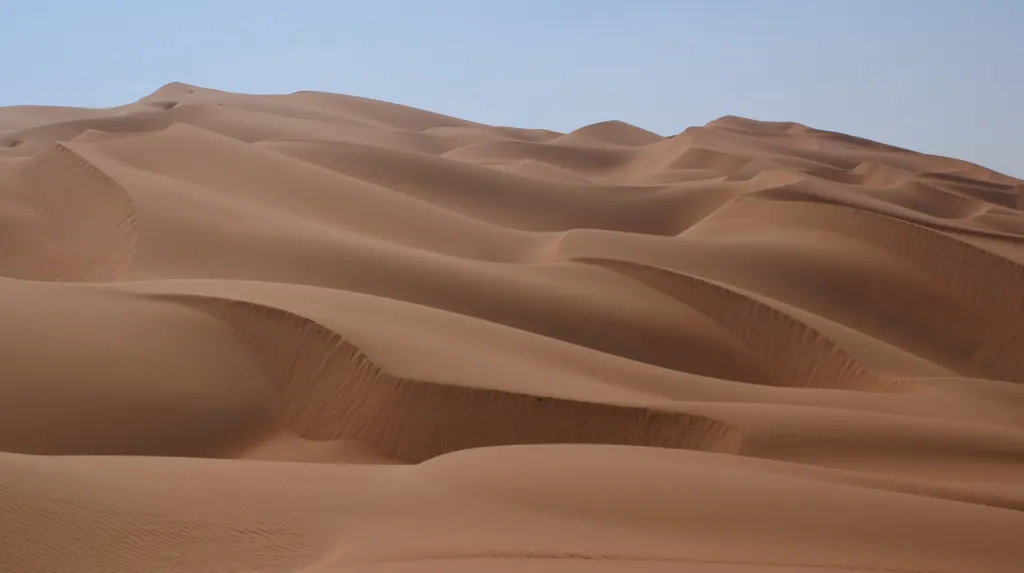
Hippos once wallowed in a freshwater lake in what is now the sand sea of southern Saudi Arabia, and people camped on its shore 125,000 years ago, hunting with what may be poisoned weapons. Researchers from Australia’s Griffith University, Saudi Arabia’s King Abdullah University of Science and Technology (KAUST) and the national Heritage Commission report the find in the journal Science.
The site, Uruq al-Julaybah, sits on the edge of ancient Lake Mundafan in the Rub’ al Khali, or Empty Quarter, the largest continuous sand desert on Earth. Today it gets less than 35 millimeters of rain a year.
A lake the size of a city
Using satellite terrain models, the researchers mapped the old lake at about 340 square kilometers, with a maximum depth of 29 meters. Lake-bed mud and aquatic fossils suggest the water stayed fresh and steady, with greenery and grassland around it.
That water drew big animals. The team recorded upward of 500 fossils, invertebrates included, scattered over 130-plus locations. Hippos shared the shore with ostriches, gazelles, Arabian oryx, camels and a long-horned buffalo species that no longer exists.
To picture how wet the place was, consider the depth alone. Filling a 29-meter-deep basin with today’s rainfall of under 35 millimeters a year would take more than 800 years, even if not a drop evaporated in the desert heat.
Thousands of flint tools and traces of poison
From the core dig area came 5,511 stone tools over 2 centimeters long. Nearly all, above 98 percent, were flint, shaped with the Levallois method, a technique of preparing a stone core so that a flake of planned shape can be struck off.
Microscopic and chemical checks on the tool surfaces found residues from many plants, some of them toxic. Resin and woody tissue suggest stone tips were fixed to handles or shafts. The KAUST release says the toxic traces are among the first evidence in Saudi Arabia of possible poison use in hunting. Other residues show people processed tubers, bushes and palm leaves, and some of the palm traces rank among the earliest in the region.
The paper’s title states it plainly: “Poisoned hunting weapons, megafauna and plant use at a 125,000-year-old Arabian paleolakeshore.”
Why it matters
About 125,000 years ago, during the last interglacial, a warm and humid phase now called Green Arabia, the peninsula was a corridor rather than a barrier. What sets this site apart is that bones, tools and plant traces were all found together in one dated layer, so researchers can rebuild daily life in unusual detail.
“This site gives us a rare and richly detailed view of how people lived in a landscape that looks nothing like Arabia today,” said Chris Clarkson, the Griffith University archaeologist who co-led the work.
“It is very exciting to see how the collaboration of so many different specialists allows to reconstruct this uniquely complete picture of life, behavior and the environment in the distant past,” added Frans van Buchem, the KAUST geologist who shared the lead.
Limits
Residues show that toxic plants touched the tools; they cannot prove every point was used to poison prey, which is why the researchers describe the hunting use as potential. The release does not say which human species made the tools; Levallois flaking was used by more than one. Hippos in the Mundafan basin are also not new, since fossil hippo remains from the area’s lake beds are already on record. The fresh contribution is the tight package of animals, tools and plant use in one dated place.
Badiyaa has followed other early hunters, including a 6,500-year-old hunting kit from a Texas rock shelter and keepsake stones kept by early humans in Israel’s Qesem Cave.
The study was published in Science on 12 November 2026 after fieldwork in the 2023 season.
Further reading
Image: Nepenthes, CC BY-SA 3.0 via Wikimedia Commons
This article was produced with AI assistance and reviewed by our Editorial Desk. How we work.