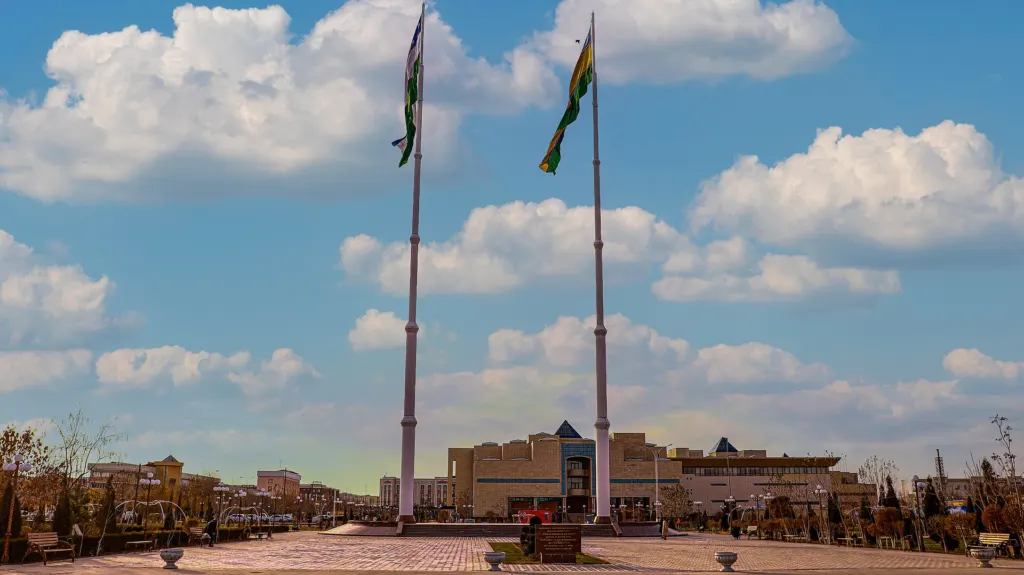
Uzbekistan adopted its national flag on November 18, 1991, making it the first of Central Asia’s new post-Soviet republics to choose a new flag. The design, by Farhod Yo’ldoshev, beat more than 200 entries and was approved at an extraordinary session of the Uzbek Supreme Soviet, weeks before the Soviet Union itself was dissolved.
The flag has three equal horizontal bands of azure blue, white and green, separated by two thin red stripes. In the blue band near the pole sit a white crescent and 12 white stars.
What the colors are said to mean
The state has never officially fixed a meaning for any part of the flag, so what follows are the common readings rather than law.
- Azure: the sky and clear water, and a color linked with the Turkic peoples.
- White: peace and good luck in Uzbek tradition.
- Green: nature, new life and a good harvest.
- Red stripes: the power of life.
- Crescent: Uzbek historical imagery and the birth of a new nation.
- Twelve stars: the country’s provinces, a nod to the historical calendar, and the pursuit of perfection and happiness.
Even the shades are loose. The government does not set exact hues and simply describes the colors as azure, white, green and red.
A flag drawn to the centimeter
The law on the state flag, Law No. 407-XII, is precise about everything else. A standard flag is 125 by 250 centimeters, a 1:2 ratio. The blue, white and green bands are each 40 centimeters deep, and each red stripe is 2.5 centimeters. The crescent and stars fit in an imaginary 30-by-75-centimeter box set 20 centimeters from the pole.
The stars run in three rows of three, four and five. That works out quickly: 3 + 4 + 5 = 12. Each star fits a 6-centimeter circle, and the stars are spaced 6 centimeters apart. Add the band depths, 40 x 3 plus 2.5 x 2, and you get exactly the 125-centimeter height.
From Soviet red to azure
Under Soviet rule, the Uzbek Soviet Socialist Republic flew a flag approved in 1952 and based on the red Soviet banner, with a blue stripe across it. Uzbekistan declared itself a sovereign, separate state on September 1, 1991, about three months before the Soviet Union broke up, and a contest for a new national flag began soon afterward.
The new flag kept a link to the old one, which its design was based on, while swapping the dominant red for azure, white and green. Later rules banned using the flag in advertising and barred non-government groups from logos resembling national symbols.
Uzbekistan’s Soviet past left other striking landmarks, such as the 22,790-mirror solar furnace near Parkent. For another flag story, read how the Betsy Ross legend first appeared in 1870, and for a late Soviet first, Buran’s uncrewed 1988 flight.
Further reading
Image: Aziko9, CC0 via Wikimedia Commons
This article was produced with AI assistance and reviewed by our Editorial Desk. How we work.