Solomon Islands raised its own flag on November 18, 1977, eight months before the country left British rule. The design is a blue triangle over a green one, split by a thin yellow diagonal, with five white stars in the upper corner. Those five stars no longer match the country’s map, and nobody has changed them.
What the colors and stars mean
- Blue: water, from rivers and rain to the Pacific Ocean around the islands.
- Green: the land and the trees and crops that grow on it.
- Yellow: sunlight, its rays running between land and sea.
- Five white stars: the five districts of 1978, namely Central, Western, Eastern, Malaita and the capital, Honiara.
The stars sit in three offset rows shaped like the letter X. That sets the flag apart from its neighbors. Australia, New Zealand, Papua New Guinea and Samoa all use stars to show the Southern Cross; the Solomon Islands stars stand for places on the ground instead. The country has since been divided into more provinces, nine plus the capital territory today, but the flag still carries five.
Two winning designs that were thrown out
The road to that flag was bumpy. A contest in 1975 first picked a design by William Robson, an English civil engineer in the Public Works Department, showing a black frigate bird inside a yellow circle ringed with chains on a blue field. It was dropped because the frigate bird was a symbol of only one province.
The next winner put a black chain on a red field. Its artist said it recalled blackbirding, the coercive recruitment of islanders as laborers, and the blood shed because of it. After a national newspaper printed it, the design caused a public argument and was also scrapped.
The flag that was finally chosen came from a New Zealander who taught visual arts at King George VI School in eastern Honiara, even though local entries were supposed to get priority.
From turtle badge to independence day
Britain declared a protectorate over the southern islands in 1893 and later took the north from Germany. Colonial flags followed: the Union Jack, a Blue Ensign with the protectorate’s name, a 1947 badge with a black-and-white sea turtle, and from 1956 a quartered shield with a lion, an eagle, a turtle, a frigate bird and local weapons. The turtle was replaced partly because it, too, belonged to only one area.
The handover ceremony on July 7, 1978, in Gizo, Western Province, was tense. Western leaders had pressed for more power for the provinces, and some residents saw the flag ceremony as a show of dominance by Malaita. Solomon Islands was the last British protectorate to gain self-rule.
The flag has had a second life at sea. Since 2012, foreign merchant ships have been allowed to fly it as a flag of convenience, a move the government expected to bring in more than US$500,000 a year in taxes.
Flags are often born out of quarrels and myths; read how the Betsy Ross story first surfaced 94 years later. For a recent Pacific islands rematch, see the Cook Islands’ 3-3 draw with Tahiti.
Further reading
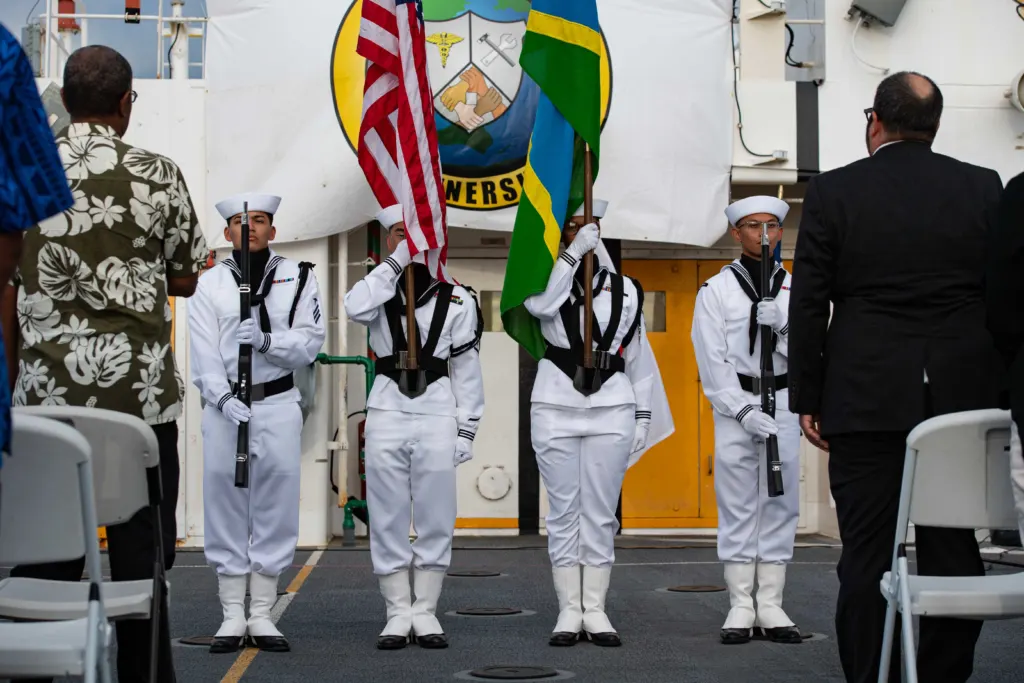
Image: U.S. Navy photo by Petty Officer 2nd Class Drace Wilson, Public domain via Wikimedia Commons
This article was produced with AI assistance and reviewed by our Editorial Desk. How we work.