Bavarian troops reached the Godesburg above the Rhine on November 18, 1583, and asked its garrison to surrender. The defenders answered that they had sworn loyalty to their archbishop and would fight to the death. It took a month, a tunnel bored into a volcanic hill and roughly 680 kilograms (1,500 pounds) of gunpowder to break them.
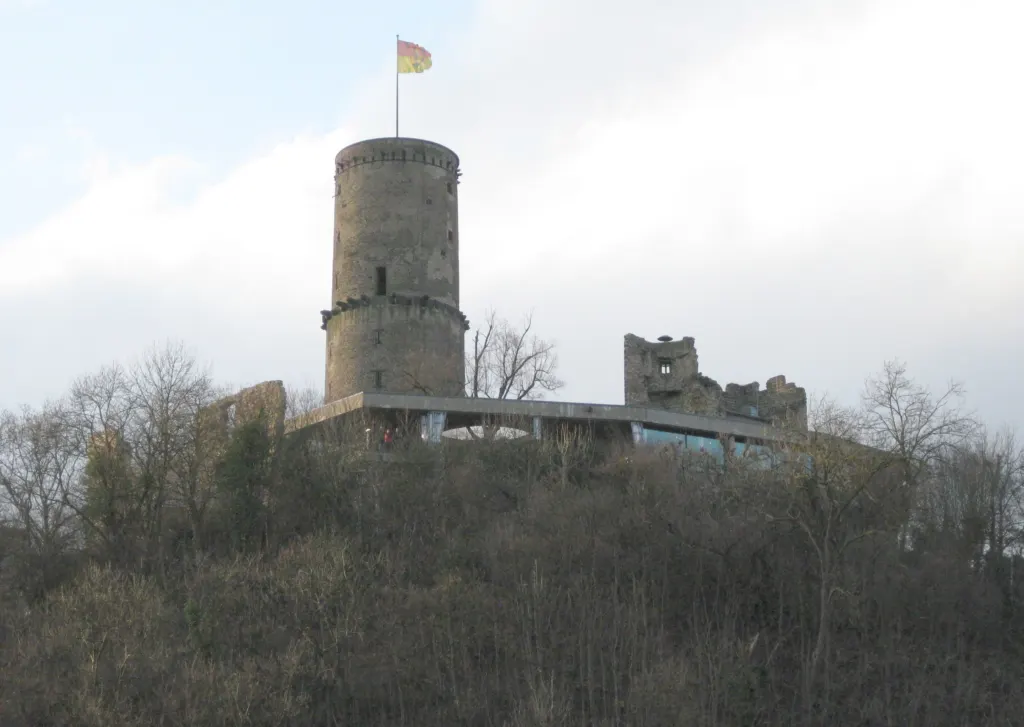
The siege of Godesberg was the first major siege of the Cologne War, a fight over who would rule one of the richest church territories in the Holy Roman Empire. The ruined castle still stands over Bad Godesberg, today a district of Bonn in western Germany.
Two archbishops, one electorate
The war started with a marriage. Gebhard Truchsess von Waldburg, Archbishop-Elector of Cologne, announced his conversion to Calvinism in December 1582 and wed Agnes von Mansfeld-Eisleben, a Protestant canoness, in February 1583. He refused to give up his post. The pope excommunicated him at the end of March, and the cathedral chapter elected a rival, Ernest of Bavaria.
Ernest had more men. His brother Ferdinand led a Bavarian army, backed by Italian mercenaries paid with papal money, through the southern half of the electorate. By late October only a handful of strongholds still held for Gebhard, and the Godesburg was the strongest of them.
Why the fortress was so hard to take
Archbishop Dietrich of Hengebach had laid its foundation stone in 1210. Over three centuries, his successors thickened the walls, raised the round central keep and stored the electorate’s archives and valuables inside. The castle sat about 120 meters (400 feet) above the Rhine, reached by a switchback road that made battering rams useless and foot assaults slow.
Ferdinand brought more than 400 foot soldiers, five cavalry squadrons and about six heavy cannons. Defending were Lieutenant Colonel Felix Buchner, Captain Eduard Sudermann, Dutch soldiers and about 180 people in all, along with several prisoners, including the Abbot of Heisterbach.
The month, step by step
- November 18: the siege begins with a formal demand to surrender, which is refused.
- November 18 to 28: cannon fire from the village below fails; defenders repair the damage every night.
- November 28: guns moved to a vineyard on higher ground breach the outer wall within hours, but storming it looks too costly.
- December 6 to 16: sappers, many of them forced local peasants, tunnel into the basalt and pack the mine.
- December 17: the mine is fired and nearly half the castle collapses.
In a letter dated December 15, Ferdinand told his brother Duke Wilhelm: “The fortress stands on solid rock.” He added that he hoped “in a day or two” to “send the fortress into the sky.”
The blast threw rubble onto houses in the valley, but the debris also blocked the attackers. A party of 40 or 50 finally climbed in through the castle’s latrine chutes. Buchner, holed up in the keep, traded his prisoners for safe passage for himself, his wife and Sudermann. The others left inside were killed. In all, 178 people died at the castle; they lie in two mass graves that have never been located.
Ernest’s forces moved on to besiege Bonn on December 21 and took it on January 28, 1584. The keep survived and later served as a watchtower in the Thirty Years’ War. Ferdinand carried the 1210 foundation stone to Munich; it is now in the Rheinisches Landesmuseum in Bonn.
Gunpowder ruined other landmarks in the same era, including the Parthenon in Athens, wrecked by a blast in 1687. For another November battle that was less heroic than its legend, read about Napoleon at the Arcole bridge in 1796.
Further reading
Image: Sir James at German Wikipedia, Public domain via Wikimedia Commons
This article was produced with AI assistance and reviewed by our Editorial Desk. How we work.