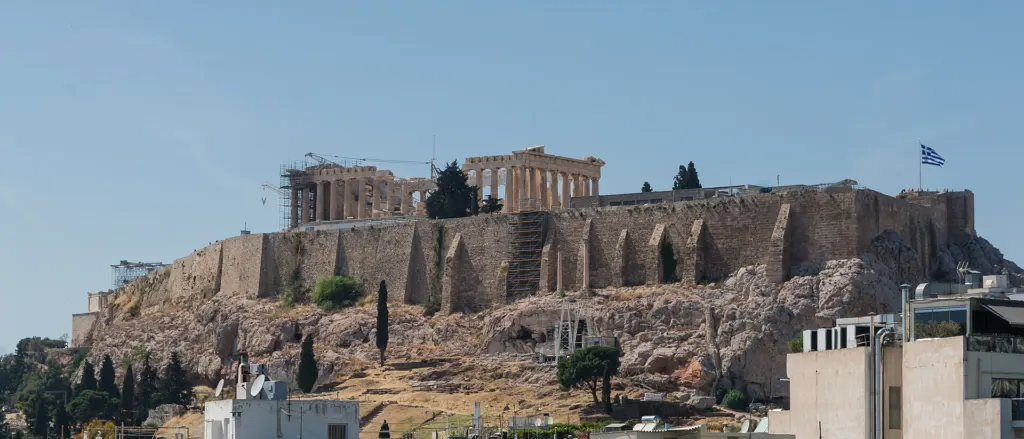
The Parthenon spent far longer as a house of Christian and then Muslim worship than most visitors to Athens realize. The temple to Athena became a church dedicated to the Virgin Mary in late antiquity, then a mosque under the Ottomans, complete with a minaret built from an old bell tower, until a Venetian shell blew up the gunpowder stored inside in 1687.
From temple to church
The Parthenon was built between 447 and 432 BC to honor Athena and to celebrate Greece’s victory over Persia. It served as a temple for close to a millennium. In 435 AD the Eastern Roman emperor Theodosius II ordered pagan temples closed, though the Parthenon’s closure may have come decades later, possibly around 481 to 484 under Emperor Zeno.
The conversion to a church came in the late fifth century, by the account in the building’s main history, though the same history elsewhere places it in the final decade of the sixth. Builders turned the whole building around. The main door moved to the western end, an apse rose at the east where the temple’s front porch had been, and the old inner chamber became the nave. Icons were painted on the walls, worshippers carved Christian inscriptions into the columns, and carvings of pagan gods on many of the metopes, the sculpted panels high on the outside, were hacked away so badly that some can no longer be identified.
The church, known as the Theotokos Atheniotissa, became a major pilgrimage site, ranked fourth in the Eastern Roman Empire after Constantinople, Ephesus and Thessaloniki. In 1018 Emperor Basil II traveled to Athens after defeating the Bulgarians for the express purpose of praying there.
Western crusader lords later took Athens, and for about 250 years the Parthenon served as a Latin Catholic church of Our Lady. They added a tower with a spiral staircase in the southwest corner.
From church to mosque
Ottoman forces besieged the Acropolis from 1456 until its Florentine defenders surrendered in June 1458. Sultan Mehmed II visited Athens in 1458 and again in 1460. Before the century was out, the Parthenon had become a mosque. Ottoman tax records of the 1500s call it the “fortress mosque of Athens.”
The changes were modest. The crusader tower was extended into a minaret, the apse became a mihrab facing Mecca, a minbar pulpit was installed, and the walls were whitewashed over the Christian images. The mosaic of the Virgin in the apse seems to have survived the switch.
In 1667 the Ottoman traveler Evliya Çelebi described the building as “like some impregnable fortress not made by human agency.”
A timeline of the Parthenon’s lives
- 447-432 BC: temple of Athena built.
- Late 5th century AD: closed as a temple, then converted into a church.
- About 1200s-1450s: Latin Catholic church for some 250 years.
- Before 1500: converted into a mosque.
- September 26, 1687: Venetian mortar round ignites the Ottoman powder magazine inside.
- Early 1700s-1843: a small domed mosque stands within the ruins.
The blast and the second mosque
In 1687 a Venetian force under Francesco Morosini besieged the Acropolis, and the Ottoman garrison used the Parthenon to store gunpowder. A mortar round fired from Philopappos Hill set it off, blowing out the middle of the building and bringing down much of its sculpture. About 300 people died.
Once the Ottomans were back in control of the Acropolis, they built a small single-domed mosque inside the shattered walls in the early 18th century. A daguerreotype taken in 1839 still shows it standing. It was taken down in 1843, when Greek archaeological work on the Acropolis began.
The Acropolis keeps turning up surprises, including the Chilean engineer’s ‘Parthenon’ souvenir that came from an older temple; for another ancient object with a double life, see the Roman Lycurgus Cup that changes color with the light.
Counted from its completion, the Parthenon was a temple for roughly 900 years and a church or mosque for about 1,100 to 1,200 years, depending on the conversion date. It has now stood as a ruin for 339 years, less than a third as long as it served as a place of Christian and Muslim prayer.
Further reading
Image: Jebulon, CC0 via Wikimedia Commons
This article was produced with AI assistance and reviewed by our Editorial Desk. How we work.