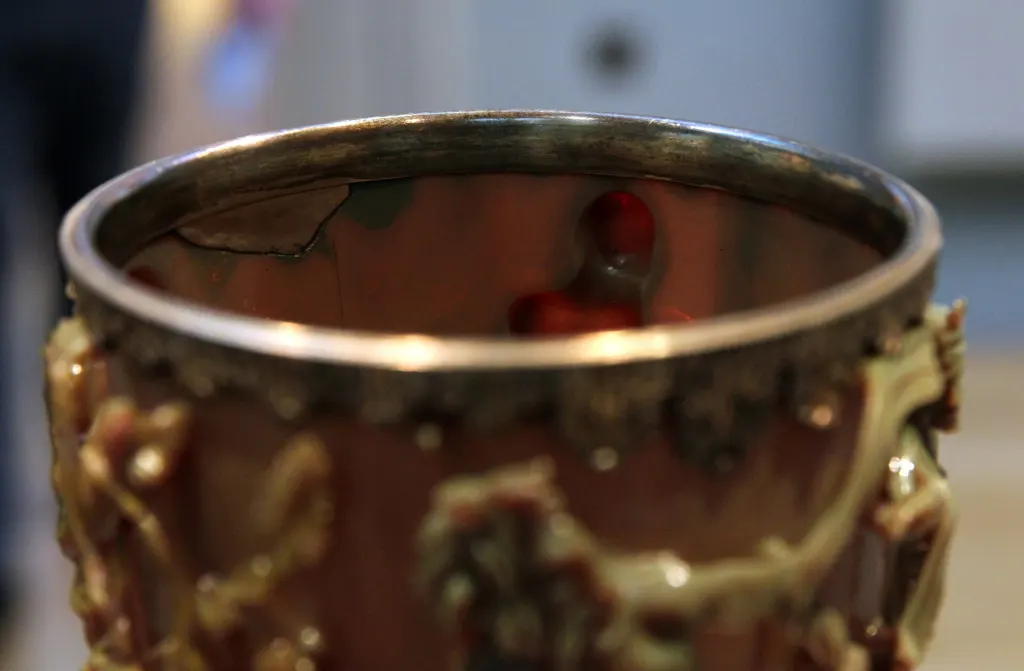
Hold the Lycurgus Cup with a lamp in front of it and the glass looks a dull jade green. Put the lamp behind it and the same 1,700-year-old cup burns ruby red. The Roman drinking vessel, now in the British Museum in London, is the only complete Roman object made from this color-shifting glass that survives.
The trick sits inside the glass itself. Analysis has found traces of silver and gold, estimated at about 330 parts per million of silver and 40 of gold, locked in the glass as particles roughly 70 nanometers across. That is so small that an ordinary microscope cannot see them; researchers needed a transmission electron microscope.
Badiyaa covered the modern side of this story last month, when a Sheffield team grew gold and silver nanocrystals in a glass melt to recreate the Roman effect. This piece looks at the cup itself: who made it, what it shows, and how it reached London.
How green glass turns red
Light hitting the front of the cup bounces off the metal particles, which are just large enough to reflect a greenish glow. Light passing through from behind meets the same particles, and they scatter blue wavelengths more strongly than red ones. What reaches your eye is red. Physicists call the underlying effect surface plasmon resonance, because the particles are close to the size of visible light waves.
Nobody thinks the Roman makers planned this at the nanoscale. The amounts of gold are so tiny that the glassmakers may never have known it was there. One theory is that gold came in with silver, since Roman silver usually carried a little gold; another is that dust or leaf on workshop tools contaminated the batch. The few other surviving scraps of Roman dichroic glass shift between quite different pairs of colors, which suggests the process was never fully controlled.
A king trapped in a vine
The cup is also a cage cup, or diatretum. Craftsmen cut and ground away most of a thick glass blank, leaving figures standing proud of the wall and in places fully undercut. It is the only well-preserved cage cup with human figures rather than a geometric pattern.
The scene comes from Greek myth. King Lycurgus attacks Ambrosia, a follower of the wine god Dionysus; she turns into a vine that wraps around him. On the cup, the naked king struggles in the vine while Dionysus, Pan, a satyr raising a rock and a panther close in. One theory links the scene to Emperor Constantine’s defeat of his co-emperor Licinius in 324. Another ties the green-to-red shift to grapes ripening, a neat fit for a wine god.
Romans did know about cups that changed color. A 4th-century imperial biography quotes a letter credited to Emperor Hadrian: “I have sent you particoloured cups that change colour, presented to me by the priest of a temple.”
A timeline of the cup
- About 290 to 325 AD: the cup is made, perhaps in Alexandria or Rome, possibly by up to three separate workshops.
- About 1800: the gilt-bronze rim and vine-leaf foot are added, hinting it left a church treasury during the French Revolutionary era.
- 1845: first mention in print, by a French writer who saw it with a “M. Dubois”.
- 1857: Lionel de Rothschild owns it.
- 1950: the first full studies confirm it is glass, not a carved gemstone.
- 1958: Victor, Lord Rothschild sells it to the British Museum for 20,000 pounds.
Put those dates together and the cup spent roughly 1,500 years out of the written record before anyone described it. Its fine condition suggests it was never buried, which is why historians think a church kept it safe.
For more ancient objects with surprising second lives, see the Chilean engineer’s Parthenon souvenir that came from an older Acropolis temple, or browse the Badiyaa history section.
The cup is cracked, so the museum has never taken off its metal rim. It stands 15.9 centimeters tall, weighs about 700 grams, and is on show in Room 41, catalogued as 1958,1202.1.
Further reading
Image: Vassil, CC0 via Wikimedia Commons
This article was produced with AI assistance and reviewed by our Editorial Desk. How we work.