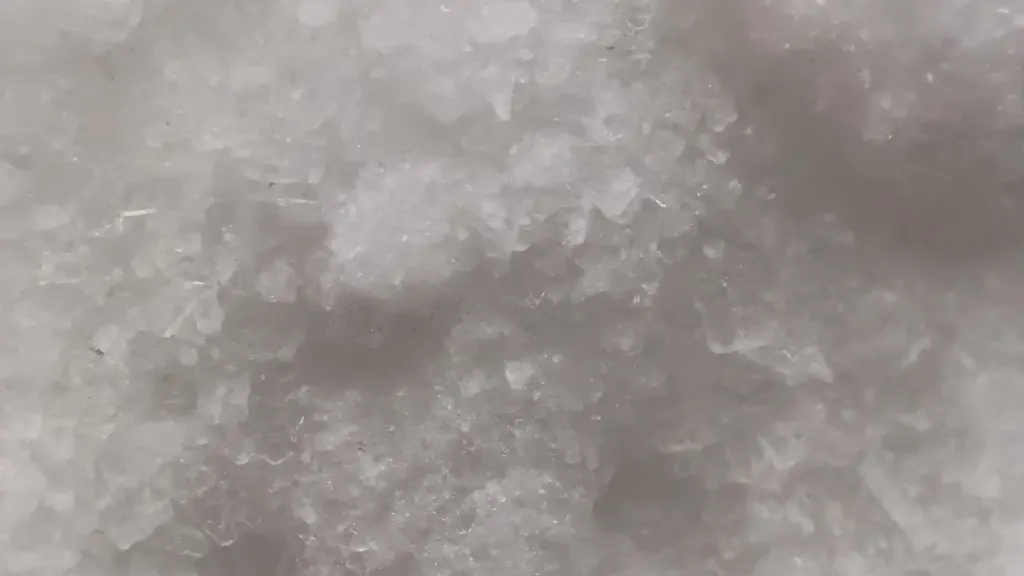
Warm a liter of water to 149°F (65°C) and it will dissolve 548 grams of oxalic acid. Let that same liter cool to room temperature, 68°F (20°C), and it can only hold 95.5 grams. The other 450-odd grams have nowhere to go but out, and they leave as crystals.
That collapse in solubility is the chemistry behind clips of oxalic acid crystals sprouting from a clear liquid, needles and plates appearing as if from nothing.
What oxalic acid is
Oxalic acid is the simplest dicarboxylic acid, a small molecule with two acid groups joined back to back, written H2C2O4. Pure, it is an odorless white crystalline solid that dissolves into a colorless solution. It usually exists as the dihydrate, H2C2O4·2H2O, in which each acid molecule locks two water molecules into the crystal.
The name comes from Oxalis, the wood-sorrel plants from which early chemists first pulled it. Swedish chemists Carl Wilhelm Scheele and Torbern Bergman made it in 1776 by treating sugar with concentrated nitric acid, and in 1824 Friedrich Wöhler produced it from cyanogen and ammonia, a reaction that may be the first lab synthesis of a natural product.
Why crystals appear so suddenly
Oxalic acid’s solubility climbs steeply with heat. Here is how much dissolves in a liter of water at different temperatures:
- 41°F (5°C): 46.9 grams
- 68°F (20°C): 95.5 grams
- 104°F (40°C): 217 grams
- 149°F (65°C): 548 grams
Badiyaa’s calculation: going from 65°C down to 20°C cuts the dissolving capacity by 548 minus 95.5, or 452.5 grams per liter. That is about 83% of the dissolved acid with no room left in the water, so it crystallizes as the liquid cools. Chill it further to 5°C and only 46.9 grams can stay dissolved, roughly one twelfth of the hot-water load.
Oxalic acid also forms solids by reacting. Its oxalate ion grabs metal ions tightly, and some of the products barely dissolve. Lanthanide oxalates, for example, drop out of strongly acidic solutions as dense, easy-to-filter crystals, which is why chemists use oxalic acid to separate those rare earth elements. Calcium oxalate is another famously insoluble product.
Where you meet it
Oxalic acid is common in kitchens and gardens. Rhubarb leaves contain about 0.5%, spinach roughly 0.65% to 1.3% of fresh weight, and parsley 1.70%, according to published food tables. Some plants of the genus Fenestraria even grow optical fibers of crystalline oxalic acid to pipe light down to buried green tissue.
Industry makes about 120,000 metric tons a year. Its main jobs are cleaning and bleaching, especially rust removal, because it binds iron into a water-soluble complex. It is sold as wood bleach, and around a quarter of production goes to dyeing as a mordant.
It is not harmless. The pure acid is classed as corrosive, contact with concentrated forms can burn the skin, and it can be toxic if swallowed in large amounts, so anyone handling the crystals uses gloves and eye protection.
For more everyday science with a strange twist, read our explainer on the Mpemba effect and whether hot water freezes first, or how New Zealand’s Moeraki Boulders grew over millions of years from minerals coming out of solution.
Oxalic acid melts at 101.5°C (214.7°F) as the dihydrate, so a crystal grown in a warm-water demo will survive a hot day without trouble.
Further reading
Image: Amethyst80, CC BY-SA 4.0 via Wikimedia Commons
This article was produced with AI assistance and reviewed by our Editorial Desk. How we work.