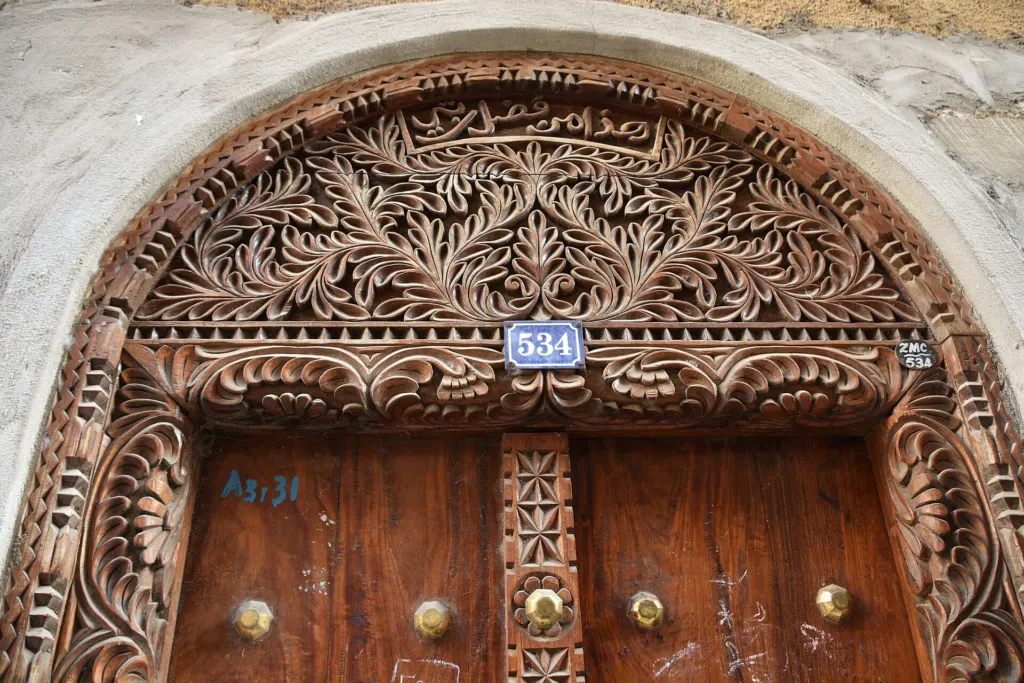
On the Swahili coast of East Africa, the front door was the household’s résumé. Carved lintels often carry an Arabic inscription, a verse from the Qur’an or details about the owner, and the door itself served as a public signal of the family’s standing.
The best-known examples are in Stone Town, the old quarter of Zanzibar City in Tanzania, a UNESCO World Heritage Site since 2000. There the finely carved wooden doors are the single most famous feature of the houses, some of them fitted with big brass studs in an Indian tradition.
Two shapes, two stories
Look at the top of a Stone Town doorway and you can usually place it. Doors in the Indian style have rounded tops; doors in the Omani Arab style are rectangular. Across the wider Swahili coast, rectangular frames with straight lintels are treated as the older local style, while arched lintels became more common in the later 19th century.
A classic Zanzibar door is assembled from seven basic parts, among them a heavy lintel, two massive upright side posts and two door panels, and together they give the doorway its consistent outline. The carvings are often Islamic in content, but other symbols appear too: Indian lotus flowers, for example, stand for prosperity.
Why the coast built this way
The doors belong to a larger building tradition. Swahili stone towns from Lamu, Mombasa and Malindi in Kenya to Kilwa Kisiwani, Songo Mnara and Zanzibar in Tanzania were built from coral limestone, coral rag and mangrove poles. Many of the grandest houses belonged to merchants and landowners who drove the Indian Ocean trade, and the decoration on their facades mixes mainland African forms with influences brought by Arab and Indian traders.
Behind the door, a typical Swahili house turns inward. Rooms are arranged around a private central courtyard, and the entrance porch faces a blank wall so passers-by cannot see in. The carved door is the one place where all that wealth and taste faces the street.
Many Stone Town houses also have a baraza, a long stone bench built along the outside wall, used for sitting and socializing or as a raised sidewalk when heavy rain floods the alleys.
The Somali connection
Further north, Somalia’s coastal cities shared the same coral-stone toolkit. After Islam arrived, builders there shifted from drystone to coral stone, sun-dried brick and limestone, and towns such as Mogadishu, Merca and Barawa grew into multistory stone cities. The Arba’a Rukun mosque, dated 1269 and one of the few early East African mosques with a minaret, frames its narrow doorway with several stepped arches, one inside the other. That layered arch is thought to be possibly the earliest of its kind there, and it later shaped how local mihrabs, or prayer niches, were built.
Badiyaa’s door-spotter’s guide, in short: a rounded top points to Indian-style work, a rectangular frame points to the Omani Arab style or the older Swahili tradition, brass studs point to Indian influence, and an inscribed lintel tells you something about the family inside.
Stone Town has its own place in exploration history, too: David Livingstone stayed there in 1866 while preparing his final expedition, years before the meeting behind the famous line we traced in how “Dr. Livingstone, I presume?” was first printed. More curiosities from around the world are collected on our Offbeat section page.
The doors are not guaranteed to last. Coral stone crumbles easily, and about 80% of Stone Town’s 1,709 buildings are in a deteriorating condition despite a 1994 conservation law. That works out to roughly 1,370 buildings that need repair.
Further reading
Image: Richard Mortel, CC BY 2.0 via Wikimedia Commons
This article was produced with AI assistance and reviewed by our Editorial Desk. How we work.