Some recent measurements say the Milky Way weighs far less than astronomers thought, but a Durham University-led team argues those low numbers are a fitting error. In a study posted to arXiv, the researchers show that a common way of modeling the galaxy’s dark matter can underestimate its total mass by a factor of about 2 on average, and by about 4 for some galaxies.
Correct for that bias, they write, and the low estimates can be reconciled with the long-standing figure of roughly a trillion solar masses.
How do you weigh a galaxy from the inside
Nobody can put the Milky Way on a scale. Astronomers instead watch how fast stars and gas circle the center, then ask how much mass it would take to hold them in orbit. Most of that mass is dark matter, which gives off no light and is thought to form a huge halo around the visible disk.
The catch is reach. The best speed measurements cover the inner galaxy, within about 30 kiloparsecs, or roughly 100,000 light-years, of the center. To get a total mass, researchers fit a mathematical profile to that inner data and extend it outward.
What the Durham team tested
Diego Dado, Shaun T. Brown, Azadeh Fattahi and colleagues at Durham and Liverpool John Moores University used ARTEMIS, a set of simulated Milky Way-like galaxies whose true masses are known. In those simulations, ordinary matter falling inward squeezes the dark matter halo, a process called contraction.
The team then fit the usual profiles only to the inner region, as real observers must. The widely used NFW profile came out low by a factor of about 2 for total mass and for concentration. Two more flexible models, Einasto and generalized NFW, matched the inner data well but carried similar errors when stretched outward. Only a contracted-halo recipe published in 2020 recovered the right mass at all radii.
Adding stars or satellites beyond about 50 kiloparsecs largely removed the bias for every model.
Why the Milky Way’s weight keeps changing
Published estimates have swung widely, and this timeline shows why the question stays open:
- March 2019: about 1.54 trillion solar masses within roughly 130,000 light-years
- 2019: another estimate of 1.29 trillion
- September 2023: about 206 billion, from Gaia data, around a tenth of earlier values
- 2026: the Durham simulations suggest low results like 2023’s come from fitting only the inner galaxy
Laid end to end, the highest and lowest of those figures differ by a factor of about 7.5, a gap far bigger than any real uncertainty in the galaxy’s stars. The mass sets how many satellite galaxies the Milky Way should hold and how it will merge with Andromeda, so the number matters well beyond bookkeeping. Our story on the Hubble census of nearby dwarf galaxies and our report on the Euclid telescope’s earliest quasars show other ways astronomers are measuring galaxies.
Limits
This is a simulation study, not a new weighing, and it assumes perfect data with no observational error. It also finds that halo-to-halo scatter of about 25 percent remains even in ideal conditions, which the authors call a likely floor on how precise any single Milky Way mass can be. The paper had not appeared in a journal as of its arXiv posting.
Further reading
- arXiv: Implications of a contracted dark matter halo for the Milky Way's inferred virial mass
- Wikipedia: Milky Way
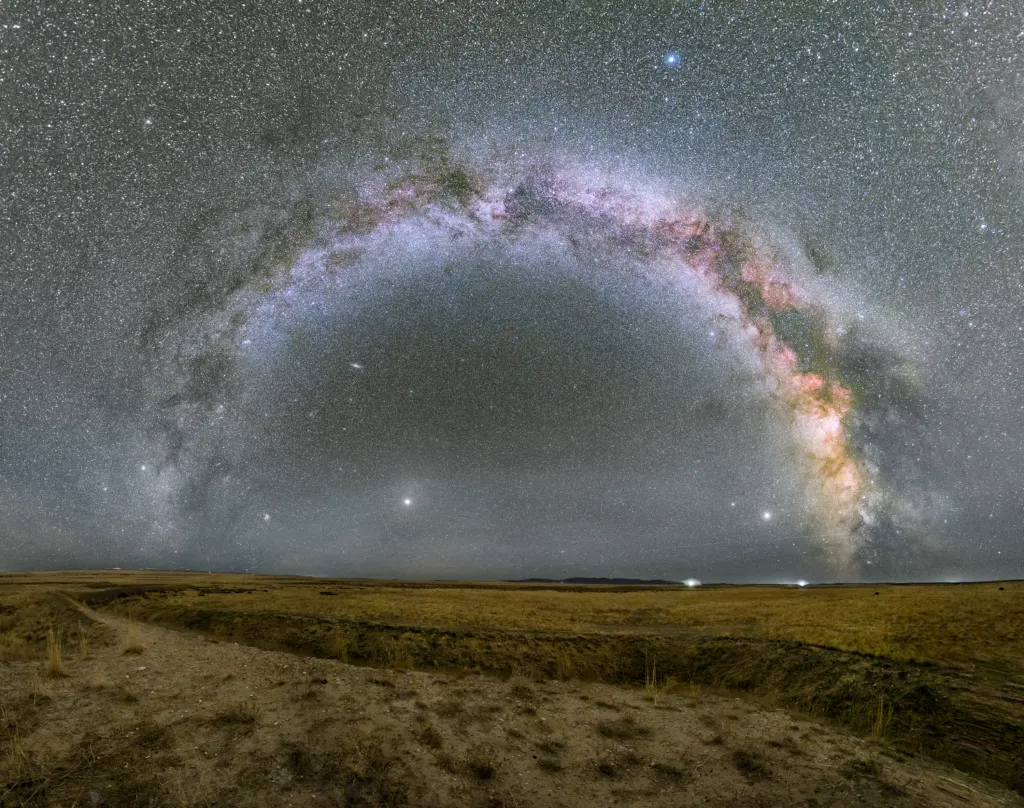
Image: Astrobond, CC BY-SA 4.0 via Wikimedia Commons
This article was produced with AI assistance and reviewed by our Editorial Desk. How we work.