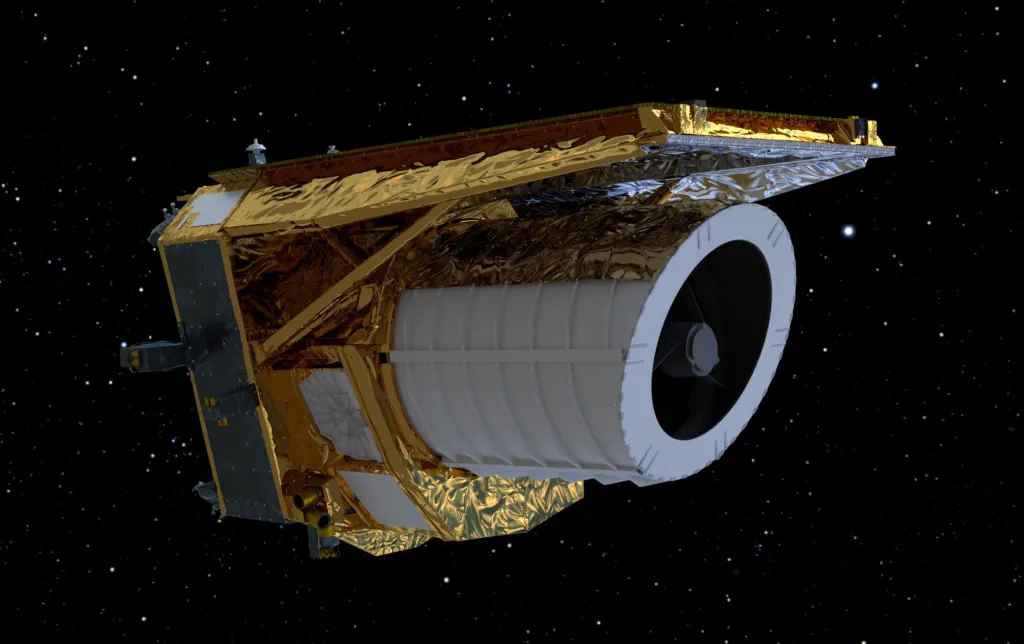
Two quasars spotted by the European Space Agency’s Euclid telescope were already blazing with the light of a trillion suns when the universe was only 670 million years old, about 5% of its present age. They are the earliest quasars anyone has confirmed, and they arrived as part of a haul of 31 newly identified quasars from the cosmic dawn.
The two record holders sit at redshifts of 7.69 and 7.77, which places them just over 13 billion light-years away. Of the 31 objects, 14 have redshifts of 7 or higher. The search results were published in the journal Astronomy & Astrophysics by a team led by Daming Yang, a doctoral student at Leiden University, and the paper is available through its DOI record.
A quasar is a galaxy whose central black hole is feeding so heavily that the infalling gas outshines every star around it. Each of these early examples is powered by a black hole of roughly a billion solar masses, according to Imperial College London.
How Euclid found them
Bright as they are, quasars this old are hard to catch. Expanding space stretches their ultraviolet glow into near-infrared wavelengths, where Earth’s own atmosphere glows and swamps faint signals. They also look almost exactly like ordinary stars in our own galaxy.
“For every one of them there are thousands of stars in our Milky Way and nearby galaxies that look almost identical in the imaging surveys,” Yang said in a University of California, Santa Barbara release.
Euclid, launched in 2023 and parked far above that infrared haze, scans wide strips of sky for its Wide Survey. Machine-learning filters and statistical sorting then cut hundreds of millions of detections down to a short list of candidates, which ground telescopes confirmed. Two-thirds of the new quasars, including the three most distant, were confirmed with the Keck telescopes in Hawaii.
Daniel Mortlock of Imperial, who has co-led Euclid’s quasar work package since 2014, called it “the ultimate ‘needle in a haystack’ problem” and said the best tool turned out to be centuries old: “Bayes’s theorem.”
Why it matters
Here is the scale of the jump. Astronomers spent more than a decade finding the first ten or so quasars at redshift 7 or above; Euclid added 14 more from roughly one year of survey data. That turns a handful of bright oddities into a sample large enough to study as a population.
The puzzle is speed. “Every step further back in time makes the puzzle more perplexing: How did the Universe produce supermassive black holes so quickly?” said co-author Joseph Hennawi of UC Santa Barbara and Leiden.
A follow-up led by Silvia Belladitta of the Max Planck Institute for Astronomy used the NOEMA radio array in the French Alps to study one fainter quasar near redshift 7.7. Its host galaxy is forming more than 250 solar masses of stars a year, against about one for the Milky Way, and weighs around ten billion suns.
Limits
Redshift-based ages depend on the standard cosmological model, and confirmation spectra exist for only part of the wider candidate pool. The Max Planck team also cautions that its host-galaxy result is incremental: a single faint quasar may be growing slowly, or its activity may be hidden behind dust, and the data cannot yet tell which.
Euclid is the same mission whose first look at the dark universe turned three this month, and its survey also feeds work on cosmic expansion such as the model suggesting dark energy switched sign.
The team now has approved James Webb Space Telescope time to weigh these black holes, and it is hunting for the first quasar beyond redshift 8, inside the universe’s first 630 million years. Euclid’s first major data release, DR1, covering almost 2,000 square degrees of sky, is scheduled for November 2026.
Further reading
- Paper: Euclid: Discovery of 31 new quasars at 6.6 < z < 7.8
- UC Santa Barbara: The earliest quasars yet observed
Image: European Space Agency, CC BY 3.0 via Wikimedia Commons
This article was produced with AI assistance and reviewed by our Editorial Desk. How we work.