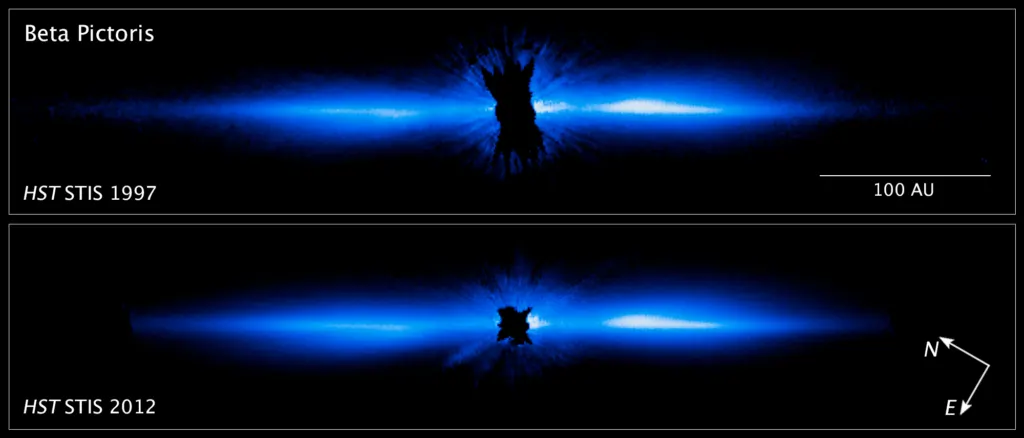
The ice drifting around Beta Pictoris, a 23-million-year-old star 63 light-years away, appears to be older than the star itself. Using the James Webb Space Telescope, a team led by Sarah Betti of the Space Telescope Science Institute in Baltimore found glassy water ice mixed with carbon dioxide ice at a ratio of about 10 to 1, a recipe the researchers say most likely formed in the cold of interstellar space before the star was born.
Less than 7% of the water ice is crystalline. The rest is amorphous, a disordered, glass-like form, according to the team’s published dataset and abstract for the Beta Pictoris ice study.
How Webb read the ice
Beta Pictoris is a classic target. In 1984 it became the first star whose surrounding disk of dust was photographed, and astronomers see that disk almost perfectly edge-on. It is a debris disk: a ring of dust kept topped up as comets and rocky building blocks smash into one another. Three giant planets are known to orbit inside it, according to the reference entry for Beta Pictoris.
The disk reaches far enough from the star that molecules in its outer parts ought to freeze. To check, the team pointed Webb’s NIRSpec instrument at the northeast arm of the disk and recorded starlight reflected by the dust from 1 to 5 microns, a near-infrared range where ices leave telltale dips. The observations ran under Webb program 1563.
The spectrum showed a water ice feature near 3 microns and two versions of carbon dioxide ice: the ordinary form and a rarer one built with the heavier carbon-13 atom. The team then tested mixes of olivine, carbon, crystalline ice, glassy ice and carbon dioxide against the data. The best fit put the carbon dioxide intimately blended into the water ice rather than sitting in separate grains.
Why glassy ice points to an older origin
Water that freezes slowly in relatively mild conditions tends to line up into an orderly crystal. Ice that forms in extreme cold, grain by grain, stays jumbled. Finding mostly glassy ice with carbon dioxide trapped inside fits a birthplace in the dark molecular cloud that gave rise to the star, during an early phase dominated by amorphous water ice. In other words, the ice was likely inherited rather than made in the disk.
Put the numbers side by side. The star is roughly 23 million years old. If the ice formed in the parent cloud, it was already frozen before the star switched on, so every grain in the disk is at least that old and has survived the star’s whole life so far.
That matters for planets. Water-rich worlds need ice delivered to them, and a debris disk is where leftover icy bodies collide. If young systems routinely inherit interstellar ice, the raw material for oceans may be common. Readers who liked Webb’s look at the dusty shell of the Lion Nebula can find more in our space and science section.
Limits
The study measured one arm of one disk, so it cannot say how often inherited ice survives elsewhere. The interstellar origin is an inference from the ice structure and mix, not a dated sample. The team also had to explain why icy grains look evenly spread through the disk; they conclude that frequent collisions must keep stirring and replenishing them.
The reduced spectra and model fits are public on the Dryad archive under a CC0 license, and the raw Webb data sit in the telescope’s archive under proposal 1563, so other groups can test the 10-to-1 ratio for themselves.
Further reading
- Dryad dataset: Carbon dioxide and amorphous water ices in the debris disk around β Pictoris
- Wikipedia: Beta Pictoris
Image: NASA, ESA, Daniel Apai and Glenn Schneider (University of Arizona), Public domain via Wikimedia Commons
This article was produced with AI assistance and reviewed by our Editorial Desk. How we work.