For 130 years, every kilogram on Earth traced back to one small metal cylinder locked in a basement vault outside Paris. Metrologists called it Le Grand K. It was roughly the size of a golf ball, and by the end it seemed to weigh about 50 micrograms less than its own copies, with no one able to say why.
On November 16, 2018, eight years ago this week, delegates at the General Conference on Weights and Measures voted unanimously to retire it. Since May 20, 2019, the kilogram has been defined by a constant of nature instead of an object.
What Le Grand K actually is
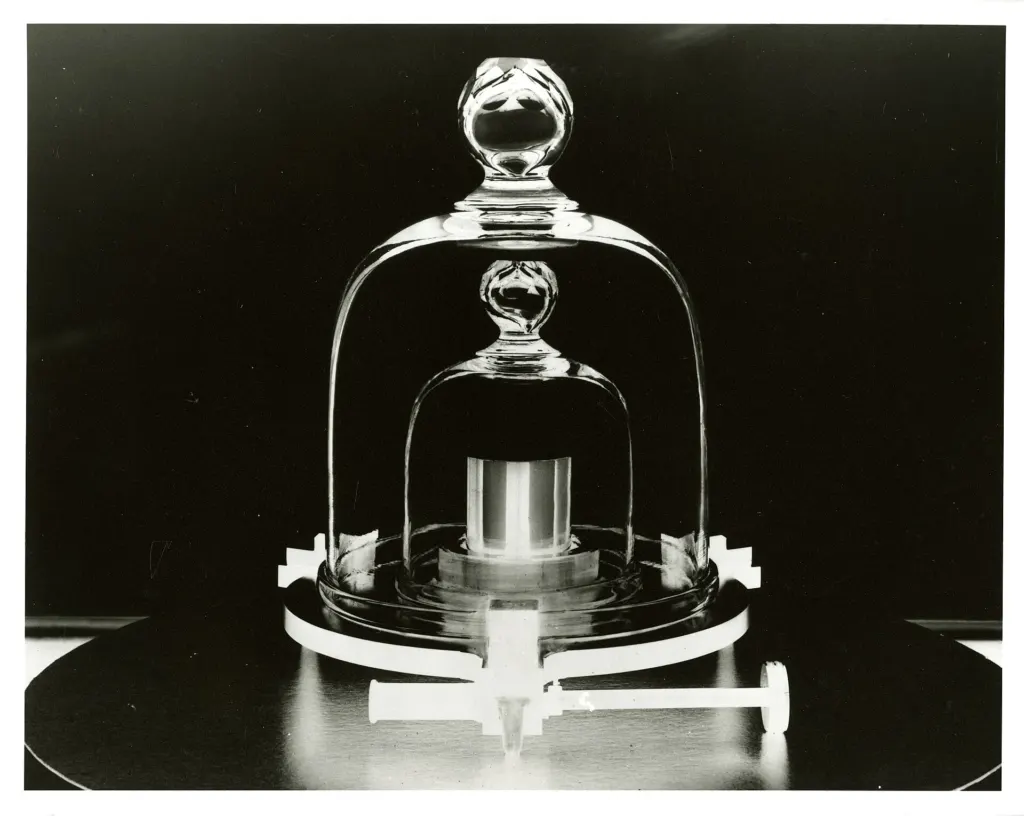
The International Prototype of the Kilogram is an alloy of 90% platinum and 10% iridium, machined into a cylinder whose height equals its diameter, about 39 millimeters. That shape keeps the surface area small, which limits how much grime can settle on it. The iridium makes it far harder than the pure-platinum Kilogramme des Archives it replaced in 1889.
A quick check shows how dense that metal is. A cylinder 39 mm wide and 39 mm tall holds about 46.6 cubic centimeters. Packing 1,000 grams into that space gives roughly 21.5 grams per cubic centimeter, which squares with the alloy being more than 21 times as dense as water. A liter bottle of water weighs the same as Le Grand K but takes up about 21 times the room.
The London metalworking firm Johnson Matthey cast it in 1879 as one of a set of three. It still sits under nested bell jars at the International Bureau of Weights and Measures in Saint-Cloud, on the edge of Paris, alongside six sister copies. Opening that vault takes three separate keys, each held independently.
The kilogram that would not hold still
Countries received official copies to serve as national standards. The US primary standard, K20, is kept at the National Institute of Standards and Technology in Maryland. These were brought back for comparison only rarely. There were just three of these periodic checks, in 1889, 1948 and 1989.
- K20 started 39 micrograms lighter than Le Grand K in 1889, read 19 micrograms light in 1948, then matched its 1889 figure again in 1989.
- K4, a US check standard used far more often, slid from 75 to 116 micrograms under the prototype over 110 years, losing 41 micrograms to wear.
- Le Grand K itself drifted about 50 micrograms against its copies over a century, possibly more.
Fifty micrograms out of a kilogram is 50 parts per billion, far too little to notice on a kitchen scale. It mattered because the kilogram propped up other units. By 2018, the ampere, mole and candela all depended on it, as did the newton, joule, watt and many more. Nobody could tell whether the prototype was losing mass or the copies were gaining it. Every cleaning removed 5 to 60 micrograms of grime, and the objects started picking up dirt again immediately afterward.
What replaced it
The 2019 revision of the SI fixed the Planck constant at exactly 6.62607015 × 10⁻³⁴ joule-seconds. Because a joule-second breaks down into kilograms, meters and seconds, and the meter and second were already tied to light and to cesium atoms, fixing that one number pins the kilogram. Laboratories can now realize it anywhere with a Kibble balance or a near-perfect silicon sphere, without a trip to France.
Mix-ups between units still bite, as the Air Canada 767 that ran out of fuel over a pounds-for-kilograms error showed, and measuring mass gets stranger off Earth, where ISS astronauts are weighed with a spring-loaded arm.
The cylinder still exists, still near Paris, under its bell jars. It is now simply an object whose mass has to be measured, like any other weight.
Further reading
Image: National Institute of Standards and Technology, Public domain via Wikimedia Commons
This article was produced with AI assistance and reviewed by our Editorial Desk. How we work.