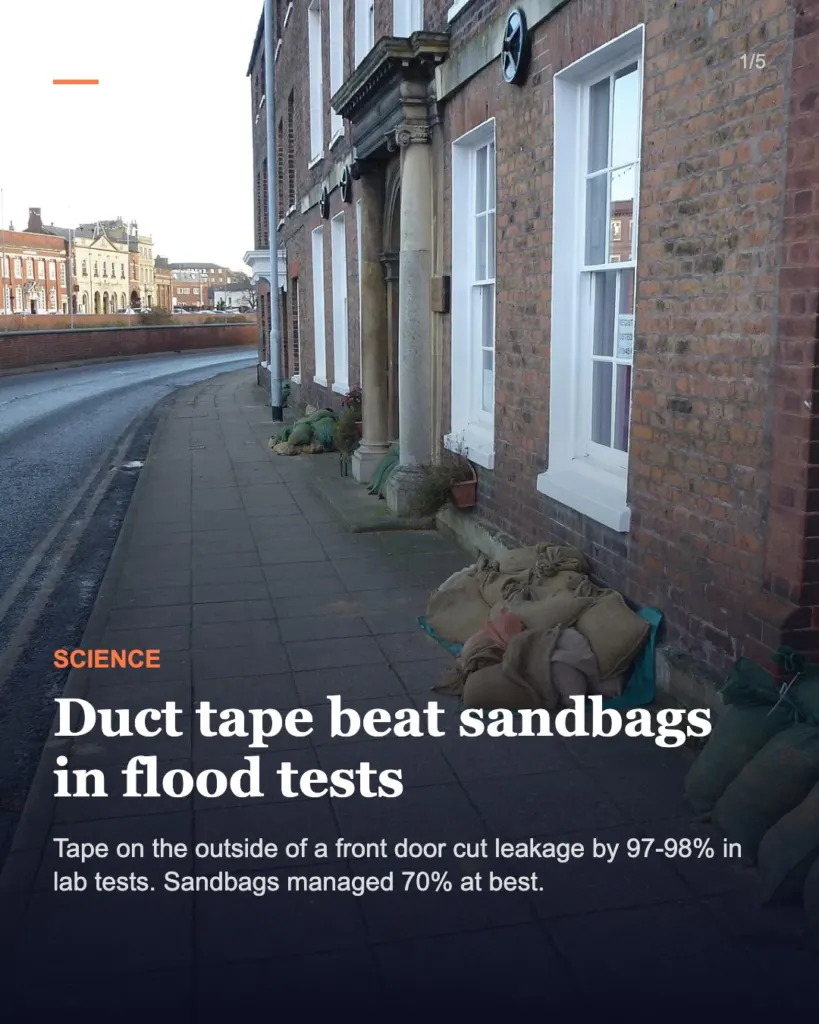
A strip of ordinary duct tape pressed across the outside of a front door cut floodwater leakage by 97 to 98 percent in laboratory tests at the University of Hull in England, while a wall of sandbags managed 70 percent at best. The results, released by the university on October 15 with Flood Re, which commissioned the work, compared low-cost emergency measures that households can keep in a cupboard.
The best performer was a flexible synthetic rubber tape, sometimes sold as flood putty tape, which reduced leakage by 99 percent. Every tape tested, including aluminum tape and yellow plastic tape, did better than sandbags. Even the weakest tape cut leakage by 80 percent.
How researchers flooded six doors to 24 inches
The work was done in the university’s Property Flood Resilience laboratory, known as PFRlab, by a team of seven led by water scientist Stuart McLelland. Their findings are set out in a technical report, “Testing the Performance of Low-cost, Temporary Property Flood Resilience (PFR) Solutions”, deposited in an open research repository in October 2026.
Trade fitters installed six common types of front door, among them wooden, uPVC (rigid plastic) and composite models. The team then raised the water outside in 2-inch (5 cm) steps up to about 24 inches (60 cm), collecting whatever came through in a sealed chamber behind each door and pumping it out to log the leak rate continuously. That depth was chosen to mimic the shallow flooding that hit Hull in 2007, when more than 8,600 homes and 1,300 businesses were damaged.
For the sandbag runs, the researchers stacked 54 bags with plastic sheeting between the bags and the door. One person applied all the tape, to keep technique consistent, and each door took about 10 to 20 minutes to seal. Commercial flood barriers were also tested; their results ranged from complete protection to outright failure, depending on how well they fitted and how skilled the installer was.
One finding needed no products at all. A standard outward-opening door leaked 74 percent less than an inward-opening one before any protection was added. Tape on the outside also worked far better than tape on the inside.
What 97 percent means in gallons at the door
McLelland writes that unprotected doors often let through thousands of liters an hour at full test depth. Take 2,000 liters (about 528 gallons) an hour as a conservative example. Duct tape at 97 to 98 percent would leave roughly 40 to 60 liters (about 11 to 16 gallons) an hour. Sandbags at their 70 percent best would leave about 600 liters (about 159 gallons) an hour. Over a six-hour flood, that works out to about 63 to 95 gallons indoors with tape against about 951 gallons with sandbags.
In that example, sandbags let in 10 to 15 times as much water as tape. The Environment Agency, which manages flood risk in England, estimates that 4.6 million people there are at risk of surface water flooding, the shallow kind these tests were built to imitate.
“Sandbags remain a symbol of flood protection, but these tests turn that assumption on its head,” said Jonathan Kassian, head of flood resilience at Flood Re.
Limits: one lab, one funder, no real flood yet
This is a single set of laboratory tests, not a field trial. The doors were modern models fitted by professionals, one person applied every strip of tape, and the water rose in controlled steps. McLelland himself notes that results will depend on the state of the door and frame, the surface the tape sticks to and the quality of the seal. Real floods bring debris, moving water and rain, and they can enter through walls, floors and drains that no tape will cover.
The study was commissioned and funded by Flood Re. It is a commissioned technical report rather than a peer-reviewed journal paper, and McLelland sits on industry and government groups working on property flood resilience. None of that undoes the measurements, but it is one team’s results on six doors, and repeat tests by other labs would make the case stronger.
The researchers are also clear that tape does not replace proper flood doors or barriers where homes face serious risk. In McLelland’s words: “A £10 roll of duct tape cannot stop a flood.”
What to keep in a flood kit
The release singles out high-quality, wide duct tape as the best mix of performance, price and ease of use. If you live somewhere that floods:
- Keep at least one roll of wide duct tape with your flood supplies, and plan on 10 to 20 minutes per door.
- Apply it to the outside of the door, sealing the gaps between door and frame.
- Sign up for flood warnings and plan in advance how you will protect valuables, move vehicles and shut off utilities.
The PFRlab results will feed into Flood Performance Certificates, which Flood Re and the university are developing to rate homes on flood risk and the steps that reduce it.
Further reading
- University of Hull: Forget sandbags, tape can keep out 99% of flood water
- Report: Testing the Performance of Low-cost, Temporary Property Flood Resilience (PFR) Solutions
Image: Richard Humphrey, CC BY-SA 2.0 via Wikimedia Commons
This article was produced with AI assistance and reviewed by our Editorial Desk. How we work.
Spot an error? Help verify this story
The story in 5 slides