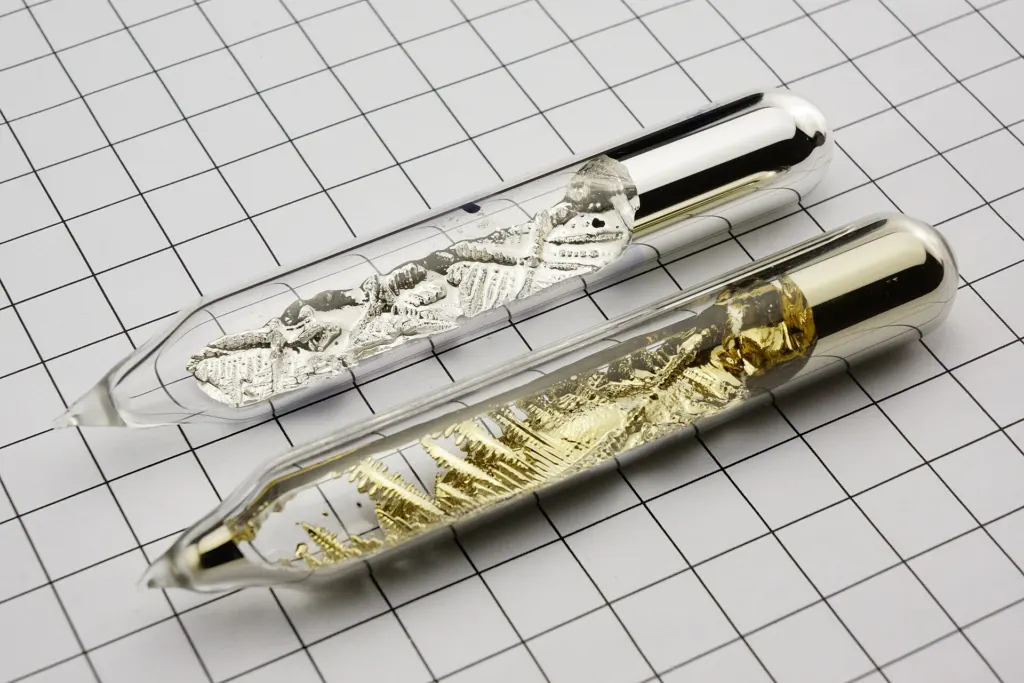
The first chemical element ever identified with a spectroscope turned up in spa water. In 1860, Robert Bunsen and Gustav Kirchhoff spotted two bright blue lines in the light from mineral water taken at Dürkheim, Germany, and named the unknown metal cesium, from the Latin caesius, “bluish gray.” A year later the same pair found rubidium in a mineral called lepidolite, this time flagged by deep red lines.
Neither discovery needed a pure sample first. That was the point of the instrument the two men had built at Heidelberg only a year earlier.
How flame spectroscopy caught them
Every element heated in a flame gives off light at its own set of wavelengths. Pass that light through a prism and it splits into thin colored lines, a fingerprint that no other element shares. Bunsen, a chemist, and Kirchhoff, a physicist, used this to scan salts and waters for lines that matched nothing known. When the Dürkheim residue showed blue lines in an unfamiliar place, they had a new element before they had a single grain of it.
Rubidium took the same route. Its name comes from rubidus, Latin for “deep red,” the color of its strongest lines. It was the second element found this way, only months after cesium.
44,000 liters for a few grams
Proving the elements were real meant pulling their salts out by hand. The pair evaporated about 44,000 liters of mineral water down to 240 kilograms of concentrated salt solution, then stripped out the other metals step by step with sulfates, oxalates, ethanol and chloroplatinic acid. The haul at the end was 7.3 grams of cesium chloride and 9.2 grams of rubidium chloride.
Put another way, every gram of cesium chloride cost them roughly 6,000 liters of water (44,000 divided by 7.3 is about 6,030). For rubidium they also worked through 150 kilograms of lepidolite that held only 0.24% rubidium oxide, which yielded 0.51 grams of rubidium chloride.
The metals themselves were harder still. When the two tried to split molten cesium chloride with electricity, they got a blue substance that, in their words, “neither under the naked eye nor under the microscope showed the slightest trace of metallic substance.” The same thing happened with rubidium. Bunsen later got rubidium metal by heating charred rubidium tartrate, and his measured density and melting point came within 0.1 g/cm³ and 1 °C of modern values. Pure cesium metal waited until 1882, when Carl Setterberg, a student working with Bunsen, electrolyzed cesium cyanide instead.
Why two obscure metals still matter
Both elements now keep the world’s time. Since 1967 the second has been defined by a microwave transition in cesium-133 atoms, ticking 9,192,631,770 times per second, and cesium clocks pace cell phone networks and the internet. Rubidium oscillators serve as cheaper frequency standards in cell towers and test gear, and rubidium-87 was the atom used for the Bose–Einstein condensate that earned the 2001 Nobel Prize in Physics.
The method mattered as much as the metals. Spectroscopy later let astronomers read the chemistry of stars from their light, the same kind of light-based detective work behind a recent Hubble census of oxygen in nearby dwarf galaxies. Element hunting has moved on to particle accelerators, as in the story of Oak Ridge chemist Clarice Phelps and element 117, and metals research continues in labs like the one that recently managed room-temperature recrystallization of molybdenum.
A quick timeline
- 1859: Bunsen and Kirchhoff build their spectroscope in Heidelberg.
- 1860: Blue lines in Dürkheim mineral water reveal cesium.
- 1861: Red lines in lepidolite reveal rubidium.
- 1882: Carl Setterberg isolates cesium metal from cesium cyanide.
- 1967: The second is redefined using cesium-133.
Today the richest known cesium deposit is the Tanco Mine at Bernic Lake in Manitoba, Canada, holding an estimated 350,000 metric tons of pollucite ore, more than two-thirds of the world’s reserve base.
Further reading
Image: ErpingWu, CC BY-SA 4.0 via Wikimedia Commons
This article was produced with AI assistance and reviewed by our Editorial Desk. How we work.