The ten-word slogan “Be the change you wish to see in the world,” does not appear anywhere in Gandhi’s Collected Works. What he did write, in his South African weekly Indian Opinion on August 9, 1913, is longer, stranger and in some ways more useful.
What Gandhi actually wrote
The passage opens with an image of reflection:
“We but mirror the world. All the tendencies present in the outer world are to be found in the world of our body.”
Then comes the sentence the slogan was boiled down from: “If we could change ourselves, the tendencies in the world would also change.” He follows it with a claim about how other people respond to us: “As a man changes his own nature, so does the attitude of the world change towards him.” He calls this “the divine mystery supreme” and adds, “A wonderful thing it is and the source of our happiness.” The last line is the practical one: “We need not wait to see what others do.”
The setting matters. Gandhi was not writing a motivational aphorism. He was arguing that inner purity shapes the outer world, and his example was the ascetic who lives unharmed among wild animals. It is a spiritual argument with a physical illustration, written for readers of a campaigning paper.
Where he was in 1913
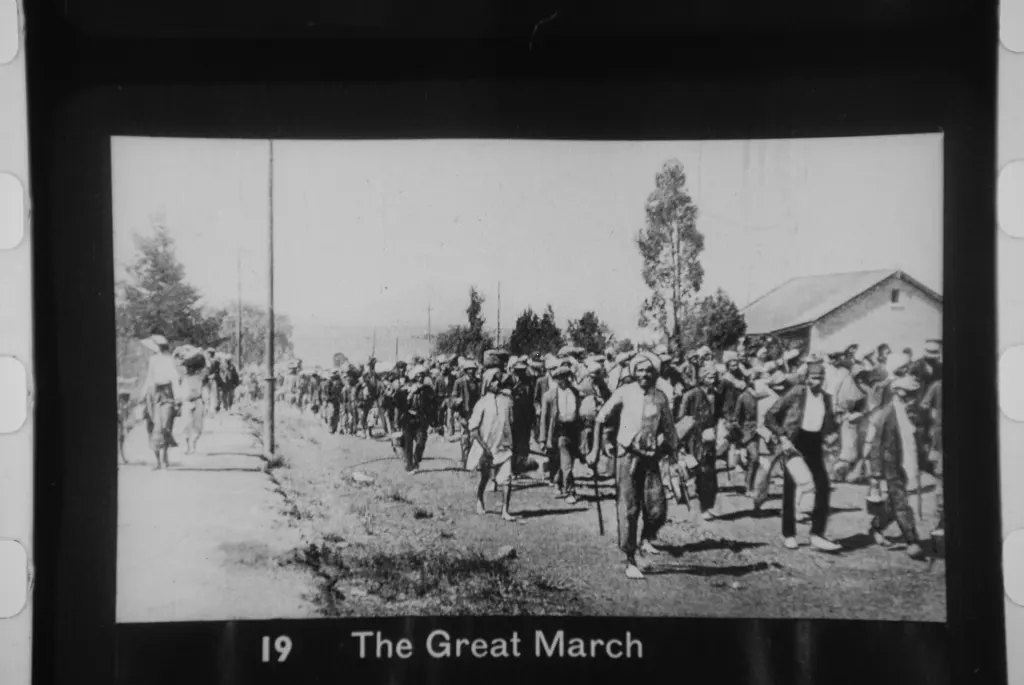
Gandhi, born in Porbandar on October 2, 1869, had sailed for South Africa in April 1893 and stayed 21 years. He started Indian Opinion in 1903, printed it in Gujarati, Hindi, Tamil and English, and in 1904 moved its press to the Phoenix Settlement outside Durban. By 1913 the paper had spent seven years urging Indians to defy the Transvaal pass laws, the satyagraha campaign that ran from 1906 to 1913. Gandhi later said satyagraha “would have been impossible without Indian Opinion.” He went back to India in 1915.
So the man writing about changing yourself first was 43, in the closing year of the 1906 to 1913 campaign, and he was not asking anyone to wait for permission.
Where the short version came from
The earliest known form of the modern slogan is not Gandhi’s at all. Arleen Lorrance, a teacher at Thomas Jefferson High School in Brooklyn, wrote it into a 1970 report on “The Love Project,” her effort to turn around a school struggling with poverty and violence. Her report, reprinted on page 85 of Richard D. Kellough’s 1974 book Developing Priorities and a Style, says: “One way to start a preventative program is to be the change you wish to see happen.”
From there the wording tightened and Gandhi’s name attached itself. Quote collections now list the line as disputed, calling it “a modern condensation of his ideas” that surfaces from the 1970s onward. The writer Brian Morton took on misattributions of this kind in an essay titled “Falser words were never spoken.”
The common mistake
The popular variant “You must be the change you wish to see in the world” turns the idea into an order. Gandhi’s own text runs the other way. It describes a mechanism (change yourself and others respond to you differently) and then removes an excuse: you do not need to wait for anyone else. That is a permission, not a command.
A quick check of the gap, by our count: Lorrance’s report came 57 years after the Indian Opinion article (1970 minus 1913) and 22 years after Gandhi’s death in Delhi on January 30, 1948 (1970 minus 1948). The slogan itself has been in circulation for more than half a century: 2026 minus 1970 is 56 years.
If you want to cite Gandhi accurately, quote the 1913 sentence about changing ourselves and give the date and the paper. Different editions of the Collected Works number the volume differently, so the date, August 9, 1913, is the reliable reference point. And if you need a short line for a poster, Gandhi already supplied one, nine words long: “We need not wait to see what others do.”
Further reading
Image: Unknown photographer, public domain via Wikimedia Commons
This article was produced with AI assistance and reviewed by our Editorial Desk. How we work.