“Power concedes nothing without a demand. It never did and it never will.” Frederick Douglass spoke those two sentences in Canandaigua, New York, on August 3, 1857, a few lines after the better-known “If there is no struggle there is no progress.” Poster versions usually stop there. The printed speech keeps going, and what follows is far sharper than the version shared online.
Badiyaa traced where the struggle line was first spoken in our earlier piece on the Canandaigua speech. This time the focus is the passage around it, read word for word in the text of West India Emancipation on Wikisource, which reproduces the pamphlet Two Speeches by Frederick Douglass, printed in Rochester in 1857.
What the occasion was
The crowd at the Ontario County fairgrounds had come for West Indies Emancipation Day. Douglass called it the 23rd anniversary of freedom becoming “the ruling law of the British West Indies.” The date marked August 1, 1834, when Britain’s Slavery Abolition Act of 1833 came into force across its colonies. Douglass put the number freed at “eight hundred thousand,” the same order of figure later counted in compensation claims.
His listeners lived in a country where slavery was still legal, so the British anniversary doubled as a rebuke. He reminded them that ten years earlier he had addressed a similar gathering in the same town, and that since then the Fugitive Slave Act had passed.
The full passage, in order
Douglass introduced the section as “a word of the philosophy of reform.” The quotable lines arrive in this sequence:
- “If there is no struggle there is no progress.”
- Those who favor freedom but dislike agitation “want crops without plowing up the ground.”
- “Power concedes nothing without a demand. It never did and it never will.”
- “The limits of tyrants are prescribed by the endurance of those whom they oppress.”
Between the third and fourth lines sits the sentence that does the real work: “Find out just what any people will quietly submit to and you have found out the exact measure of injustice and wrong which will be imposed upon them.” Douglass added that such wrongs last until people resist “with either words or blows, or with both.”
What posters leave out
The shared versions are gentler than the original. Right after the passage, Douglass named people who had resisted slave catchers by force, including the band at Christiana, Pennsylvania, whom he credited with the first successful resistance to the Fugitive Slave Bill. He told the crowd that freedom would be paid for “by labor, by suffering, by sacrifice.” Read in sequence, the famous lines are not a general motto about effort. They are an argument, made on a holiday celebrating British abolition, that Americans held in slavery would not be freed by waiting.
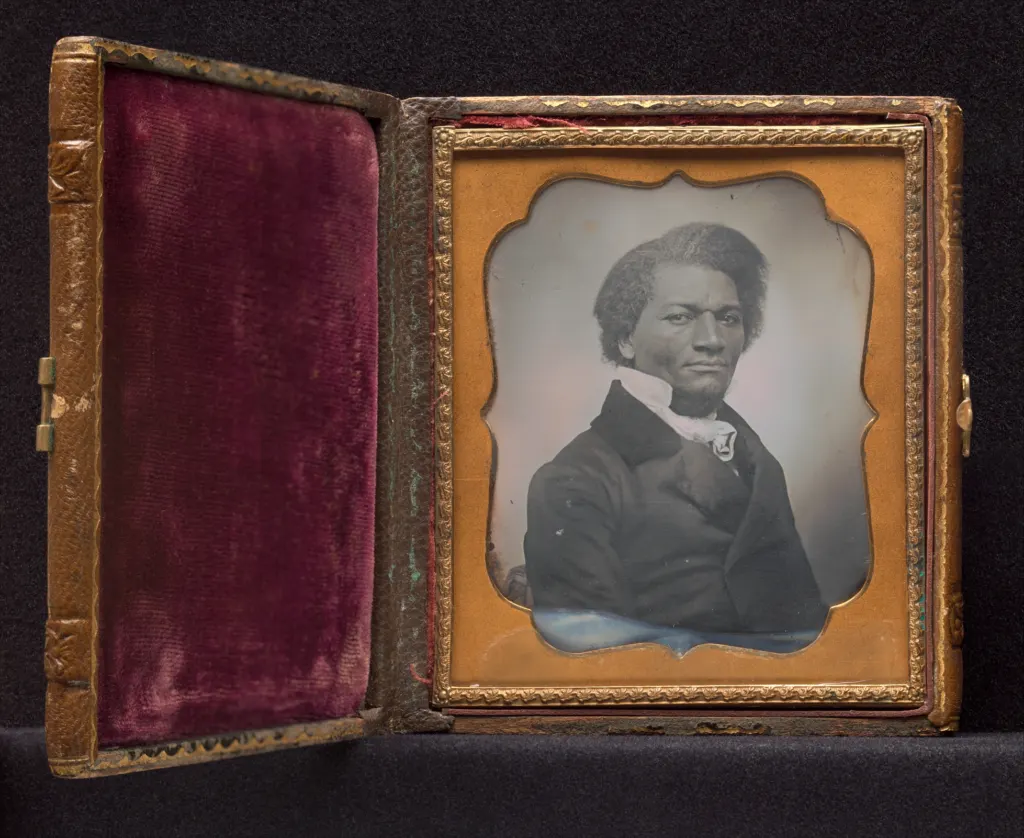
That context fits the man. By 1857 Douglass had escaped slavery in Maryland, published his own newspaper, the North Star, and become, in the words of his Wikipedia biography, the most important leader of the 19th-century movement for African-American civil rights.
Badiyaa has also traced how Booker T. Washington’s “Cast down your bucket” line and Martin Luther King Jr.’s “Injustice anywhere” sentence read inside their original texts.
Douglass ended the speech by saying he had “more than filled up the measure” of his time. The pamphlet that preserved it was printed by C. P. Dewey in Rochester, the city where Douglass is buried.
Sources
- West India Emancipation (1857 speech text), Wikisource, 1857
- Slavery Abolition Act 1833, Wikipedia, 2026
- Frederick Douglass, Wikipedia, 2026
Image: Unknown photographer (The Metropolitan Museum of Art), CC0 via Wikimedia Commons
This article was produced with AI assistance and reviewed by our Editorial Desk. How we work.