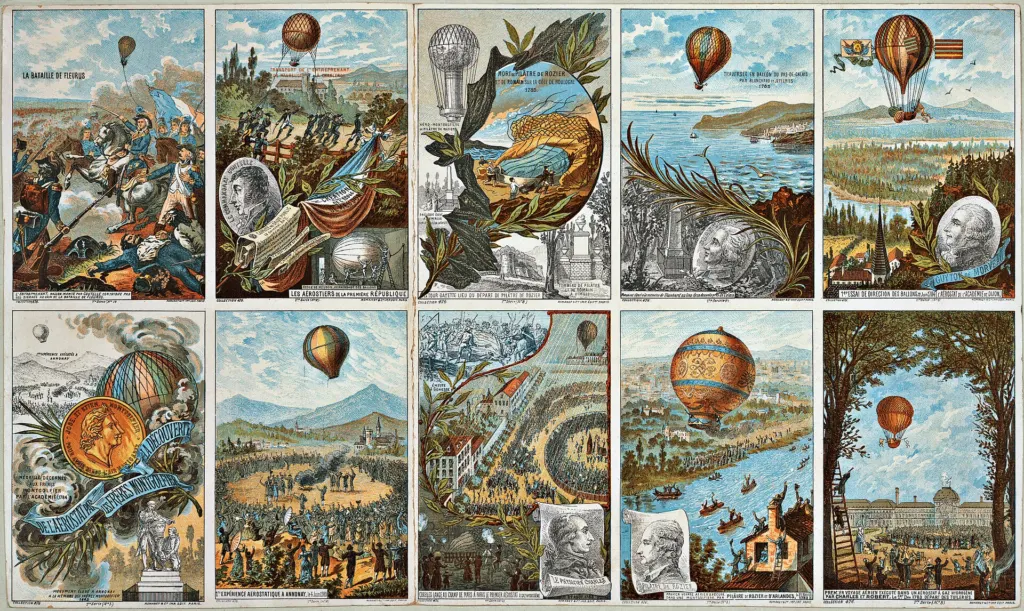
The first people ever to fly were supposed to be two condemned prisoners. King Louis XVI had decided that convicts should test the Montgolfier brothers’ hot air balloon, until a 29-year-old science teacher argued that the honor belonged to someone of higher rank. On November 21, 1783, that teacher, Jean-François Pilâtre de Rozier, and an army officer, the marquis François Laurent d’Arlandes, drifted over Paris for 25 minutes in the first crewed free flight in history.
Saturday marks 243 years since the flight, which Wikipedia’s hot air balloon history describes as the debut of the first successful technology to carry humans into the air.
A paper family’s sky-blue machine
Joseph-Michel and Jacques-Étienne Montgolfier ran a paper business in Annonay, in southern France. According to the brothers’ biography on Wikipedia, Joseph began experimenting in November 1782 after noticing how rising heat lifted embers from a fire. By June 1783 the brothers were flying unmanned balloons in public.
That September, a balloon carried a sheep named Montauciel (“Climb-to-the-sky”), a duck and a rooster for about eight minutes above the palace of Versailles. The animals came down safely, and the king allowed human flights.
The craft built for them held about 1,700 cubic meters of air and stood roughly 23 meters (75 feet) tall, decorated in gold on deep blue with zodiac signs and suns bearing the king’s face. On or around October 15, Étienne Montgolfier and then Pilâtre de Rozier made short tethered hops in it.
Who argued his way into the basket
Pilâtre de Rozier’s biography says the king’s first plan was to send two condemned criminals. Pilâtre, a chemistry and physics teacher from Metz, recruited the Duchess de Polignac to make his case that the first balloonists should be of higher status, and d’Arlandes agreed to go with him.
Twenty-five minutes over Paris
They lifted off from the garden of the Château de la Muette, beside the Bois de Boulogne on the western edge of Paris. D’Arlandes’ biography puts takeoff at 1:54 p.m., with the king and the American envoy Benjamin Franklin among the onlookers.
The balloon climbed to about 3,000 feet and traveled roughly 9 kilometers (5.5 miles) to the southeast. It was not a calm ride. Burning embers from the onboard fire singed the fabric and had to be dabbed out with sponges. They came down at the Butte-aux-Cailles, then outside the city walls, with enough fuel left to have gone four or five times as far. Afterward, the pilots celebrated with champagne, a custom balloonists still keep.
The flight in numbers
- Takeoff: 1:54 p.m., November 21, 1783
- Time aloft: about 25 minutes
- Height: about 3,000 feet
- Distance: roughly 9 kilometers
- Balloon volume: about 1,700 cubic meters
That works out to an average ground speed of about 22 kilometers per hour (9 km in 25 minutes), slower than a city bus.
Within weeks, Paris was hooked. Rival hydrogen balloons rose that December, and ballooning images turned up on fans, furniture and handkerchiefs. A century later, French printers were still selling souvenir cards of the flight, like an 1890s sheet held by the Library of Congress.
Pilâtre de Rozier did not see that boom last long. He was killed on June 15, 1785, when his hybrid balloon caught fire during an attempt to cross the English Channel, and the hydrogen-and-hot-air design is still called the Rozière balloon.
For what Paris flew next, read how the La France airship made the first fully controlled round trip in 1884, or how 1920s balloon jumpers bounced across fields under half-buoyant gas bags.
Sources
- Montgolfier brothers, Wikipedia, 2026
- Jean-François Pilâtre de Rozier, Wikipedia, 2026
- François Laurent d’Arlandes, Wikipedia, 2026
- Hot air balloon, Wikipedia, 2026
- Collecting cards of early ballooning history (Library of Congress print, 1890s), Wikimedia Commons, from the Library of Congress Prints and Photographs Division, 1890–1900
Image: Romanet & Cie., Paris (Library of Congress), Public domain via Wikimedia Commons
This article was produced with AI assistance and reviewed by our Editorial Desk. How we work.