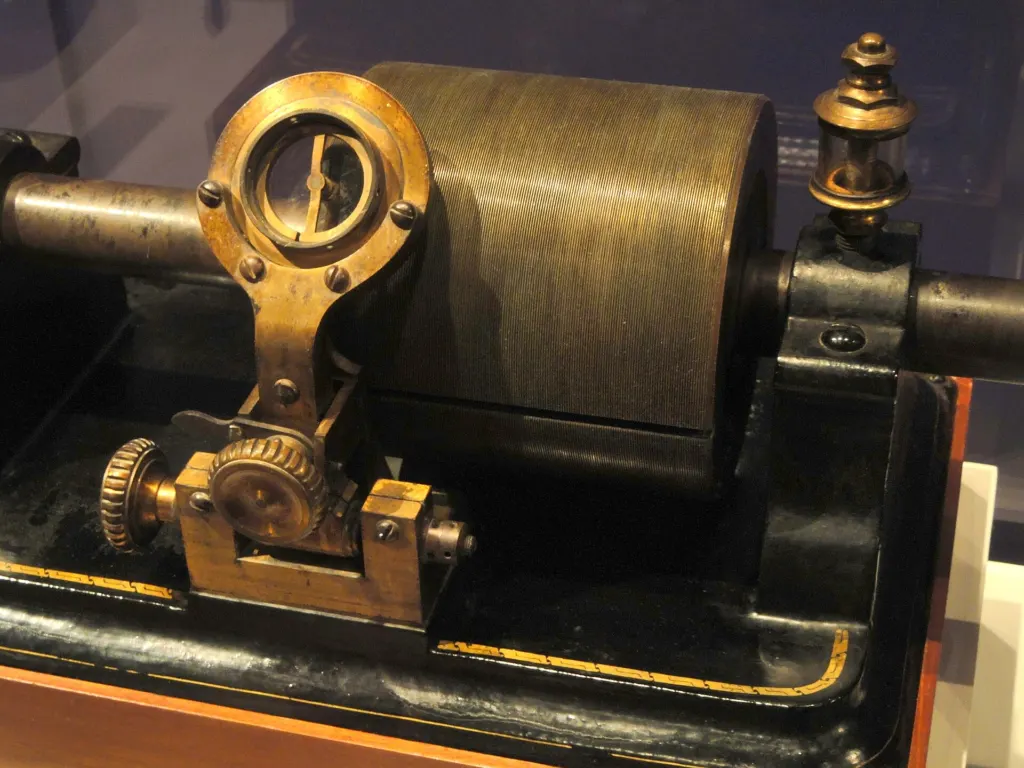
The first words Thomas Edison ever played back from a recording came out as “ary ad elll am.” That garbled scrap of “Mary had a little lamb,” pulled off a strip of waxed paper in his Menlo Park, New Jersey, lab in 1877, was the seed of the phonograph, the invention Edison announced to the world on November 21, 1877, according to Wikipedia’s history of the phonograph.
The clip of Edison reciting the nursery rhyme that circulates online today is not that recording. It is a reenactment he staged in 1927 for the phonograph’s 50th anniversary. The original tinfoil was never preserved.
It started with the telephone
Edison was not trying to build a music machine. The National Park Service’s Edison history explains that he was chasing improvements to Alexander Graham Bell’s telephone and wanted a way to store spoken messages the way telegraph offices stored dots and dashes on paper tape. In July 1877 he wrote that he was sure he could “store up and reproduce automatically at any future time the human voice perfectly.”
His chief assistant, Charles Batchelor, later described the night it first worked. Edison talked into a diaphragm fitted with a needle while Batchelor dragged waxed paper beneath it. Edison used “one of our favorite stereotyped sentences used in experimenting on the telephone”: “Mary had a little lamb.” On the second pass, the paper talked back. “Something that was not fine talking, but the shape of it was there,” Batchelor recalled.
The tinfoil machine
That strip device stayed in the lab, and no example survives. The machine most people picture came months later. In late November, sketches were drawn for a cylinder wrapped in tinfoil, and the mechanic John Kruesi built it. When Edison tried it, by his own account in the park’s timeline of his path to the phonograph, “I shouted ‘Mary had a little lamb,’ and the machine reproduced it perfectly. I was never so taken aback in my life.”
On December 7, Edison, Batchelor and Edward Johnson walked unannounced into a New York editorial office, set the machine on a desk and turned the crank. It asked about everyone’s health and bid them good night.
The legal paperwork followed fast. Edison’s patent, No. 200,521, was filed on December 24, 1877, and granted on February 19, 1878. It describes a cylinder cut with “ten grooves to the inch,” covered preferably with metallic foil, and states the goal plainly: “to record in permanent characters the human voice and other sounds.”
Why a nursery rhyme
The verse itself was barely 47 years old at the time. The rhyme’s history traces it to the American writer Sarah Josepha Hale, who published it in Boston on May 24, 1830. Its short, punchy syllables made it a handy test phrase, and it became the first recorded English verse.
It was not the first recorded sound, though. In Paris, Édouard-Léon Scott de Martinville traced “Au clair de la lune” onto soot-blackened paper with his phonautograph in 1860. His machine could only draw sound, not replay it; those tracings were first turned back into audio in 2008. Edison was likely unaware of his work.
A timeline of 1877
- July: waxed-paper strip test plays back “ary ad elll am”
- November 21: Edison announces the phonograph
- Late November: Kruesi builds the tinfoil cylinder machine
- December 7: first demonstration outside the lab, in New York
- December 24: patent application filed
Edison’s reputation is full of stories that need checking. Badiyaa has traced how his “10,000 ways that won’t work” line began with a 1910 battery story, and how inventor Lewis Latimer’s 1882 filament patent fits into the light bulb race.
From the lab test in July to the patent grant in February, the whole journey took about seven months.
Sources
- Phonograph, Wikipedia, 2026
- Origins of Sound Recording: Thomas Edison, Thomas Edison National Historical Park, U.S. National Park Service, 2017
- Origins of Sound Recording: Edison’s Path to the Phonograph, Thomas Edison National Historical Park, U.S. National Park Service, 2017
- US Patent 200,521: Improvement in Phonograph or Speaking Machines, U.S. Patent Office record via Google Patents, 1878
- Mary Had a Little Lamb, Wikipedia, 2026
- Phonautograph, Wikipedia, 2026
Image: Daderot, CC0 via Wikimedia Commons
This article was produced with AI assistance and reviewed by our Editorial Desk. How we work.