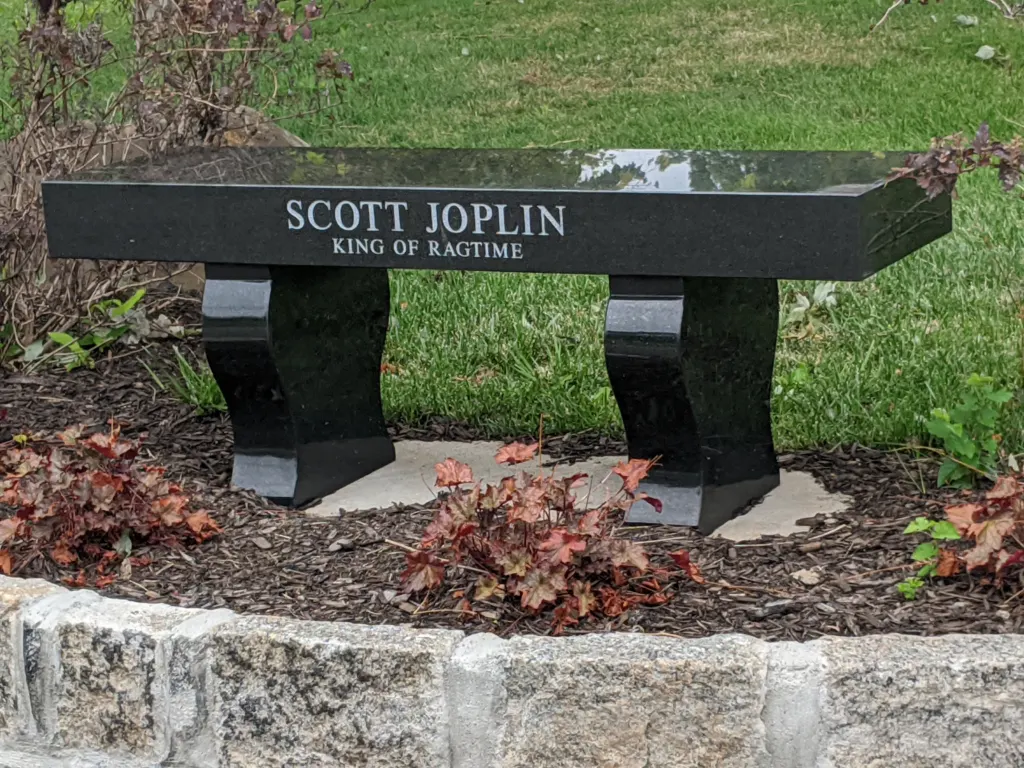
The man who wrote “The Entertainer” lay in an unmarked pauper’s grave in New York for 57 years. Scott Joplin, the “King of Ragtime,” died in 1917, and his resting place at St. Michael’s Cemetery in East Elmhurst, Queens, only got a marker in 1974, the same year a Hollywood caper film turned his 1902 rag into a hit, according to Wikipedia’s biography of Joplin.
His traditional birthday falls next Tuesday, November 24. Early biographers gave the date as November 24, 1868, though the later biographer Edward A. Berlin found he was more likely born between June 1867 and mid-January 1868, somewhere in northeast Texas.
A rag written for a mandolin club
Joplin was the son of Giles Joplin, a formerly enslaved man from North Carolina, and Florence Givens, a freeborn woman from Kentucky. By 1901 he had moved to St. Louis, where he wrote some of his best-known pieces. Missouri State Parks now runs the modest Delmar Boulevard flat where he rented a room in 1902 as a historic site, with a player piano filling it with his music.
That year, the St. Louis publisher John Stark & Son put out “The Entertainer,” subtitled “A Rag Time Two Step.” The rag’s history notes it was dedicated to “James Brown and his Mandolin Club,” that its copyright was registered on December 29, 1902, and that the first recording did not come until 1928, by a duo playing mandolin and guitar.
Joplin wanted more. He saw ragtime as classical music for concert halls and poured his savings into an opera, Treemonisha, about a young freedwoman who leads her community through education. He self-published the score in 1911, but the opera was never fully staged in his lifetime. A single read-through in Harlem in 1915, with Joplin alone at the piano, failed to win backers.
How a film brought him back
Joplin died in New York on April 1, 1917, at 48. His music faded with ragtime itself, until a scholarly revival took hold around 1970. A million-selling album of his piano rags appeared that November, and the New York Public Library published his collected works in 1971.
Then came The Sting, released on Christmas Day 1973. Marvin Hamlisch adapted Joplin’s pieces for its score, and the film won seven Academy Awards, including Best Picture. Hamlisch’s version of “The Entertainer” reached No. 3 on the US pop singles chart on May 18, 1974.
Treemonisha finally got its first full staging in Atlanta in January 1972, and in 1976 Joplin received a special Pulitzer Prize “bestowed posthumously in this Bicentennial Year, for his contributions to American music.”
Joplin’s long road to recognition
- 1899: “Maple Leaf Rag” published
- 1902: “The Entertainer” published in St. Louis
- 1911: Treemonisha score self-published
- 1917: Joplin dies; buried without a marker
- 1973: The Sting released
- 1974: grave marked; “The Entertainer” climbs the charts
- 1976: special Pulitzer Prize
From his death to his Pulitzer, that is 59 years. He reportedly once told a friend, “When I’m dead twenty-five years, people are going to recognize me.”
Badiyaa has covered other chapters of this story, including how “Maple Leaf Rag” took a year to sell its first 400 copies and how W.C. Handy slipped a tango into “St. Louis Blues”. A 2020 photograph of Joplin’s memorial at St. Michael’s Cemetery shows the stone that now marks the grave.
Sources
- Scott Joplin, Wikipedia, 2026
- The Entertainer (rag), Wikipedia, 2026
- The Sting, Wikipedia, 2026
- Treemonisha, Wikipedia, 2026
- Scott Joplin House State Historic Site, Missouri State Parks, Missouri Department of Natural Resources, 2026
- Scott Joplin Memorial in St. Michael’s Cemetery (photograph), Wikimedia Commons, 2020
Image: CaptJayRuffins, CC BY-SA 4.0 via Wikimedia Commons
This article was produced with AI assistance and reviewed by our Editorial Desk. How we work.