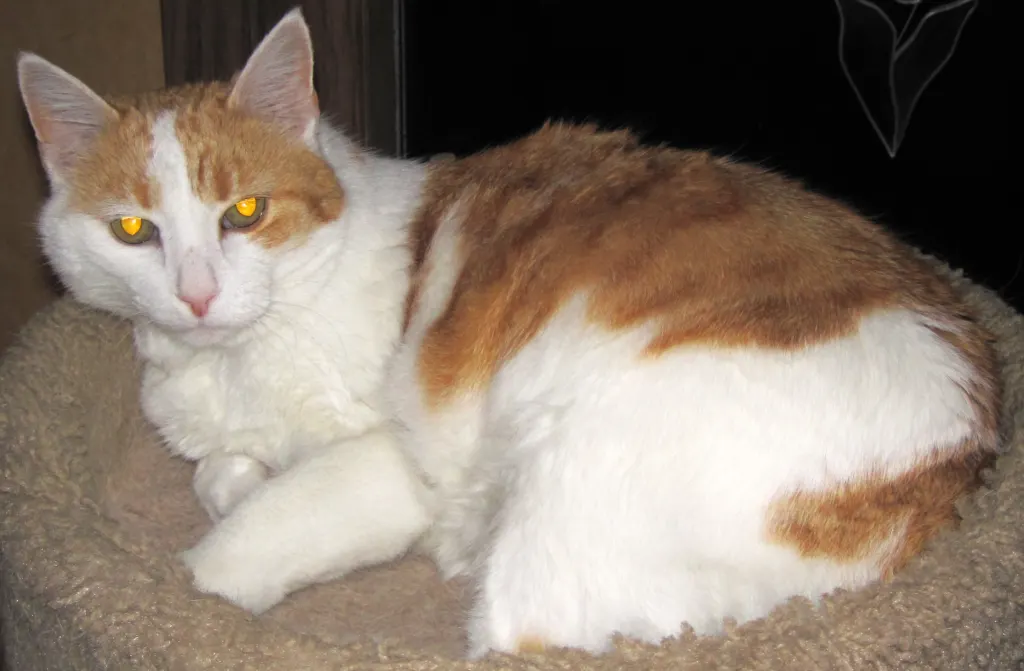
Cats’ eyes glow in a flashlight beam or a phone photo because of a built-in mirror. Behind the retina sits a reflective layer called the tapetum lucidum, Latin for “bright tapestry,” that bounces incoming light back through the eye for a second chance at being detected.
In cats that layer is unusually powerful. Wikipedia’s entry on the tapetum lucidum puts a cat’s reflectance at nearly 130 times that of a human eye, thanks to a mirror built from 15 to 20 layers of cells.
How the mirror works
The tapetum acts as a retroreflector, sending light straight back along the path it came in. That gives the light-sensitive cells in the retina a second hit of the same image, which matters in dim light. In cats, the reflective crystals are made with riboflavin and zinc; dogs and ferrets use zinc.
The payoff is real. According to Wikipedia’s article on cat senses, a tapetum plus a retina packed with dim-light rod cells lets cats see using roughly one-sixth of the light people need. That suits an animal built to hunt at dawn and dusk.
The trade-off is sharpness
Bouncing light around inside the eye scatters it slightly, so cats give up some detail. Their visual acuity is estimated at somewhere between 20/100 and 20/200, meaning a cat has to stand at 6 meters to see what an average person can see at 20 or 30 meters. Cats also take in a wider scene, with a field of view of about 200 degrees against 180 in humans.
Cat, dog and human eyes compared
- Cats: a dense tapetum of 15 to 20 cell layers; kittens’ eyeshine starts blue and turns yellow with age, and adults range from light orange to green.
- Dogs: 9 to 20 layers of zinc-rich cells in the upper half of the eye; it looks yellow-green in adults and blue in puppies until about four months.
- Humans: no tapetum at all. The red-eye in flash photos is a weak reflection from blood-rich tissue behind the retina.
That is why the same camera flash turns a person’s eyes red but a cat’s eyes green or gold. The color shifts with viewing angle and with the minerals in the crystals, and odd-eyed cats can show red eyeshine in the blue eye and a different color in the other.
An old source of wonder
The glow has impressed people for a long time. Ancient Egyptians, the tapetum entry notes, believed cats’ eyes held on to sunlight and reflected it after dark.
Plenty of other animals share the trick, including many carnivores, cows, horses, some deep-sea fish and most spiders. Squirrels, pigs, red kangaroos and humans and other haplorhine primates do without it.
Cats’ night tool kit does not stop at the eyes. Read how cat whiskers let them feel their way in the dark and why a slow blink from a cat is a friendly signal, according to a University of Sussex study.
Next time a cat’s eyes flash green in the hallway, that is roughly 130 times more light coming back than a human eye would return.
Sources
- Tapetum lucidum, Wikipedia, 2026
- Cat senses, Wikipedia, 2026
Image: James St. John, CC BY 2.0 via Wikimedia Commons
This article was produced with AI assistance and reviewed by our Editorial Desk. How we work.