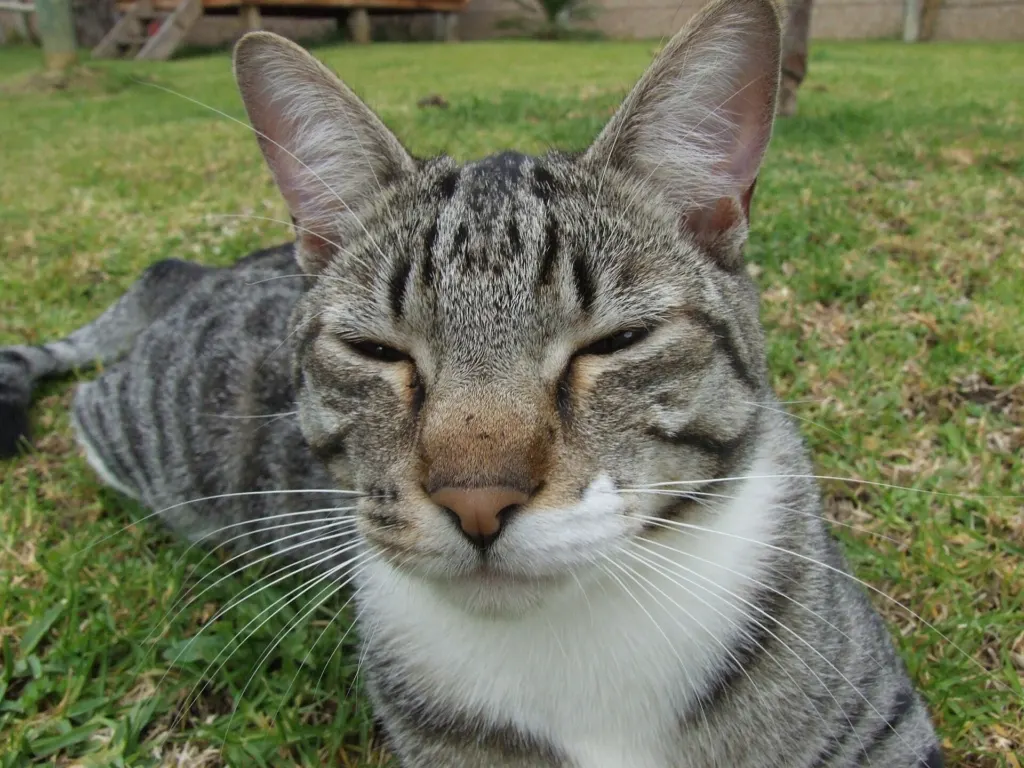
Narrow your eyes slowly at a cat and there is a good chance it will narrow its eyes back, and then walk over to you. That is the finding of a University of Sussex study that put the “slow blink”, a trick cat owners have traded for years, through two controlled experiments in cats’ own homes.
The work, led by Tasmin Humphrey and Karen McComb and published in the journal Scientific Reports in October 2020, was the first experimental test of the behavior. The researchers called the result evidence that slow blinking “may function as a form of positive emotional communication between cats and humans.”
What a slow blink looks like
The team defined a cat slow blink sequence as a run of half-blinks, where the eyelids move toward each other without closing, followed by either a held squint or a full eye closure. Every movement was scored with CatFACS, a coding system built on the muscles of the cat face, so that a reflexive blink and a deliberate squint were counted separately.
Experiment one: owners
Fourteen owners in Sussex slow-blinked at their own cats, 21 animals in all, with 18 cat-owner pairs left after outliers were removed. Each cat was also filmed for a control trial in which the owner stayed in the room but did not interact. When owners slow-blinked, the cats narrowed their eyes at roughly twice the control rate, 0.06 narrowings per second against 0.03, and half-blinked more too. Ordinary blinks did not change, which suggests the cats were responding rather than simply getting sleepy.
Experiment two: a stranger
The second test removed the bond. A researcher the cats had never met sat opposite 24 new cats, with 18 analyzed, and either slow-blinked or held a neutral face while looking slightly away. Over a one-minute trial the cats produced about 5.3 half-blinks after a slow blink versus 1.9 after the neutral face, and 2.8 eye narrowings versus 0.3. When the researcher then held out a hand, the cats were more likely to approach after the slow blink.
Pilot trials taught the team something useful along the way. A neutral face with direct eye contact seemed to unsettle some cats, so the control was changed to avoid a straight stare. That matches a common piece of feline etiquette: an unbroken stare can read as a threat, and the authors suggest slow blinking may have begun as a way to break one.
How to try it
A quick guide drawn from the study’s method:
- Wait until the cat is settled and looking at you, about a meter away.
- Soften your face, then narrow your eyes slowly into a half-squint, or close them for longer than half a second.
- Open them gently and repeat every few seconds; owners in the study averaged around 15 slow eye movements a minute.
- Watch for half-blinks or a squint in return, then offer a flat, open hand.
The limits
The samples were small, the trials ran in ordinary living rooms, and owners varied in how well they performed the blink, which the authors list as sources of noise. The study cannot say whether cats inherited the behavior or learned it because people reward it, and the authors say more work is needed before drawing firm conclusions about the emotion behind it.
Cat body language is a running theme here: see why cats knead or “make biscuits”, what it means when a cat wraps its tail around its paws, and how a Brazilian team found cats meow more when a person is near an out-of-reach treat.
The squint itself costs nothing to test. The Sussex cats approached an open hand with an average score of 2.78 on a three-point scale after a slow blink, against 2.39 after a neutral face.
Further reading
- Humphrey et al. (2020), The role of cat eye narrowing movements in cat-human communication
- Wikipedia: Cat communication
Image: Bob Adams from George, South Africa, CC BY-SA 2.0 via Wikimedia Commons
This article was produced with AI assistance and reviewed by our Editorial Desk. How we work.