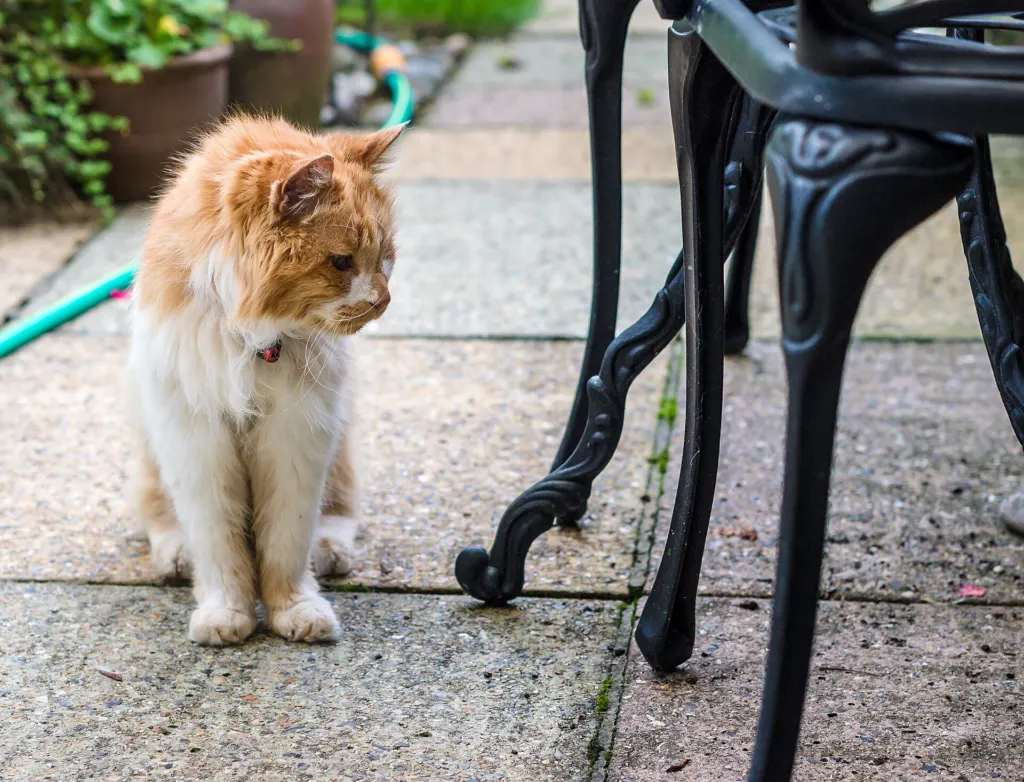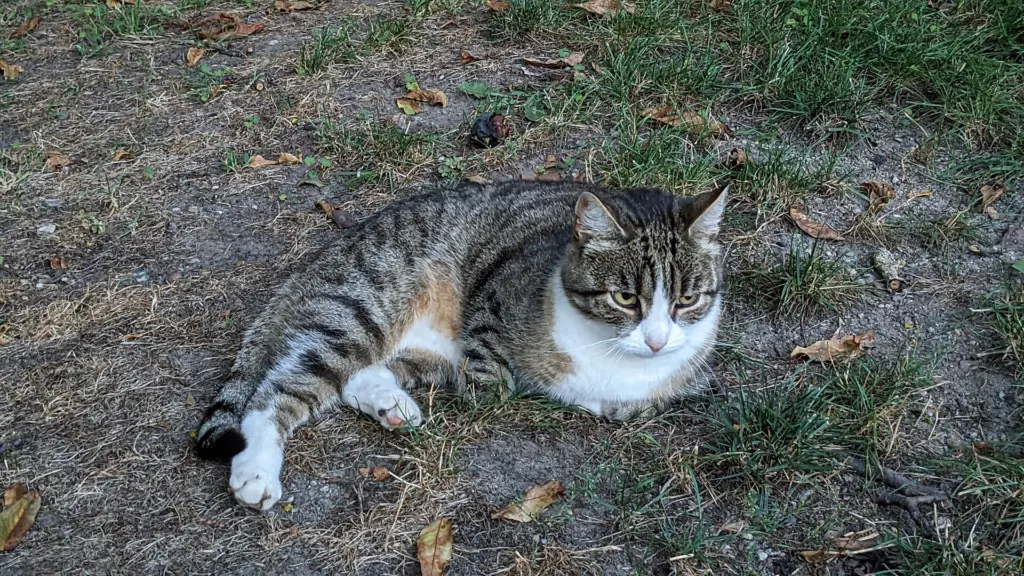
A cat sitting bolt upright with her tail curled neatly over her front paws is among the top posts on Reddit’s r/aww this week. Her owner posted it as “Look at how neatly she wrapped her tail around her paws like a true gentlewoman,” and readers piled in with “Very mindful, very demure” and “not just a gentlewoman – a dame!”
The pose is familiar to anyone who lives with a cat. It also says something. In the catalog of feline postures that behavior researchers use, a tail loosely wrapped around a sitting cat sits firmly on the relaxed side of the chart.
What the wrapped tail means
Cat body-language guides describe a relaxed cat as one lying on its side or sitting, breathing slowly, legs bent, with the tail “loosely wrapped, extended, or held up.” The neat tail-over-paws sit in the Reddit photo fits that first option.
A close cousin is the “loaf,” where the paws vanish under the chest, the body sits low and the tail runs underneath or around the body. Cats loaf when they are relaxed, and also when they are cold. A tail drawn around the feet keeps a little more body heat close, which is why the pose turns up so often on chilly windowsills in November.
When a tucked tail means the opposite
The difference between calm and scared is in the rest of the body, not just the tail. A fearful cat crouches directly on top of its paws, sits very low and may shake, with the tail curled tight against its body. A tense cat lies on its belly with its hindquarters lower than its shoulders and the tail tensed or curled downward.
A quick way to read the difference:
- Relaxed: sitting upright or lying on the side, slow breathing, tail resting loosely around the paws or body.
- Cold or settled: the “loaf,” paws tucked under, tail curled around.
- Fearful: crouched low over the paws, fast breathing, tail clamped tight to the body, sometimes trembling.
The calm sitter in the r/aww photo is upright and looking ahead, the opposite of a crouch.
The rest of the tail vocabulary
Cats lean on their tails more than most pets do. A tail held straight up usually signals a friendly or confident cat, often used as a greeting, and a quivering upright tail when an owner comes home is read as delight. We covered the science behind that signal in our story on what a cat’s raised tail means and the 2009 Italian study behind it.
A slow, lazy side-to-side swing generally means a relaxed animal. A twitching tip shows up when a cat is hunting, alert or playful, and a fast low lash is a warning that a swipe may be coming. A frightened cat can fluff out the hair on its tail and back to look bigger. Even tailless breeds such as the Manx move their short stubs as if a full tail were there.
Tails are only one part of the signal set. Slow blinks show trust, and cats that knead or “make biscuits” are repeating a kitten’s nursing motion. Adult cats also save most of their meows for people: domestic cats meow far more than feral ones and rarely meow at other cats, a habit explored in our piece on cats meowing at humans to get a problem fixed.
So the “gentlewoman” pose is mostly what it looks like: a calm cat keeping its feet warm. If the tail stays loosely draped and the breathing is slow, the cat is at ease. If the same tail is clamped tight while the cat crouches and shakes, the message is fear.
Further reading
Image: TricksterWildcat, CC BY-SA 4.0 via Wikimedia Commons
This article was produced with AI assistance and reviewed by our Editorial Desk. How we work.