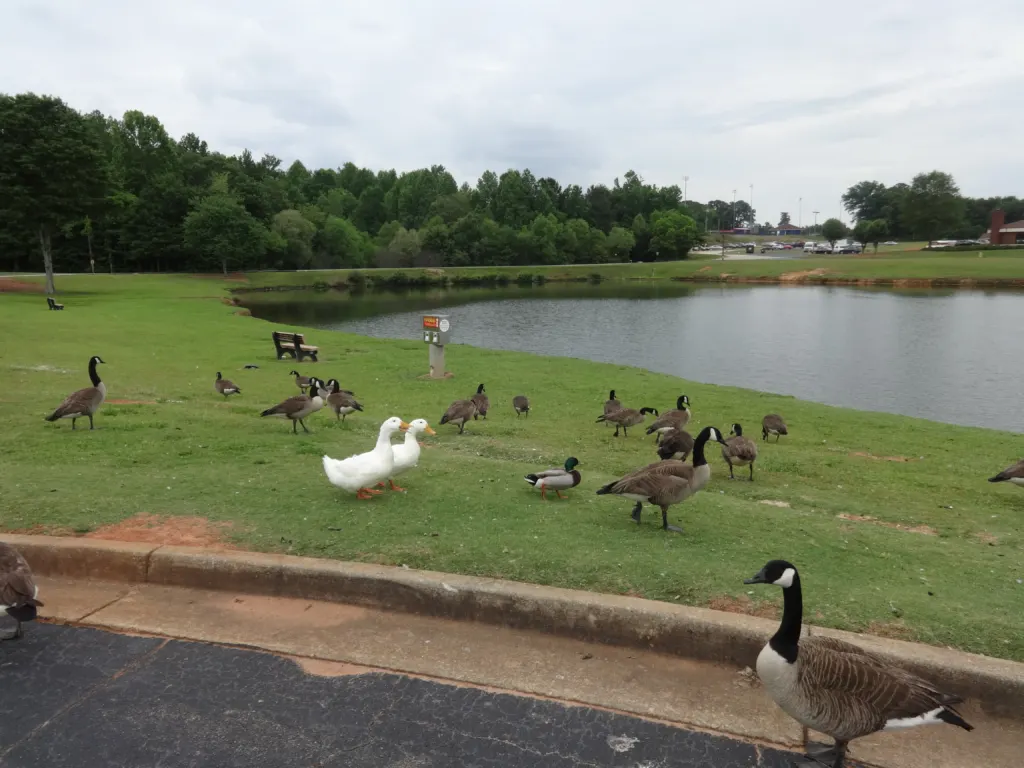
From the ground it would look like a crowded farmyard. From above, it looks like a flower bed. An overhead clip titled “Ducks at their feeders making daisies from above” climbed onto Reddit’s front page this week after being shared in the r/oddlysatisfying community, showing tight rings of birds packed around their feeders with stragglers drifting at the edges.
Commenters ran with the image. “The stray ducks around the edges are just loose petals,” one wrote. Another said they first took the shapes for real flowers until the petals started moving.
Is the clip real?
Not everyone was sold. A few viewers called it AI-generated, with one pointing to a shadow that seemed to vanish around the ten-second mark and to the clip’s many cuts. Others pushed back, saying the shadows looked normal and that an AI video of so many similar birds would show more morphing, while these ducks visibly shove one another. Badiyaa could not trace the footage to the person who filmed it, so it cannot confirm where it was shot or rule out editing. Treat it as an unverified clip.
Viewers also noticed a camera that never seemed to bother the birds. One commenter who has used drones for ground-nesting bird surveys said the birds barely reacted to the machine, yet scattered when a hawk flew far overhead.
Why ducks build a daisy
The geometry is simple. A feeder is a single point of food, and every bird wants its head as close to it as possible. Bodies point inward, tails point out, and a circle of white backs radiates from the center like petals. Late arrivals cannot squeeze in, so they hover on the rim until a gap opens.
Behavior spreads the pattern, too. Animal researchers call it social facilitation: one animal doing something, such as feeding, raises the odds that others nearby will do the same. Feeding is one of the classic settings, which is why a single duck dipping its bill can pull the whole flock toward the trough. It is the same pull that fills backyard bird feeders once the first visitor lands.
What kind of ducks are these?
Several commenters identified the birds as a Pekin-type farm flock raised for meat, and much of the thread turned to that point. The white Pekin, also called the Long Island duck, descends from Chinese “ten-pound” ducks. Nine birds survived a 124-day voyage from Shanghai to New York in 1873, and four of them founded the American line. In the United States today, more than half of all ducks raised for slaughter are Pekins.
The breed is built for speed of growth. A Pekin can top 3.5 kilograms (8 pounds) in seven weeks. Spread across those 49 days, that is 3,500 ÷ 49 = about 71 grams of weight gained every day, which helps explain why mealtimes draw such a dense crowd. Its white feathers were prized from the start because stray fluff on a plucked bird does not show.
For a gentler waterfowl story, Badiyaa covered the young swan netted to safety on England’s A1 earlier this month.
Further reading
Image: Michael Rivera, CC BY-SA 4.0 via Wikimedia Commons
This article was produced with AI assistance and reviewed by our Editorial Desk. How we work.