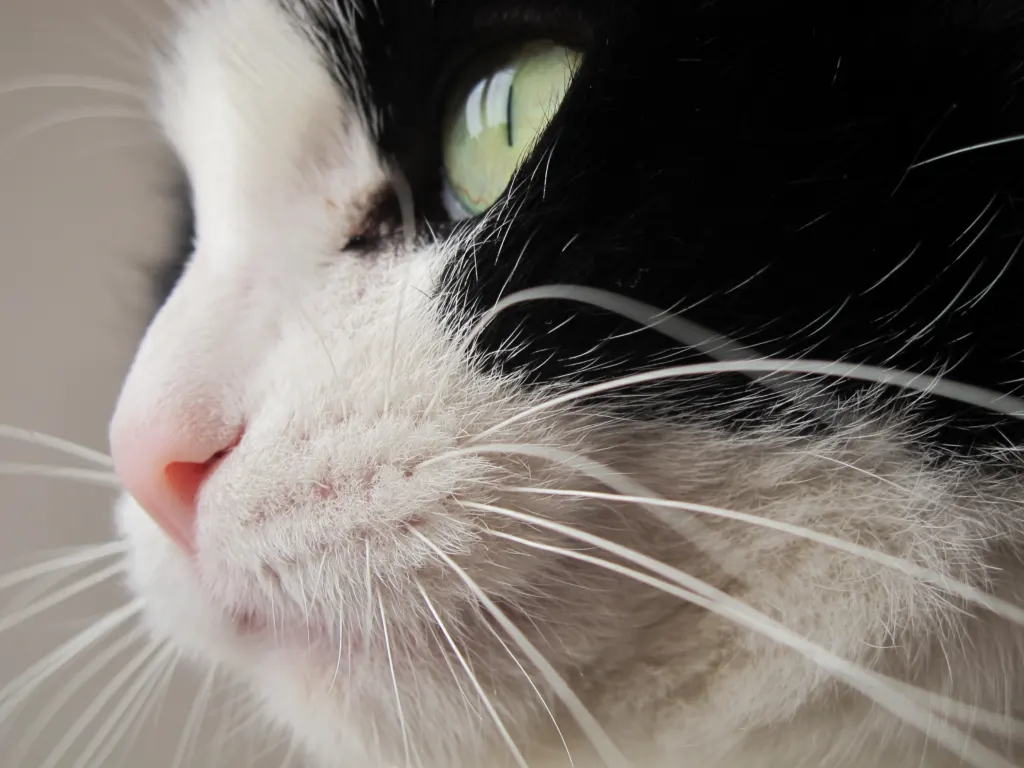
Each of a cat’s whiskers is wired to between 100 and 200 nerve cells. That is why a whisker is far more than a long hair: it is a feeler planted in a nerve-packed pocket of skin, and even a tiny bend sends a signal to the brain.
Scientists call whiskers vibrissae, from the Latin word for “to vibrate.” Nearly every mammal has them, from mice to seals, and the trait probably dates back to the ancestors of mammals in the Triassic period.
What makes a whisker different from fur
A whisker is thicker, stiffer and much longer than the fur around it. The hair shaft itself is dead keratin with no nerves, just like ordinary hair. The difference is at the root. Each whisker grows from a special follicle wrapped around a capsule of blood, called a blood sinus, and that capsule is heavily supplied with sensory nerves.
In cats, as in rats, rabbits and guinea pigs, each of those follicles is served by 100 to 200 nerve cells, which feed at least eight different kinds of touch sensor. The result: brush a whisker and the cat feels it, even when the touch is too light to register on skin.
Where cats have whiskers
The famous ones sit on the muzzle, where a mustache would be. Cats also have whiskers above the eyes, on the cheeks and under the chin. Fewer owners notice the set on the back of the front legs, just above the paws. These are called carpal whiskers, and many land mammals have them.
The muzzle whiskers are arranged in a neat grid of rows and columns, with shorter whiskers at the front and longer ones toward the back. Tiny muscles at the base of each one let the cat move it, and larger muscles sweep the whole set together. Watch a cat yawn and the whiskers fan forward.
Do cats measure gaps with their whiskers?
The popular claim is that a cat’s whiskers span the width of its body, so it can judge whether it will fit through an opening. The evidence is thinner than the internet suggests. Whisker length appears to be set by genetics and does not change as a cat gains or loses weight. Laboratory rats, though, can judge the size of an opening to within 5 to 10% using their whiskers, so cats may well use theirs the same way. The many cats found with their heads stuck in a discarded container suggest they do not always listen.
What is better documented is the hunt. Cats push their whiskers forward as they pounce, bending them toward the prey as the teeth close in.
Whiskers compared
Cats do not “whisk” the way rodents do. Rats and mice beat their whiskers back and forth at up to 25 times a second, one of the fastest movements any mammal makes. A rat’s face has about 30 large whiskers on each side, served by an estimated 25,000 nerve cells in total.
Seals take it further. Each seal whisker carries about ten times as many nerve fibers as a rat’s, and the total for a seal’s muzzle has been put at more than 300,000 nerve cells. That is roughly 12 times the rat figure, enough for harbor seals to follow the invisible wake of a fish that swam past minutes earlier.
Whiskers also carry mood, with different movements linked to emotions such as fear or curiosity. For more on how cats work, read why cats knead with a kitten’s nursing motion and how house cats can sprint at 30 mph.
Further reading
Image: Annika of Nine, CC BY-SA 4.0 via Wikimedia Commons
This article was produced with AI assistance and reviewed by our Editorial Desk. How we work.