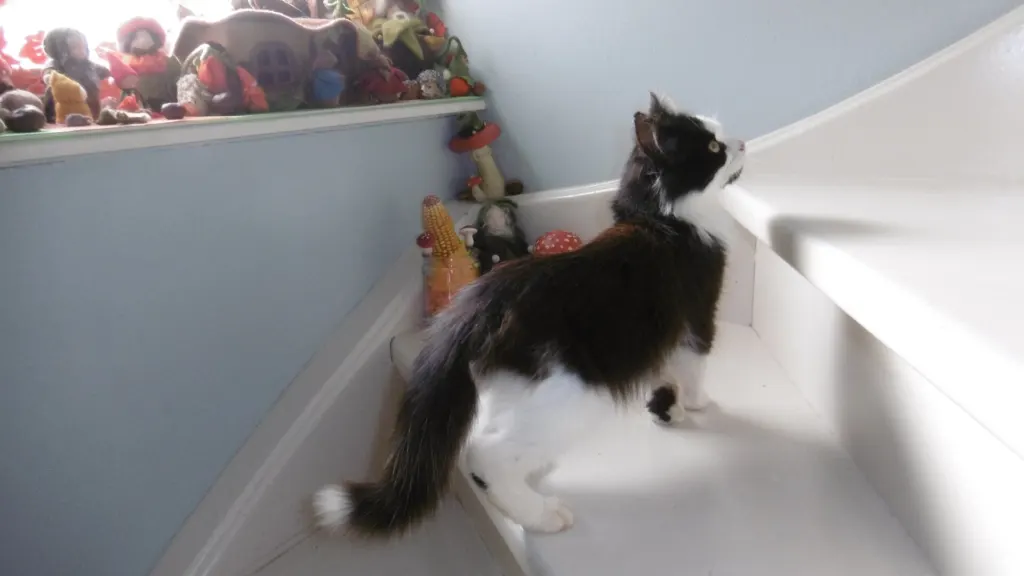
A snow-white mother cat nursing a litter of jet-black kittens looks like a mix-up at the hospital, but genetics expects it. A solid white cat is often a cat of some other color wearing a white mask, and she can pass that hidden color straight to her kittens.
The mask is a gene variant called dominant white. Any cat carrying a single copy of it comes out white, no matter which color genes sit underneath.
How the white mask works
Most white in a cat’s coat is controlled by one gene, KIT. Its strongest variant, dominant white (written W), stops pigment-making cells called melanocytes from multiplying and spreading into the skin while the kitten develops. No melanocytes, no color: the coat grows in white everywhere.
Crucially, the color genes are still there. A white cat may carry everything needed for black fur, or orange, or tabby stripes. Her coat simply never shows it.
The same KIT gene has milder variants. One copy of the white spotting variant gives a cat a white chest, paws and belly, the classic tuxedo. Two copies push the white further, up to the Van pattern of the Turkish Van, where color is confined to the head and tail. Cats with neither variant have no white at all.
Where the black comes from
Black is the default dark pigment in cats. The B version of the browning gene makes black pigment, while rarer versions give chocolate or cinnamon. To look solid black rather than tabby, a kitten also needs two copies of the recessive non-agouti variant, which keeps pigment flowing along the full length of every hair and hides the tabby stripes.
So a black kitten born to a white mother needs two things: her non-white copy of KIT, plus black-making genes from both parents. Its father supplies half of its genes, so a black tom is the usual suspect.
The odds of an all-black litter
A white cat that carries one dominant white copy and one normal copy hands one or the other to each kitten, a coin flip each time. If the father has no white, every kitten has a 1 in 2 chance of escaping the mask. For all four kittens in a litter to come out colored, the odds are 1/2 × 1/2 × 1/2 × 1/2, or 1 in 16. If the mother carries two dominant white copies, the chance drops to zero: every kitten will be white.
Seeing four black kittens is therefore unusual but far from impossible, and it tells you something concrete: that white mother carries only one copy of the white gene.
A note on white cats and deafness
Dominant white is linked to blue eyes and to deafness present from birth. The same early cells that become pigment cells also give rise to some nerve-related cells, including ones the inner ear relies on. White cats with one or two blue eyes are especially likely to be deaf. Albino cats are different: their white comes from a separate gene with no known effect on hearing.
Coat genes produce plenty of other surprises. Badiyaa has explained why calico cats are almost always female, and how two X chromosomes gave one tortie Maine Coon kitten her patchwork coat.
Further reading
Image: NeoMeesje, CC BY-SA 4.0 via Wikimedia Commons
This article was produced with AI assistance and reviewed by our Editorial Desk. How we work.