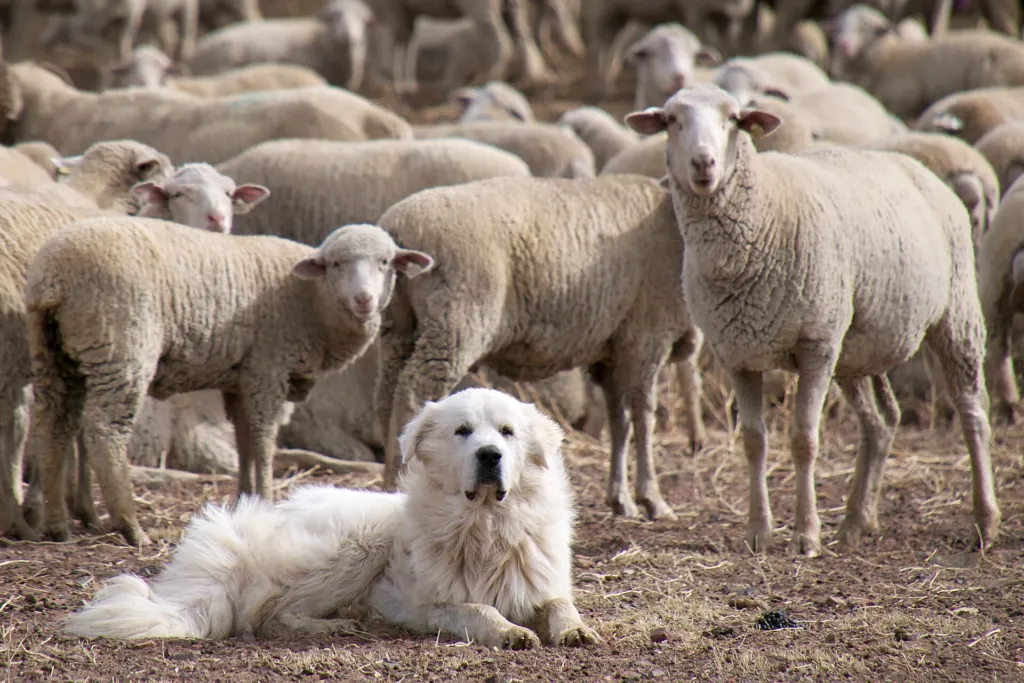
He walked into a pet shop looking like a polar bear that had been rolled through a bowl of chocolate sprinkles. The dog is a Newfoundland and Great Pyrenees cross, and a short clip of him standing beside another white giant has given pet fans a new favorite mash-up this week.
The video comes from Brad, who posts as @bradpetshopguy and says on his profile that he has spent more than 50 years in the pet business. He films many of the animals that come through the store. This one stood out: a huge white dog flecked all over with small brown spots, posed next to a second fluffy white dog for scale.
The clip went up on Instagram on Monday, October 19, with a short caption and the hashtags #greatpyrenees, #newfoundlanddog and #bigdogs. When we checked it on Wednesday it showed 716 likes. Pet sites picked it up on October 27, putting him in the running for most pettable dog of all time and comparing him to a sprinkle-covered polar bear.
One detail most retellings got wrong
Several write-ups describe the second dog as a “regular” or “standard” Great Pyrenees. The creator’s own caption says something different. It reads: “Great Pyrenees mix meets Great Pyrenees/Newfoundland mix.” In other words, this is a meeting of two crossbreeds, not a purebred standing next to a hybrid, so the size gap in the frame is not a clean breed-versus-breed comparison.
The caption also does not mention a DNA test, so the exact ancestry of either dog rests on what the owners have been told or believe.
Where the sprinkles could come from
Both parent breeds bring color options to the table. Great Pyrenees are mostly white, but the French breed standard allows patches of badger, wolf-gray or reddish tan on the head and on up to a third of the body. “Badger” is a blend of brown, black, gray and white hairs, common in puppies and often fading with age.
Newfoundlands, by contrast, come in black, brown, gray and the black-and-white pattern called Landseer, named after the artist Sir Edwin Landseer, who painted the dogs again and again. Brown is accepted by the American Kennel Club but not by the Canadian Kennel Club, which allows only black and black-and-white for showing.
Mix a mostly white coat with a breed that carries brown, and a speckled result is not a shock. What is unusual is how evenly this dog’s flecks are spread, which is exactly why the “sprinkles” line caught on.
How big is a Newfoundland-Pyrenees cross?
Here is how the two parents compare on paper, using the published breed figures:
- Newfoundland males: about 143 to 176 pounds (65 to 80 kg), around 28 inches (71 cm) at the shoulder
- Great Pyrenees males (French standard): 28 to 31 inches (70 to 80 cm) tall, with healthy adults at 120 to 165 pounds (55 to 75 kg)
- Great Pyrenees in US references: listed lighter, at 90 to 125 pounds (41 to 57 kg), standing 25 to 32 inches
Run the numbers and the Newfoundland side adds weight more than height. At the bottom of each range a male Newfoundland outweighs a male Pyrenees by about 10 kg (65 minus 55), roughly 22 pounds, while the tallest Pyrenees can actually stand a little higher at the shoulder. That fits what viewers see in the clip: a dog that looks wider and heavier, with a broader head, rather than one that simply towers.
An old family reunion
The pairing is not as random as it looks. One theory holds that French settlers brought Pyrenean dogs to Canada, where they may have fed into the Newfoundland’s ancestry. In the 1830s, both breeds were among the dogs used to develop the Leonberger. So this dog may be a modern reunion of two lines that crossed before.
The jobs were different, though. The Pyrenees spent centuries guarding sheep from wolves and bears in the mountains between France and Spain; Louis XIV even named it the Royal Dog of France. The Newfoundland worked beside fishermen, hauling nets and carts, and built a reputation for water rescue thanks to webbed paws and an oily, water-resistant coat.
Before you want one
A cross like this is a lot of dog. A large North American study of more than a million veterinary cases found the Newfoundland had the highest rate of hip dysplasia, 17.16% against 3.52% across all dogs. A 2024 UK study put the breed’s life expectancy at 11 years, and the same study gave the Great Pyrenees a median of 10.9 years.
Anyone hoping to adopt a sprinkle-coated giant of their own should plan for hip screening, serious grooming during shedding season and a yard with space to roam, and should remember that a male Newfoundland parent alone can weigh up to 176 pounds.
Further reading
Image: Don DeBold from San Jose, CA, USA, CC BY 2.0 via Wikimedia Commons
This article was produced with AI assistance and reviewed by our Editorial Desk. How we work.