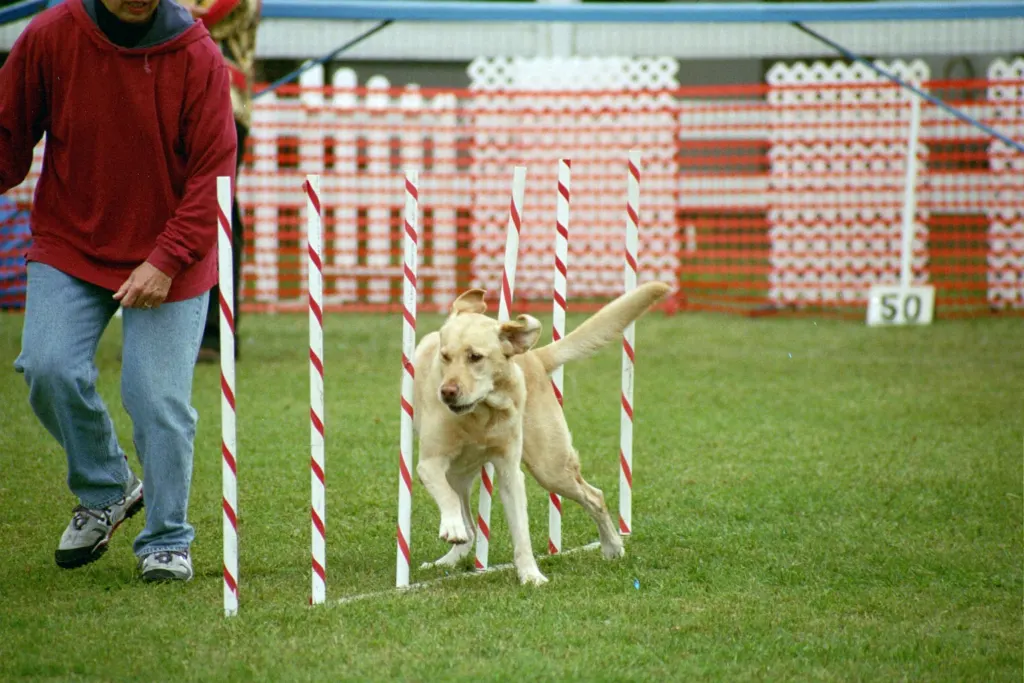
The dog sport now packed with weave poles, seesaws and tunnels began as filler. Before the 1978 Crufts dog show in England, show committee member John Varley was asked to come up with something to keep the crowd entertained between the conformation judging and the obedience events. He teamed up with dog trainer Peter Meanwell, borrowed the idea of a horse show-jumping course, and dog agility was born.
Varley, who narrated that first run, said the aim was to “bring some fun into the more serious side of Crufts … it has been designed to test a dog’s ability over a number of obstacles and against the clock.” An Alsatian, the breed Americans call the German Shepherd Dog, went first, followed by several Border Collies.
A course that was almost the same as today’s
That 1978 course already had tunnels, a collapsible fabric chute, an A-frame and a jump made from a tire. It also had a raised plank Varley called a catwalk, and in his commentary he wondered aloud whether it should be renamed the dog walk. It was. At first there was only one jump, and it was very high.
The crowd loved it. Agility came back to Crufts in 1979 as a competitive event, and in 1980 Britain’s Kennel Club recognized it as a sport, wrote the first general rules and began licensing trials.
Timeline: from intermission act to world sport
- 1978: first agility demonstration at Crufts, shown on Belgian television.
- 1979: first Pedigree Chum Agility Stakes final, held with the Olympia Christmas horse show.
- 1980: the Kennel Club in Britain recognizes agility and licenses trials.
- 1985: American trainer Kenneth Tatsch sees agility at Crufts at Earl’s Court in London.
- 1986: Tatsch forms the United States Dog Agility Association at an obedience event in Houston.
- 1994: the American Kennel Club’s first licensed agility trial in Houston draws 192 dogs from 58 breeds.
- 1996: the event once run as a European championship becomes the FCI Agility World Championships.
Today the American Kennel Club alone counts more than one million agility entries a year.
Which dogs excel
Border Collies have been at the front since that first Crufts run, and they still set the pace. At the 2015 FCI world championships in Bologna, Slovak handler Pavol Vakonič made history by winning both gold and silver in the same event with two Border Collies, Ikea and Fiona. The flip side of that speed is wear and tear: handler surveys find Border Collies are more likely to be injured than other breeds.
The sport is far from a one-breed show, though. Jump heights are adjusted by size, so short-legged dogs such as Pembroke Welsh Corgis race against dogs of similar height, and since 2009 mixed-breed dogs have been able to enter AKC agility. Speedy small dogs already have fans here, thanks to NFL halftime corgi races that hit 25 mph, and clever Labradors too, like Java, who clipped 8 clothes pegs to a line in a minute.
What matters most is teamwork. Dogs run off leash with no food or toys, the handler may not touch the dog or the equipment, and directions come only from voice and body language. Handlers get about eight minutes to walk each new course without their dogs before the timed run begins.
Further reading
Image: Elf, CC BY-SA 4.0 via Wikimedia Commons
This article was produced with AI assistance and reviewed by our Editorial Desk. How we work.