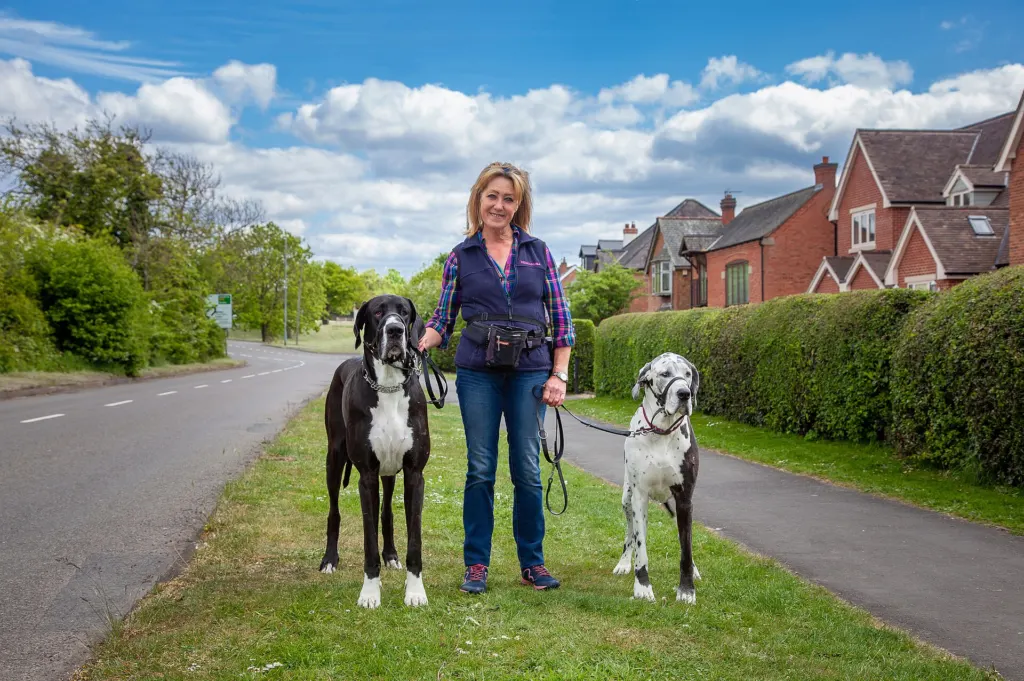
Long before Great Danes were sofa-hogging family pets, the favorites among them slept in the bedchambers of German princes. Known as Kammerhunde, or chamber dogs, they wore ornate collars and were kept close at night to guard their sleeping lords against assassins.
That history helps explain why a dog that can stand taller than a kitchen counter has a reputation as a calm but watchful guardian. The breed is generally not unduly aggressive toward people or other animals, yet its sheer size does much of the deterring.
From boar hunter to luxury dog
The story starts in the 16th century, when European nobles imported strong, long-legged dogs from England and Ireland, some mastiff-like and some built like sighthounds. In German they were called the Englische Dogge, simply the English dog. German courts bred them on their own lines from the early 1600s.
Their job on the hunt was brutal and specific. As a catch dog, the Dogge was sent in after the other hounds to seize a bear, boar or deer and pin it until the huntsman arrived to make the kill. Once firearms changed how hunting worked, many of these dog types faded away, and the Englische Dogge survived mainly as a hobby or luxury animal.
Why a German dog is called a Dane
In 1878 a committee in Berlin renamed the breed the Deutsche Dogge, or German mastiff, laying the foundation for the modern Great Dane. English speakers knew it at the time as the German Boarhound. As tensions grew between Germany, France and Britain, the English name shifted to Great Dane, a literal translation of the French name Grand Danois. The breed has no known link to Denmark. Late in the 19th century the dogs were sometimes nicknamed Reichshunde, empire dogs, because of their association with Chancellor Otto von Bismarck.
The American Kennel Club sums up the naming mix-up in one line: “This breed is indeed great, but not a Dane.” The club calls the breed easygoing but adds that owning a dog of such size, weight and strength “is a commitment not to be entered into lightly.”
How big is big
- Breed standard minimums at the shoulder: 76 cm (30 inches) for males and 71 cm (28 inches) for females.
- Minimum weight in the UK and New Zealand standards, for dogs older than 18 months: males 54 kg (120 lb), females 45 kg (100 lb).
- Record holder: Zeus, a black Great Dane, stood 111.8 cm (44 inches) at the shoulder, the tallest dog on record.
- Daily food: a neutered adult of about 64 kg (140 lb) needs roughly 2,200 to 2,500 calories.
Put another way, a dog at the male minimum is already about as tall at the shoulder as a typical dining table, before you count its head and neck.
A guardian with a short life
The breed’s nickname, the heartbreak breed, comes from heart disease and a shorter lifespan. A 2024 UK study put the average life expectancy at 10.6 years, against 12.7 for purebreds overall. Bloat is the biggest killer of Great Danes, which is why owners of giant breeds often discuss it with their vet early.
Working dogs have a long record of guarding people, from the trained patrol dog Nottingham police bought for £5 in 1910 to Sergeant Stubby, the Yale stray who went to war in 1917. Great Danes have one wartime star of their own. Just Nuisance was formally enlisted in Britain’s Royal Navy during World War II and served at HMS Afrikander, the shore base at Simon’s Town in South Africa’s Western Cape.
Further reading
Image: Les Golding, CC BY-SA 4.0 via Wikimedia Commons
This article was produced with AI assistance and reviewed by our Editorial Desk. How we work.