Beethoven was still beating time when the music stopped. At the first performance of his Ninth Symphony, in Vienna on May 7, 1824, the composer stood by the stage several bars behind the orchestra, unable to hear either the players or the crowd. The 20-year-old contralto Caroline Unger walked over and gently turned him around so he could see the audience on its feet.
Accounts from people who were there differ on whether it happened at the end of the scherzo or the end of the whole symphony. They agree on the reaction: five standing ovations, with hats and handkerchiefs waved in the air so that a man who could not hear the applause could at least see it.
A premiere Vienna nearly lost
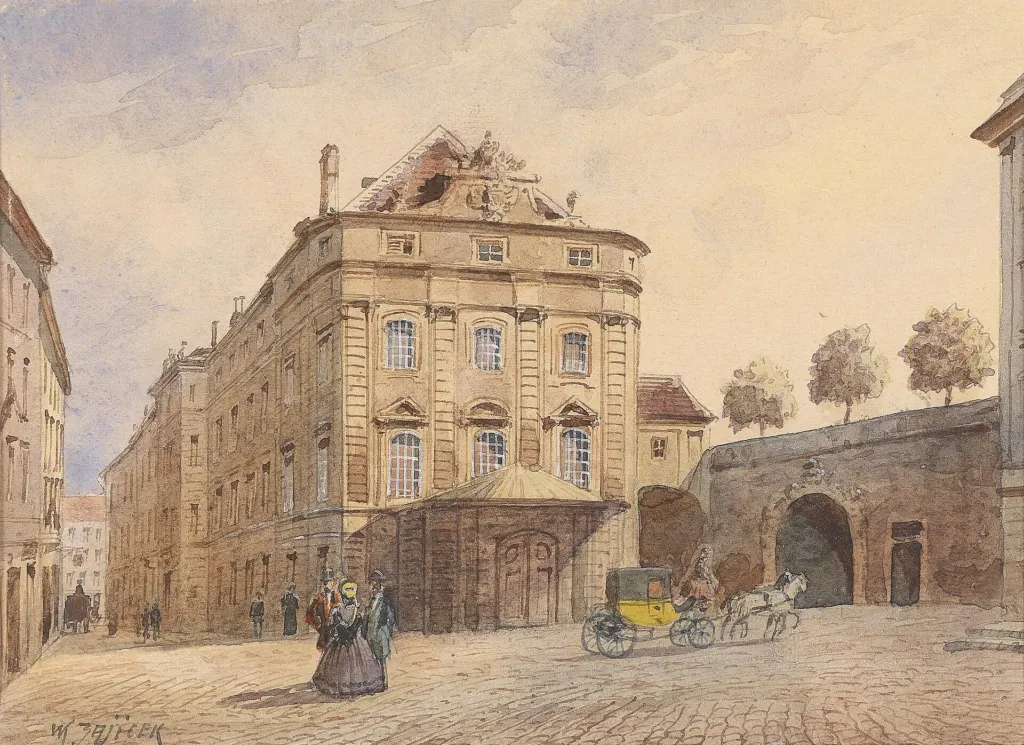
Beethoven had wanted to launch his new works in Berlin, convinced Vienna had moved on to Italian opera and Rossini. His friends and backers sent him a petition, signed by leading patrons and performers, begging him to stay. He agreed, and booked the Theater am Kärntnertor.
The program also carried the overture The Consecration of the House and three sections of the Missa solemnis. It was his first time on stage since 1814, and the hall was packed. Franz Schubert, Carl Czerny and the Austrian chancellor Klemens von Metternich were among the audience.
Two conductors on one stage
Officially, the theater’s Kapellmeister, Michael Umlauf, was in charge. Two years earlier he had watched a Beethoven-led dress rehearsal of Fidelio collapse, so he quietly told the singers and players to ignore the composer. Beethoven sat by the stage, gave the tempo at the start of each section and turned the pages of his score for an orchestra he could not hear.
The violinist Joseph Böhm remembered the sight: “At one moment he stretched to his full height, at the next he crouched down to the floor, he flailed about with his hands and feet as though he wanted to play all the instruments and sing all the chorus parts.” The players, he added, “followed his baton only” when it was Louis Duport’s.
The band was nearly twice the usual size, combining the theater orchestra, the Vienna Music Society and skilled amateurs. There were only two complete rehearsals. Unger and the 18-year-old soprano Henriette Sontag had both been recruited by Beethoven himself.
Why the moment still lands
Here is the arithmetic of that evening: the most celebrated new symphony of the century was heard by everyone in the room except the man who wrote it. Its final movement, with words adapted from Friedrich Schiller’s 1785 poem “Ode to Joy,” was the first time a major composer put singers into a symphony.
The afterlife was huge. The score’s handwritten manuscript in the Berlin State Library became, in 2001, the first musical score added to UNESCO’s Memory of the World register. In 1972 the Council of Europe adopted the “Ode to Joy” melody as the Anthem of Europe, later taken up by the European Union. In Japan the symphony is a year-end tradition; one December, 2009, saw 55 performances by major orchestras and choirs.
For more music history, read why W.C. Handy sold ‘The Memphis Blues’ for $100 and how Ringo Starr ended up on tambourine for the album version of Love Me Do.
Further reading
Image: Carl Wenzel Zajicek, Public domain via Wikimedia Commons
This article was produced with AI assistance and reviewed by our Editorial Desk. How we work.