Francisco Goya never meant anyone outside his family to see Saturn Devouring His Son. He painted it in oil straight onto a wall of his own dining room, in a country house on the edge of Madrid, sometime between 1820 and 1823. Thirteen more dark murals filled the rooms around it. Nobody commissioned them, and the artist never gave any of them a title.
Today they hang in the Museo del Prado as the Black Paintings, among the most studied works in Spanish art. Getting them off the walls took half a century and a wealthy French banker.
The Deaf Man’s Villa
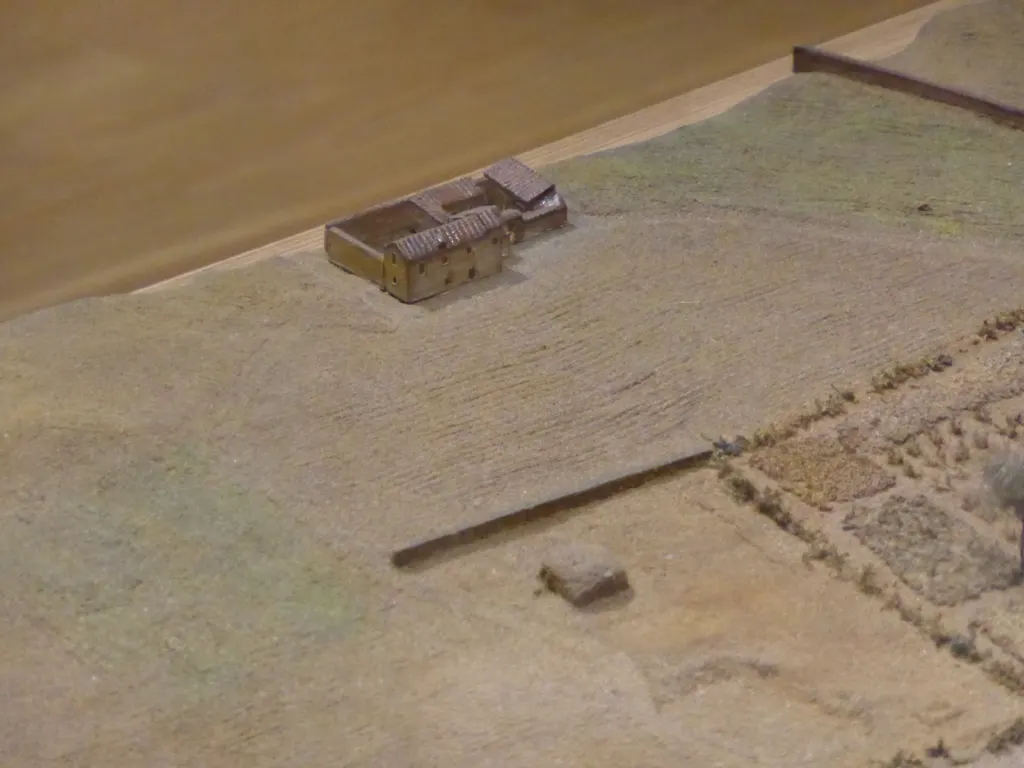
Goya bought the two-storey house in February 1819, when he was 72. It stood on the banks of the River Manzanares, near the Segovia bridge, looking out over the plains of San Isidro. Locals called it the Quinta del Sordo, or Deaf Man’s Villa. The name came from an earlier owner who was deaf, but it fit the new one too: an illness at 46 had left Goya almost unable to hear.
He lived there with his companion and housekeeper, Leocadia Weiss. Some time after September 1819, and possibly after a serious illness he recorded in a self-portrait with his doctor in 1820, he began painting over the walls. Under the new murals were older, lighter country scenes with small figures; in some places Goya reused those landscapes as backgrounds.
What hung where
An inventory made in 1828 by Goya’s friend Antonio Brugada, together with photographs taken inside the house in 1874, lets historians rebuild the layout room by room:
- Ground floor: A Pilgrimage to San Isidro and Witches’ Sabbath faced each other on the long walls. On the back wall, either side of a window, were Judith and Holofernes and Saturn Devouring His Son. La Leocadia, a portrait of his companion, stood beside the door.
- Upper floor: Asmodea, the Procession of the Holy Office, Atropos and Fight with Cudgels lined the long walls. Men Reading and Man Mocked by Two Women shared the back wall, and The Dog sat beside the door.
Picture eating dinner under that program every night. The house had ordinary patterned wallpaper, fruit and leaves downstairs and diagonal geometric designs upstairs, and Goya painted on top of it. One art historian summed up how personal the cycle was: “these paintings are as close to being hermetically private as any that have ever been produced in the history of Western art.”
Off the walls and into the Prado
Goya left for Bordeaux in 1823 and handed the villa to his grandson Mariano. In 1874, Baron Frédéric Émile d’Erlanger, a French banker of German origin, had the murals lifted under the supervision of the restorer Salvador Martínez Cubells. The painted wallpaper layer was peeled away and fixed to canvas. The baron hoped to sell them at the 1878 Paris World’s Fair. Instead, in 1881 he donated them to the Spanish state. The house itself was demolished in 1909.
Count the gap: the murals spent roughly 51 years on the walls of a private home before they were moved, and more than 140 years since then in a public museum.
Are they really Goya’s?
In 2003 the art historian Juan José Junquera argued that the upper floor did not exist in Goya’s lifetime, so at least some murals could not be his. Goya scholar Nigel Glendinning rejected that theory in a published study, and the Prado treats the series as authentic. A possible fifteenth painting, Heads in a Landscape, became separated from the rest and is now in a private collection in New York.
For more art with an unusual backstory, see how Pieter Bruegel packed more than 90 games into one 1560 painting, how a student-era Keith Haring mural pushed a Tribeca loft’s price to $25 million, and the story of Manuel Orazi’s occult 1895 calendar.
Further reading
Image: Carlos Teixidor Cadenas, CC BY-SA 4.0 via Wikimedia Commons
This article was produced with AI assistance and reviewed by our Editorial Desk. How we work.