On November 17, 1592, Sigismund III Vasa, already King of Poland and Grand Duke of Lithuania, also became King of Sweden. For a few years one man wore the crowns of two rival Baltic powers, and it ended with his own uncle pushing him off the Swedish throne.
The union looked tidy on paper. Sigismund was Swedish by birth and Polish by his mother’s line. In practice, a devout Catholic king trying to rule a Lutheran kingdom from Poland proved unworkable within seven years.
A prince born in a prison castle
Sigismund was born on June 20, 1566, at Gripsholm Castle in Sweden, where his parents were being held prisoner. His father was Duke John, later King John III of Sweden; his mother was Catherine Jagiellon, daughter of King Sigismund I of Poland. The family was freed in October 1567 at the request of John’s brother, Duke Charles. That uncle would become Sigismund’s great rival.
In 1587 the Polish-Lithuanian nobility elected the 21-year-old Swede as their monarch, and he was crowned at Wawel Cathedral in Kraków on December 27 that year. When John III died in 1592, the Polish parliament let Sigismund claim the Swedish crown he had inherited. He started counting his Swedish reign from November 17.
How the double crown came apart
To win over the Swedes, Sigismund promised to respect Lutheranism as their state religion. The Uppsala Resolution of 1594 spelled it out: Lutheran faith upheld, non-Lutherans barred from office and from teaching, and limits on the king raising war taxes. He was crowned at Uppsala on February 19, 1594, but a papal nuncio rode in the royal procession, which did not reassure anyone. He soon went back to Poland and left Duke Charles in charge as regent.
The timeline from there moves quickly:
- 1594: Sigismund rules that Sweden’s parliament, the Riksdag, cannot meet without royal consent.
- 1595: Charles calls a parliament at Söderköping anyway.
- July 1598: Sigismund sails from Danzig with about 5,000 men; Kalmar surrenders without a fight.
- September 25, 1598: Charles’s forces win the Battle of Stångebro at Linköping, helped by fog and seizing the river bridges.
- July 24, 1599: a Riksdag in Stockholm formally deposes Sigismund.
Count it out: from November 17, 1592, to July 24, 1599, is about six years and eight months, and Sigismund spent most of it back in Poland. Charles later took the throne as Charles IX, and the two branches of the Vasa family stayed at war for decades. Sigismund’s cousin Gustavus Adolphus later seized parts of Polish Livonia.
What he left in Warsaw
Sigismund kept the Polish crown until his death on April 30, 1632, a reign of nearly 45 years. He is still divisive in Poland: his armies reached Moscow and gave the Commonwealth its largest extent, but his rule also saw the end of the Polish Golden Age and the first signs of decline. He enforced Catholicism, leaned on Jesuit advisers and dabbled in alchemy.
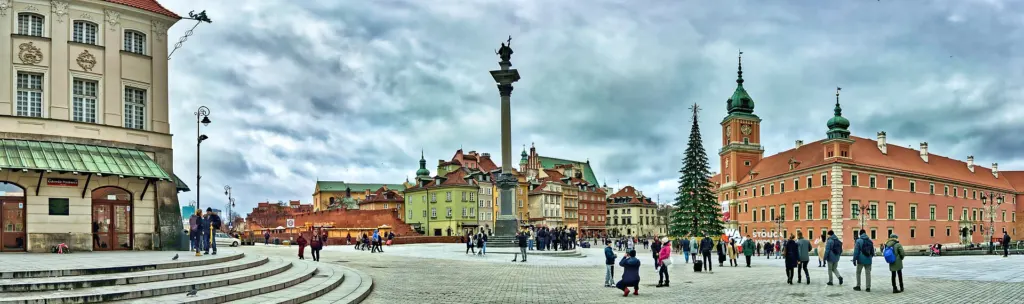
His most visible legacy is the capital itself. Sigismund made Warsaw the capital of Poland in 1596, taking the role from Kraków. In 1644 his son and successor, Władysław IV Vasa, put up Sigismund’s Column on Castle Square, a 22-meter Corinthian column topped with a bronze statue of the king in armor, modeled on ancient Roman memorials. It is credited as modern history’s first column raised as a secular, non-religious monument.
Badiyaa’s other November 17 royal story, Elizabeth I’s accession in 1558, came just 34 years before Sigismund’s Swedish reign began, and another monarch shaped by travel appears in King Kalākaua of Hawaii. Sigismund was buried at Wawel Cathedral on February 4, 1633, back in the old capital he had left.
Further reading
Image: Hauke Musicaloris, CC BY 2.0 via Wikimedia Commons
This article was produced with AI assistance and reviewed by our Editorial Desk. How we work.