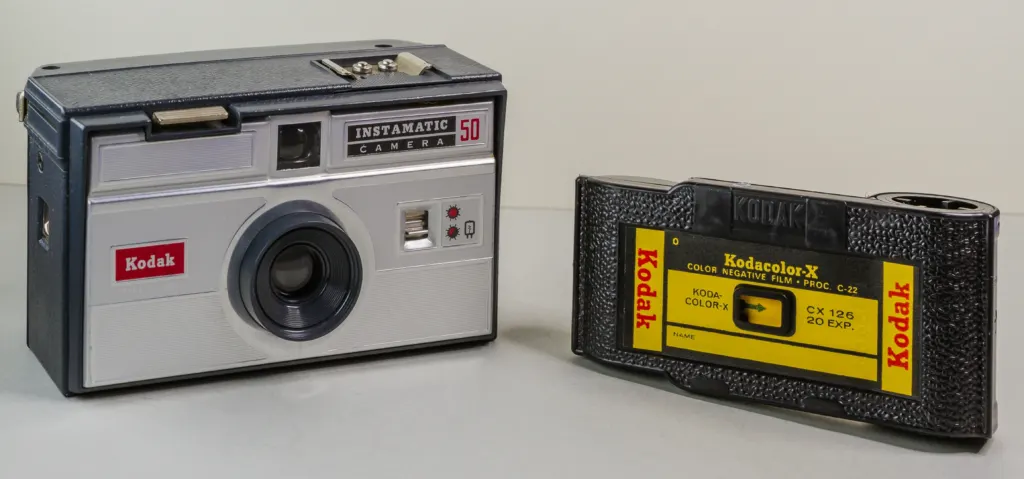
Kodak spent about a decade on an internal effort to build a camera nobody could load wrong. It started in the early 1950s as project Easy Load, was renamed Project 13, and reached shops in 1963 as the Instamatic. Between 1963 and 1970, Kodak produced more than 50 million of them.
The idea came from market research, not from engineers. Kodak’s surveys found that most customers wanted film loading and exposure settings taken out of their hands. Plenty of people who would happily take snapshots never bought a camera at all, because threading roll film or 35mm film was too fiddly.
The trick was in the cartridge
Project 13’s answer was to move the hard part from the camera into the film. The new 126 cartridge, sold under the brand name Kodapak, was a closed plastic case with its own take-up spool. You dropped it in, shut the door and started shooting. There was nothing to thread and nothing to rewind.
The cartridge also did jobs the camera body used to do. It supplied the backing plate that held the film flat and its own frame counter, visible through a window in the back. Each frame had one registration hole; a pin in the camera dropped into it and locked the wind lever, so you could not wind past the next picture. That cut design complexity and manufacturing cost, which is why the cameras could be cheap.
The film was 35mm wide but recorded square images, nominally 28 by 28 mm. Kodak reused the old “126” number, which had belonged to an unrelated roll film from 1906 to 1949.
From Project 13 to the shop shelf
The lead designer for the program was Dean M. Peterson, working from an original design by Alexander Gow. A. D. Johnson, Kodak’s advertising manager, is credited with the name Instamatic. Here is how the launch unfolded:
- Early 1950s: development begins as project Easy Load, later renamed Project 13.
- February 1963: the Instamatic 50 goes on sale in the UK first.
- About a month later: the Instamatic 100 reaches the US, adding a built-in flashgun for single-use bulbs.
- 1965: models ending in 4, such as the 104, switch to flashcubes.
- 1972: the Pocket Instamatic arrives with the smaller 110 cartridge.
- 1988: the X-15F, the last Instamatic sold in the US, leaves the shelves.
The basic model was foolproof by design. Aperture, focus and shutter speed were fixed, with the shutter set at 1/90 of a second, in the tradition of Kodak’s earlier Brownie cameras. The first Instamatics cost $16.
How big it got
Do the arithmetic on the headline number: more than 50 million cameras in roughly eight years works out to over six million a year, or about 17,000 a day. Rivals including Canon, Minolta, Olympus, Ricoh, Zeiss Ikon and Rollei built their own 126 cameras, and Kodak later sold more than 25 million Pocket Instamatics in under three years.
The name became shorthand for any cheap point-and-shoot. Its look outlived the film, too: the square 126 frame and the boxy camera body directly inspired the redesigned Instagram logo, and early photo apps imitated the snapshot style of the Instamatic and the Brownie.
Badiyaa has looked at other moments when a single exposure made history, such as Ansel Adams’ Moonrise, Hernandez, New Mexico, shot on one negative in 1941, and at the optics behind the pinhole cameras formed by leaves during a solar eclipse. Kodak officially discontinued 126 film on December 31, 1999, and the Italian maker Ferrania ran the last scheduled production of it in April 2007.
Further reading
Image: Friedrich Haag, CC BY-SA 4.0 via Wikimedia Commons
This article was produced with AI assistance and reviewed by our Editorial Desk. How we work.