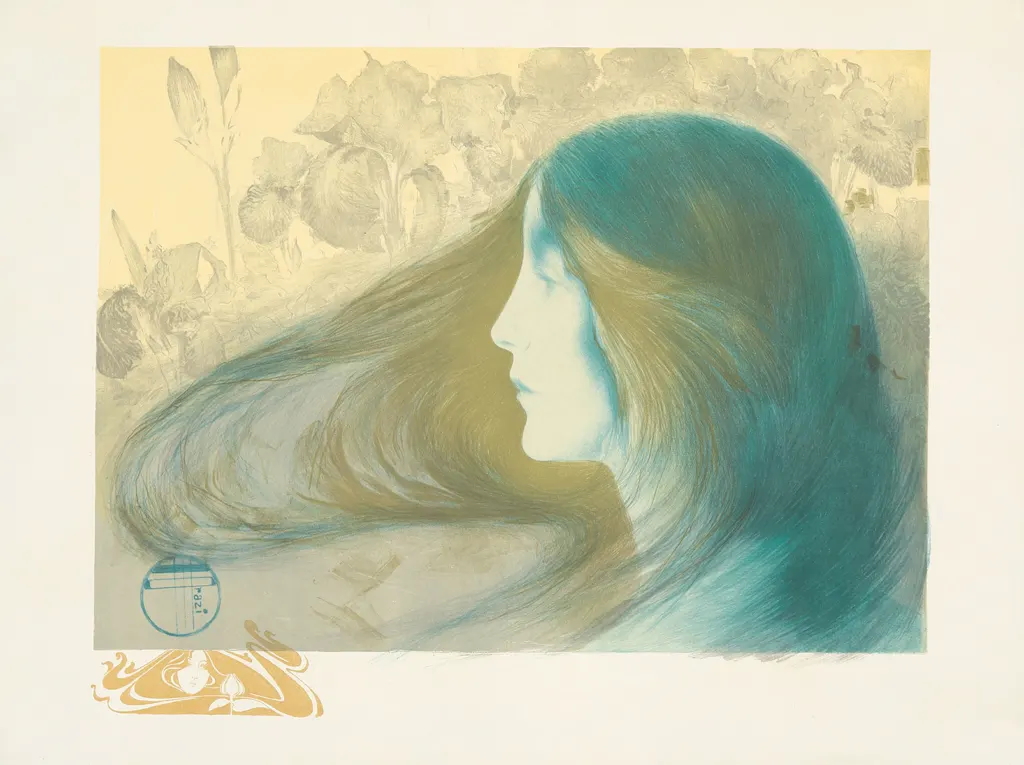
In 1895, the Rome-born illustrator Manuel Orazi produced a calendar for the coming year filled with witches, sabbaths and spells, and printed exactly 777 copies of it. The Calendrier Magique, written with the French author Austin de Croze, is still studied by designers more than 130 years later.
It was not a joke gift. It was a luxury object from the heart of Paris’s Art Nouveau scene, and a full copy now sits in the print department of the Bibliothèque nationale de France, the French national library.
A calendar for 1896, printed in 1895
The colophon, written in deliberately old-fashioned French, says the work was printed during the months of 1895 by the Imprimerie Lemercier, “maistre imprimeur,” under the sign of L’Art Nouveau at 22 rue de Provence in Paris. The title page then dates it “An. Dom. MDCCCXCVI”: the year of our Lord 1896, the year the calendar was meant to cover.
That address matters. The library’s catalog lists Siegfried Bing as the man who commissioned it, and the sign of L’Art Nouveau was his. A year later, Bing’s Maison de l’Art Nouveau would show Orazi’s jewelry.
The national library’s scan runs to 19 images. Its catalog gives the sheet size as 15.8 cm by 50.6 cm, roughly 6.2 by 19.9 inches: long, narrow panels, more like a scroll than a wall calendar you would pin up in a kitchen. The library files it under art and esotericism, witchcraft in art, and 19th-century fantastic art.
Why 777?
Neither the colophon nor the library record explains the number, but a run of three sevens fits a calendar built around magic. The Orazi biography notes the limited edition and that the calendar is “still noted for its graphic design.”
There is also a nice accident of timing. 1896 was a leap year, so the calendar had 366 days to fill. Orazi’s 777 copies come to a little over two for every day of the year it covered.
Who was Manuel Orazi?
Surprisingly little is known about him. Born Emmanuel Joseph Raphaël Orazi in Rome on October 5, 1860, he worked in Paris as a poster artist, book illustrator and jewelry designer, and died there on October 28, 1934, at 74.
His work ran with the darker side of the Belle Époque. He was drawn to the Decadent and Symbolist writers and illustrated books by Jean Lorrain, Pierre Louÿs and Arthur Conan Doyle, as well as an edition of Oscar Wilde’s Salome and, in the year he died, Baudelaire’s Les Fleurs du mal.
He also had a commercial streak. He designed jewelry shown at the Maison de l’Art Nouveau in 1896 and some of the first pieces for the Maison Arnould in 1899. The dancer Loie Fuller hired him for the poster for her theater at the 1900 Paris Exposition, which ran in three color versions. Two decades later, in 1921, he dressed the cast and built the look of the silent film L’Atlantide.
A timeline of the Calendrier Magique
- 1860: Orazi born in Rome
- 1895: calendar printed in Paris by Lemercier, in 777 copies
- 1896: the year the calendar covers; Orazi jewelry shown at Bing’s gallery
- 1934: Orazi dies in Paris
- 2024: the library’s scans of all 19 images uploaded to Wikimedia Commons as public domain
For more forgotten stories behind famous names, read how Garrett Morgan’s 1923 traffic signal patent really worked and why George Washington Carver did not invent peanut butter, or browse our History section.
The library’s copy is catalogued under shelfmark RESERVE FOL-DC-3684, which is where anyone wanting to see Orazi’s witches in person would start.
Further reading
Illustrative image. Image: Manuel Orazi, Public domain via Wikimedia Commons
This article was produced with AI assistance and reviewed by our Editorial Desk. How we work.