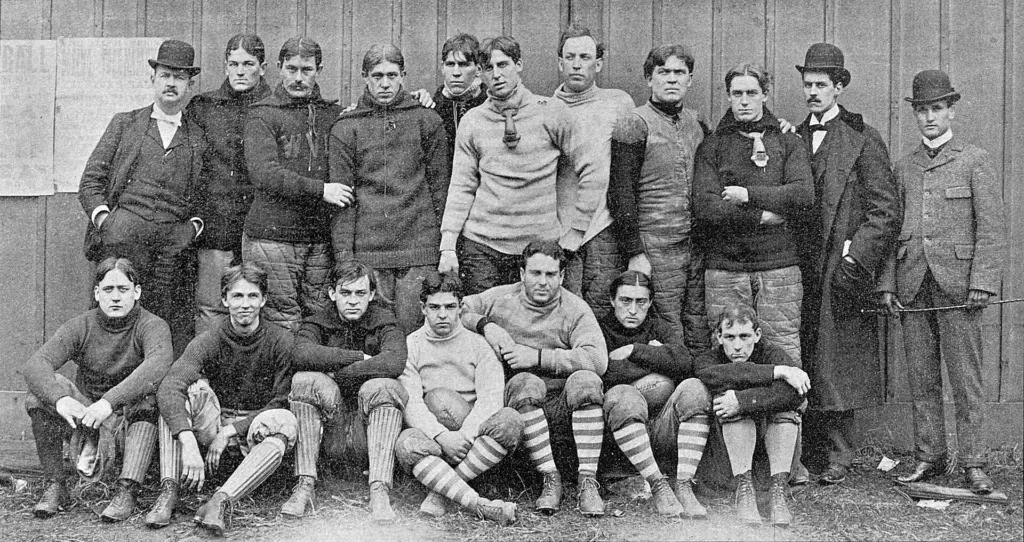
Pro football began with a bonus in cash. On 12 November 1892, the Allegheny Athletic Association paid Yale’s star guard William “Pudge” Heffelfinger $500 to play a single game in Pittsburgh, making him the first player on record to be openly paid to play American football. That was 134 years ago today.
The proof surfaced decades later: a page from the club’s expense ledger, now held by the Pro Football Hall of Fame, with one line that reads “Game performance bonus to W. Heffelfinger for playing (cash) $500.” The Hall calls the sheet “pro football’s birth certificate.”
A rivalry and a bidding war
In 1892, football was supposed to be an amateur game. Athletic clubs got around that with jobs, pawnable trophies and “double expense money” for star players. Two Pittsburgh clubs, the Allegheny Athletic Association and the Pittsburgh Athletic Club, were bitter rivals and had already tied 6-6 earlier that season.
Heffelfinger, a three-time All-American at Yale under Walter Camp, was touring the East with the Chicago Athletic Association. Standing 6 feet 3 inches, he was widely seen as the best lineman of his era. The Pittsburgh club offered him $250 to switch sides for the rematch. He said that was not enough to risk his amateur status. Allegheny doubled it.
Game day in Allegheny
When the teams lined up at Recreation Park, in what is now Pittsburgh’s North Side, the Pittsburgh players spotted Heffelfinger and two Chicago teammates in Allegheny colors. Their coach walked them off the field. Fans had bet heavily, and the rival club cried foul over the imported players. After long arguments the two sides agreed to call it an exhibition, with all bets off, and cut the halves from 45 to 30 minutes to beat the dusk.
Heffelfinger decided it. Midway through the first half he forced a fumble, picked it up and ran 25 yards for the only touchdown. Touchdowns were worth four points then, so Allegheny won 4-0.
Allegheny’s manager, O. D. Thompson, brushed off the protests, saying his club had simply done “what the Pittsburghs tried to do. Only we were successful where they failed.” The expense sheet that later proved the payment carries Thompson’s own signature.
What $500 bought
Put the fee in context with the figures on record:
- $500 was twice the $250 the rival club offered and lost with.
- In 2025 money it is roughly $17,900, for one shortened game of 60 minutes.
- It was 50 times the $10 and expenses paid to John Brallier in 1895, who was long credited as the first pro.
- Even after paying Heffelfinger, Allegheny’s ledger shows a net profit of $621 on the game.
That last line is the one that mattered. A club could pay a star and still come out ahead, and within a year Allegheny had players on contracts at $50 a game for the whole 1893 season.
The man after the money
Heffelfinger never built a pro career. He coached California in 1893, Lehigh in 1894 and Minnesota in 1895, then went into his family’s Minneapolis shoe business and later real estate, and served 24 years on the Hennepin County Board. He kept turning up at Yale practices into his fifties and played his last game at 65. He entered the College Football Hall of Fame with its first class in 1951 and died in 1954.
Today’s league plays far from those muddy club fields, from a regular-season NFL game at Real Madrid’s Bernabéu stadium to weekly shootouts like the Packers’ 45-27 win over the Patriots in Foxborough. Pittsburgh’s odd firsts go beyond sport, too: read about the Pittsburgh plumber who built an aluminum observatory dome for $178.
Despite the ledger, Heffelfinger is still not in the Pro Football Hall of Fame in Canton. A smaller honor came in 2015: the Pittsburgh Pro Football Hall of Fame added him, in the city where he earned that $500.
Further reading
Image: Unknown photographer, Public domain via Wikimedia Commons
This article was produced with AI assistance and reviewed by our Editorial Desk. How we work.